

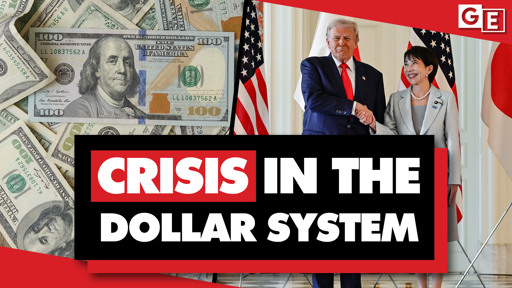
The US government quietly bailed out Japan this August.
The US Treasury intervened in the foreign exchange market to prop up Japan’s currency, the yen. It was the first time that Washington had done this since 1998, when there was a financial crisis unfolding in much of East and Southeast Asia.
This incident is symptomatic of a slow-motion financial crisis that is enfolding not only in Japan, but in the international financial system centered around the US dollar.
It reflects the growing cracks in the dollar system, and the gradual decline of global dollar dominance.
US Treasury intervenes to prop up Japan’s yen
Bloomberg noted that the US Treasury’s foreign exchange (FX) intervention was an “unusual operation”.
The superficial, facile explanation for why Washington acted was simply that Japan is a close US ally, and its currency has been depreciating very significantly against the US dollar, which has Tokyo concerned.
In January 2021, one US dollar could buy roughly 100 yen; in July 2026, a dollar could buy more than 160 yen.

However, that is not the main reason for this FX intervention.
In reference to Japan, US Treasury Secretary Scott Bessent declared, “We will do whatever it takes to support them in a way that helps the American economy, the American taxpayer, stabilizes the global economy”.
When Bessent said the “global economy”, he really meant the dollar-based international financial system, which he is dedicated to uphold.
It is worth emphasizing that Bessent is a former hedge fund manager from Wall Street. He worked for years with billionaire oligarch George Soros, specializing in currency speculation. Together they “broke the Bank of England”, shorting the British pound in a trade that made Soros more than $1 billion.
Bessent is part of a class of extremely rich plutocrats. Just how much wealth he has is not clear. He has been widely reported to be a billionaire, although this has been disputed. At the very least, he has hundreds of millions of dollars of wealth.
Regardless, the point is that Bessent has a vested economic interest in propping up the dollar-based financial system that has enriched oligarchs like him. And Japan has helped to maintain this system.
Japan’s special role in the US empire
Japan plays a special role in the US empire.
First and foremost, Japan hosts more US bases than any other country.
The US has approximately 750 military bases and other installations all around the world.
Japan alone hosts 120, where more than 50,000 US troops are permanently stationed.

Japan has been occupied by the US empire for more than 80 years, since the end of World War Two.
The imperial arrangement has continued because Japanese corporate elites benefit from the US occupation. Japan has been essentially a one-party state since 1955, ruled almost exclusively by the right-wing, pro-corporate, pro-US Liberal Democratic Party (LDP), in what is known as the 1955 System.
The perfect symbol of Japan’s subordination came this July, when the country celebrated the 250th anniversary of the founding of the United States, with a drone show featuring Donald Trump alongside Japan’s ultra-conservative Prime Minister Sanae Takaichi.

Japan’s status as a close US military and political ally is widely known.
What is less commonly known is the central role that Japan plays in upholding the global dollar system.
Japan’s special role in the global dollar system
Japan provides another crucial service for the US empire: it serves as the largest foreign holder of Treasury securities (ie, US bonds, US government debt).
In other words, Japan lends more money to the US than any other country.
For decades, Japan has maintained a massive current account surplus. Following an investment-led, export-oriented model, it established itself as a manufacturing powerhouse, specializing in advanced technologies, selling high-quality products to customers all around the world.
What has Japan done with the gargantuan surplus generated by its high-tech manufacturing sector? It has recycled much of it into US dollar assets — especially Treasury securities.

Japan even continued to buy US government debt in the 2010s, when yields were extremely low, and real returns were often negative (as US interest rates were basically zero, below inflation, and the Federal Reserve engaged in quantitative easing).
Tokyo kept converting its surplus into Treasuries not only because it faced political pressure from Washington (which was certainly a factor), but also because its manufacturing sector benefits from an undervalued yen, which make its exports more competitive (particularly at a time when it fears growing competition from China).
As of February 2026, Japan owned about $1.24 trillion ($1,239,300,000,000) in Treasuries.

It is striking to contrast Japan’s Treasury holdings with those of mainland China.
Beijing has been steadily reducing its net investment in US government debt for more than a decade. Its Treasury holdings peaked at more than $1.3 trillion in 2014.
As of 2026, China now owns less than $700 billion, and its holdings shrink year by year, as Beijing steadily dedollarizes — due to Washington’s weaponization of its currency.

US Treasury market dysfunction and Iran War energy crisis
Japan has remained the number one holder of US Treasuries for years. However, in recent months, the country has reduced its holdings.
Why was this? At the end of February, the Donald Trump administration launched an unprovoked war of aggression against Iran. This unleashed a global energy crisis that has severely harmed East and Southeast Asian economies.
Japan relies almost entirely on importing its oil, and it gets 95% of its crude from West Asia (the so-called Middle East), roughly 70% of which passes through the Strait of Hormuz, which Iran closed in response to the US war of aggression.
Skyrocketing energy prices put further downward pressure on the yen, forcing the Bank of Japan to intervene.
In the following months, Tokyo trimmed some of its Treasury holdings, intervening in the foreign exchange market (by selling Treasuries to get dollars, and using those dollars to buy back its own currency).
By July, Japan’s holdings had fallen to less than $1.12 trillion ($1,116,700,000,000). This means Tokyo’s net holdings dropped by more than $100 billion in just four months. Japan was clearly selling a lot of US Treasuries.
This has troubled Washington, because the yields on US Treasury securities have been steadily rising for six years, since the inflation crisis that followed the supply-chain disruptions of the Covid-19 pandemic.

The US government is particularly worried about the stubbornly high 10-year Treasury yield, which is used as a benchmark for other interest rates in the economy (such as corporate bonds, mortgages, car loans, student loans, etc.).
This is why, just a few weeks after the unusual FX intervention to support the yen, the US Treasury announced that it “is increasing, by at least double, the size of liquidity support buyback operations for longer-dated nominal coupon securities (the 10-year to 20-year sector and the 20-year to 30-year sector)”.
In other words, the US Treasury is issuing shorter-term debt in order to buy back its own longer-term debt, in an attempt to keep the long end of the yield curve under control.
This is quite ironic, given that Scott Bessent harshly criticized Joe Biden’s Treasury secretary, Janet Yellen, because she issued mostly short-term debt securities (known as bills). The idea was that, by reducing the supply of longer-term securities, the Treasury could relieve the upward pressure on yields.
But since Bessent replaced Yellen, he has done exactly the same, issuing overwhelmingly on the short end of the curve.

This July, the Treasury issued $2.57 trillion in bills (short-term securities of up to one year in duration), compared to $310.3 billion of notes (securities of two to 10 years in duration) and just $37.3 billion of bonds (20 to 30 years in duration).
That means 86.4% of the nearly $3 trillion in securities issued this July were bills (short-term securities), compared to 10.4% for notes (medium-term), and a mere 1.3% for bonds (long-term).
From the petrodollar to the hedge fund dollar
Foreign governments held $3.78 trillion in US Treasuries as of this June. The vast majority of that (more than 90%) consists of notes and bonds — that is, longer-dated securities, ranging from one to 30 years.
Washington wants foreign governments to keep buying long-dated US securities, but it does not want them to be sold, because that would increase the upward pressure on Treasury yields, at a time when they remain stubbornly high.
The problem is that foreign governments are less and less interested in holding US Treasuries — precisely at the moment when Treasury issuance is exploding, because US debt is rising so quickly, with federal deficits consistently at roughly 6% of GDP.
The share of Treasuries held by foreigners has hovered around 32-33% since the Covid-19 pandemic. This is a stark decline from more than 45% in the early 2010s.

Meanwhile, foreign official (ie, government) holdings of US Treasuries have remained static over the past few years, even as issuance has increased significantly.
A big reason for this is growing fear of weaponization of the US dollar. Many foreign central banks are afraid their Treasuries could be seized if their governments do something that Washington doesn’t like.
The 2022 decision by the US and European countries to seize Russia’s holdings of approximately $300 billion in dollar- and euro-denominated assets was a wake-up call, and global central banks have instead piled into gold.
So the supply of US Treasuries has steadily risen, while foreign government demand has steadily fallen.
What has filled the gap? Foreign private firms, especially hedge funds and other firms registered in financial centers like the City of London or tax shelters in Caribbean islands.

Like Japan, these private firms are also holding up the global dollar system. This is why Adam Tooze has argued the arrangement should be called the “hedge fund dollar”, or the “billionaire dollar”.
After the US government delinked the dollar from gold in the 1971 Nixon shock, Washington pressured major oil producers like Saudi Arabia to recycle their surpluses into US assets, primarily Treasuries, in order to prop up the dollar. The petrodollar still remains an important pillar of the global dollar system, but the hedge fund dollar has become even more important in recent decades, given the rapid financialization of Western economies.
This is one reason why the Donald Trump administration has further deregulated the financial sector, while strongly promoting stablecoins — because issuers often use Treasuries to back their stablecoins, or at least claim to do so.
This explains how stablecoin-issuing corporations, such as Tether and Circle, have in a short period of time become some of the world’s biggest holders of Treasuries, competing with major foreign governments.
However, even this rising foreign private demand has not been enough to keep US yields low.
This is why Washington is especially worried about foreign governments selling their Treasury holdings.
Crisis in the dollar system: The US doesn’t want other countries selling their Treasury holdings
What all of this demonstrates is that there is a growing crisis in the heart of the dollar-based international financial system.
This was precisely the conclusion reached by one of the world’s leading scholars of the dollar system, Barry Eichengreen, a professor of economics at the University of California, Berkeley, and author of the book Exorbitant Privilege: The Rise and Fall of the Dollar and the Future of the International Monetary System.
In an article in the Financial Times, Eichengreen noted that the Trump administration’s intervention to prop up the yen “contains troubling information about the dollar”.
“The message is that US Treasury secretary Scott Bessent & Co worried that selling dollar securities to prop up the yen would put additional strain on the long end of the US Treasury market”, he wrote.
This concern was evidenced by Bessent’s decision to fund the FX intervention not with dollars, by rather with the euro that the Treasury held in its Exchange Stabilization Fund (ESF).
In other words, the US government sold euro to buy yen in the FX market, because it didn’t want to sell Treasuries, as that would increase the upward pressure on yields.
What was especially striking about this is that the US government sold its euro holdings in this intervention without consulting its ostensible “allies” in Europe. The FT reported that the European Central Bank (ECB) was only informed after the operation.
Eichengreen, the leading expert on the dollar system, came to the following conclusion in the FT:
[These] moves are an indication that the dollar’s status as a reserve currency is not what it used to be. Central banks are accustomed to holding foreign reserves in dollars because markets in US Treasury securities are liquid. Central banks hold US Treasuries because they can be freely bought and sold and used in interventions. But not now, at least not in unlimited quantities.
…
The bottom line is that Washington, fearing the consequences for US financial markets, is reluctant to see foreign central banks use their dollar reserves. This is telling us that the dollar is not the attractive reserve currency it once was. When this message sinks in, other countries will redouble their search for more attractive, readily usable alternatives. Reserve diversification is apt to gather steam.
This is the most important message to take away from the US government’s bailout of Japan.
The cracks in the structure of the dollar system are growing, as the global dedollarization movement picks up steam.
Wall Street benefits from the yen carry trade
There is one other significant point to make about the US government’s historic bailout of Japan. That is that it is not only Washington that benefits from the subordination of Japan, but also Wall Street.
This is because Wall Street financial firms, investors in the US and across the West more generally, benefit from the depreciating yen through something known as the carry trade.
What exactly is the carry trade? The idea behind it is very simple: it is when an investor borrows money in one currency, which has a low interest rate, in order to buy an asset in a different currency, which has a higher interest rate, to benefit from the spread (the differential).
For decades, Japan had extremely low interest rates, including sometimes even negative rates. So what investors would do is take out debt denominated in yen, convert that money into US dollars, and then buy Treasury securities that had higher yields, or US corporate stocks (thereby helping to inflate the enormous bubble in the US equity market).
The yen carry trade has been hugely profitable for Wall Street. And the trade has gone on for years, driven not only by financial markets — it’s not the “invisible hand” — but also because the US and Japanese governments have a kind of unspoken agreement in which they facilitate the trade.
US financial assets, especially the stocks of Big Tech corporations, have benefited greatly from the yen carry trade. Japanese exporters have also benefited, because as the yen steadily depreciates against the dollar, it makes their products more competitive internationally.
This is a much-needed boost at a time when Japan is having trouble competing with China, as the latter has rapidly moved up the global value chain and advanced into higher value-added industries, eating away at Japanese corporate profit margins.
The editorial board of The Guardian has gotten many things wrong, and is normally pro-imperialist, pro-US, and pro-Atlanticist. But because the leading British newspaper is anti-Trump, its critical analysis of the Trump admin’s bailout of Japan hit the nail on the head, explaining the real motivation behind the FX intervention:
this is less a rescue of the yen than an attempt by Scott Bessent, the US treasury secretary, to preserve a cash spigot that benefits the US. Japan’s ultra-cheap money has become a global funding utility: bankers borrow yen, sell them for dollars and buy higher-returning US assets, notably tech shares. Rising American stock markets support collateral and investment. Japan’s “carry trade” is one of the reasons Wall Street can lever hundreds of billions into AI. Research suggests AI sucks up more than 1% of US GDP.
Washington wants to keep this tap open, but not at the cost of a collapsing yen or US treasury sales.
This crucial role that the yen plays as a “cash spigot” for Wall Street also benefits Washington, upholding its global power by reinforcing the dollar system.
However, the cracks in the foundations of this system are growing, and the slow-motion financial crisis unfolding in Japan is a reflection of the deep rot of the structure built upon it.
The post Dollar system in crisis: The real reason the US bailed out Japan appeared first on Geopolitical Economy Report.
From Geopolitical Economy Report via This RSS Feed.