

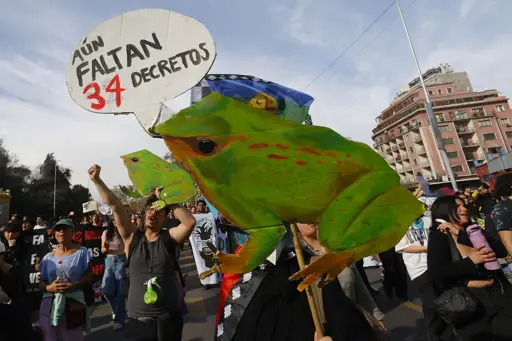
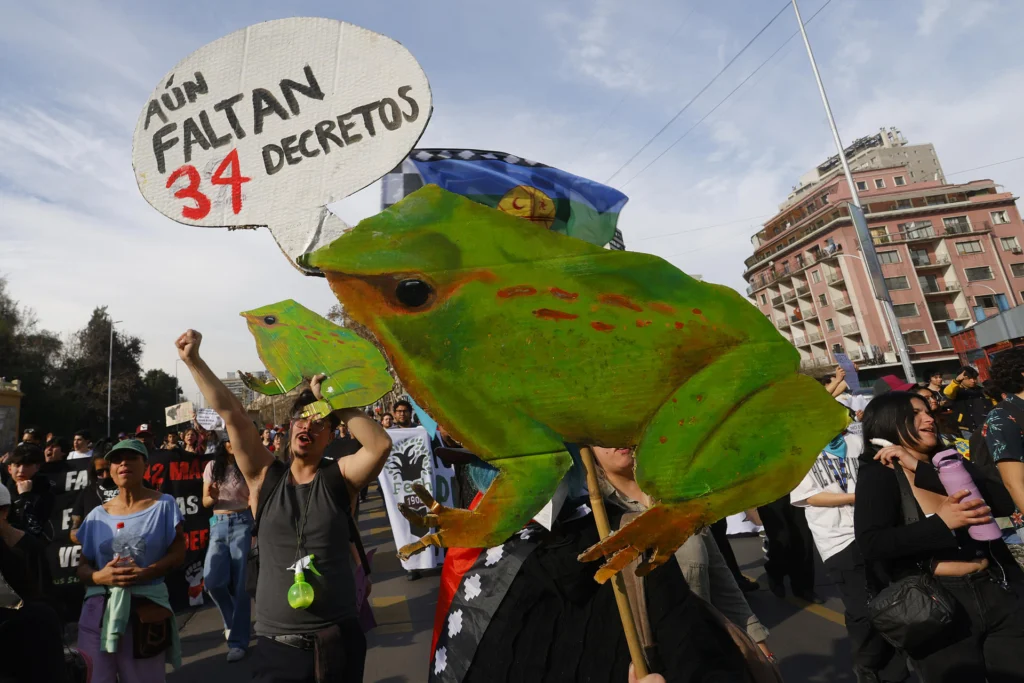
Hundreds of environmental activists and social groups protested across Chile, demanding the restoration of protections issued under Gabriel Boric.
Hundreds of people marched in Santiago and other parts of Chile on Saturday to protest what environmental groups describe as a rollback of environmental protections under President José Antonio Kast, demanding the full reinstatement of 43 environmental decrees issued during the previous administration.
RELATED: Chile Declares Catastrophe State in Tocopilla After Mudslides
The nationwide demonstration was organized by the National Ecologist Assembly, social organizations and student groups under the banner of a march against environmental setbacks and for animal protection.
Environmental activists said Kast’s government has yet to restore all 43 decrees inherited from former President Gabriel Boric’s administration. The measures were withdrawn from the Comptroller General’s review in March after being advanced between 2023 and 2026 under Boric.
Text Reads:  Hundreds of people belonging to the National Ecologist Assembly, social organizations, and student groups demonstrated in Santiago, Chile, and other regions of the country in the National March Against Environmental Setbacks and for Animals, convened to protest the measures of the far-right government of José Antonio Kast. Environmental activists spoke out against what they consider an environmental setback under the current administration.
 In the call to action issued on social media, the organizations denounced policies they consider extractivist and deregulatory, such as the relaxation of environmental regulations in favor of corporate projects that threaten wetlands, marine parks, and native species. Among the most critical points, environmentalists emphasize that the government has still not reinstated all 43 environmental decrees it repealed at the beginning of its term, and they warn about the new plan that authorizes the hunting of sea lions to benefit the salmon farming industry and industrial trawling. Added to this is the intention to create a State Insurance for Pollution, a mechanism that, they denounce, would force the State to pay millions in compensation to companies sanctioned by the Environmental Courts, transferring the cost of the destruction of ecosystems to the State.
The groups also criticized policies they described as promoting extractive activity and deregulation, including the easing of environmental rules for corporate projects that they said threaten wetlands, marine parks and native species.
One of the main concerns raised by protesters was a new plan that would allow the hunting of sea lions, which environmental groups said would benefit the salmon-farming industry and industrial trawling.
The organizations also opposed plans to create a state insurance mechanism for pollution. They said the proposed system would require the government to pay large compensation claims to companies sanctioned by environmental courts, shifting the cost of ecosystem damage onto the state.

March against environmental setbacks and for animal protection. Photo: EFE
The groups warned that Chile’s ecosystems and wildlife face serious risks. They cited the expansion of rare-earth mining in the south, the destruction of wetlands that causes flooding, and forest fires linked to groups known as the “Fire Cartel” and to forestry companies.
The organizations said the government’s environmental policies were the reason for the nationwide mobilization. In a statement posted on social media, they said: “Faced with the serious environmental setback we are experiencing, with José Antonio Kast’s government directly acting against the environment, we cannot remain silent.”
During the demonstrations, protesters chanted slogans and carried representations of animals, including penguins, one of Chile’s protected species.
From teleSUR English via This RSS Feed.