

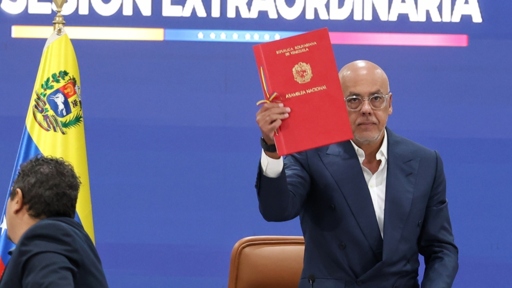
Caracas, August 22, 2026 (venezuelanalysis.com) – The Venezuelan National Assembly unanimously approved on Friday the Law on the Promotion and Protection of Housing Construction, a reform establishing updated rules for the construction and commercialization of residential properties.
The legislation, which replaces the Law Against Real Estate Fraud from April 2012, consists of four chapters and 40 articles establishing rules for purchase and sale contracts, construction company responsibilities, and oversight mechanisms under the Ministry of Housing and Habitat.
“This is a law that protects real estate developers and companies dedicated to housing construction while also protecting homebuyers so they can gain access to housing quickly and preventing any situation that undermines their right to acquire a home,” National Assembly President Jorge Rodríguez said on social media.
The initiative was backed by opposition parties alongside the ruling United Socialist Party (PSUV). COPEI deputy Miguel Salazar stated that the legislation creates “great expectations” and “strengthens the legislative ecosystem that protects the real estate sector.”
The law has been sent to Acting President Delcy Rodríguez for final approval before being published in the National Gazette.
The newly endorsed legislation establishes a series of conditions for real estate developers to meet before beginning to pre-sell housing units, including proof of land ownership, municipal approval of the preliminary project, and mechanisms to protect funds contributed by buyers.
The law also establishes a unified registry for real estate projects and provides a financial protection mechanism. Funds deposited through an escrow arrangement may only be released once the development has obtained the corresponding permits. Companies must also detail the characteristics of the homes and the construction schedule in each contract.
The law also establishes fines for delays in submitting documents, permit failures, non-compliance with regulations, and violations of preventive measures, among other offenses.
At the same time, the legislative project establishes incentives for private sector constructors such as greater flexibility to set prices, an end to a prior existing 24-month deadline for completing certain projects, and modified conditions benefiting sellers should buyers fail to make payments.
The bill also eliminated the lending banks’ liability in case the real estate project is not completed. For buyers, the change removes one of the parties they could potentially hold accountable in case the purchased home is not delivered.
Venezuelan authorities have moved to improve conditions for private real estate companies and landlords in the wake of the 7.2 and 7.5 earthquakes that struck Venezuela on June 24, leaving some 17,900 people homeless, particularly in La Guaira state. On July 14, National Assembly President Jorge Rodríguez estimated that 25,000 homes would be needed to accommodate those who lost their houses.
The government has assigned 335 apartments to displaced families since the earthquake. Acting President Rodríguez has pledged to deliver 4,000 homes before December and reach 10,000 by the end of 2027. Venezuelan authorities have likewise created a credit program for housing purchases and provided loans to condominium boards for repair works.
The legislative initiative favoring real estate developers came on the heels of the Residential Property Lease Law approved on July 31. Authorities presented the project’s goal as improving conditions for landlords to put their properties on the market.
The law allows landlords and tenants to freely and independently establish contractual terms and rental rates and sidelines the state’s housing superintendency SUNAVI. The bill allows rents to be paid in national or foreign currency and establishes a three-month rent limit for deposits.
In addition, landlords and tenants have access to multiple mediation mechanisms, including conciliation centers, arbitration, the intervention of local peace justices, or municipal court proceedings. Tenant organizations had recently denounced recurrent landlord practices of bringing trespassing criminal charges as a way to force evictions.
At the same time, the new law acceded to a long-time demand from real estate lobbies in fast-tracking evictions. Landlords can rescind the rental agreement if tenants are two months behind on rent, have illegally sublet the property, or have given it a different use than the one agreed to, among other conditions.
The 2011 law regulating housing leases, which was approved by former President Hugo Chávez and is highly protective of tenant rights, remains valid for existing contracts, while all rentals signed in the future will be governed by the new law. However, local media have reported on a spate of evictions after the new law was enacted.
Edited by Ricardo Vaz in Caracas.
The post Venezuelan Parliament Approves Law to ‘Protect’ Real Estate Developers appeared first on Venezuelanalysis.
From Venezuelanalysis via This RSS Feed.