

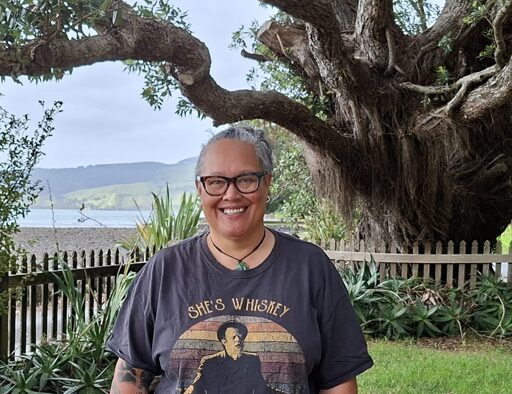

Aroha Gilling at Little Huia next to Te Manukanuka o Hoturoa (Manukau Harbour). Photo supplied.
Coping with everyday acts of racism takes a toll, and not just on the person being discriminated against, writes Aroha Gilling.
For most of my adult life, I’ve fought an internal battle before going into a shop or service provider. I mentally cross my fingers, breathe deeply to suppress fear, and hope the service will not be racist and hostile.
I lived in a small town for nearly 30 years. During that time, I developed a mental list of shops and providers. There were the places that were safe to go into because the service was good (or at least neutral), the places where you had to time your visit or lurk outside, peering in, to ensure the dodgy staff member was on a break or serving someone else, and then the places to be avoided at all costs because of the openly racist behaviour of staff.
But when you live in a small town, you don’t have much choice. So sometimes you just brace yourself and decide to cope with racist attitudes to get the medication, or the appliance, or to join your friends for a birthday dinner.
That prolonged coping across a lifetime takes a significant emotional toll.
When I explained all this to a friend, he was dismissive at first. So, I took him to a shop where I knew the server was openly racist.
Beforehand, I told my friend what I expected to happen. Then I asked him to enter the shop as though he wasn’t with me. I went in first, and he followed. He began to browse the shelves, and I went straight up to the counter to engage the staff member.
The woman behaved exactly as I’d foreseen. She ignored me and walked out from behind the counter. Even though she had to brush right past me, she went over and engaged my Pākehā friend in conversation.
“I think that lady was before me,” he said.
“She can wait,” she said.
I walked out of the shop immediately, and he followed. To say he was astonished and appalled is to understate his reaction.
When I moved to Tāmaki Makaurau for work, it was a pleasant surprise to find I no longer had to steel myself before pushing the door open. That’s not to say the service here is uniformly good (it isn’t), but so far, any poor service doesn’t seem to be racially-motivated.
For example, I was recently in an upmarket shop buying a modest marked-down scarf, and there was a well-dressed Pākehā woman in front of me, spending several hundred dollars more. Both she and I received the same coolly indifferent service from the young woman behind the counter. We even exchanged a raised eyebrow and a shrug about it.
Online shopping has been a welcome reprieve. An automated payment system doesn’t discriminate — if you have the money, you’re welcome to buy. For a few years, I’ve shopped with a favourite online vendor, so when I happened to be in the same town as the flagship shop, I was excited to visit in person. I was bitterly disappointed to find that the woman who fronts their social media videos, who I’d always imagined I’d enjoy talking to, was dismissive, rude, and singularly unhelpful. Meanwhile, she gushed over an older Pākehā woman. I won’t be buying from that retailer again. It’s also one of my Mum’s online favourites, so I’ll make sure to tell her the story next time I visit.
It’s liberating to realise that I can decide where I spend my money, and to keep a mental checklist of shops and services to support or reject. While this only affects my own spending choices, I know others who use social media to share their experiences and influence others’ spending decisions.
My cousin is an example. He’s one of those people who accepts friend requests from people he doesn’t know and then proceeds to get to know them. This is just an extension of his behaviour in real life. One day he announced he’d made two new friends, “in the library queue”, and he’s still close to one of them almost 30 years on.
His extensive social media reach means he’s well-placed to influence other people’s spending decisions, particularly when he’s had a negative experience in a shop or restaurant. We used to eat out together regularly when we lived near each other, and we have a shared list of places we like and dislike, based on the discriminatory service rather than the quality of the food and coffee. For some time, we regularly ate brunch at a café with terrible coffee but fantastic, warm, personalised and racism-free service.
Our conversations about these things made me wonder about the financial cost of racism to the discriminator.
The shop where I took my friend to witness the racist service, for example, not only lost out on the $40 I would have spent that day, but also my future spending. I never went into that shop again.
There are also the five people my friend talked to at the pub afterwards. Three of them said they’d intended to pop in to pick up items on the way home and would now go elsewhere.
The whole group was uniformly appalled by his story. It seemed unlikely the other two listeners would shop there again. Then I overheard two of the initial audience passing the story on, which presumably resulted in more spending being withheld. A small shop in a small town can’t afford that ripple effect.
It’s no secret that advertisers use values, lifestyle, motivation, perception, beliefs, and attitudes to shape what people buy. The service industry should remember that these same factors can also influence where shoppers choose not to buy.
Julian Batchelor’s racist anti-co-governance rallies in 2023 motivated me to boycott the venue that hosted him in the town where I was living. This was also true for several of my friends and their wider family, social and political groups. While I was writing this reflection, I had to look up Batchelor’s name because I’d consigned his details to oblivion. But I had no trouble recalling the name of the venue. When a new friend suggested coffee there the last time I was in town, I quickly rebuffed the suggestion and explained why. She immediately vowed never to go there either, and to tell her own friends the reason.
Sometimes I feel like there’s a little gremlin in my head chanting: “Are you a racist? Are you a racist?” at every new encounter. This is a wearying and anxiety-provoking way to live, but it’s also the reality of dealing with the everyday, casual acts of racism that persist in activities as mundane as buying toilet paper, collecting a prescription, or choosing a new moisturiser.
Racist service has a lingering impact on the person receiving it. So it’s comforting to reflect that I retain some power.
There’s a critical role we can all play in our individual spending choices. So I’ll continue to happily walk out of my way to go to a shop that is welcoming, and avoid the nearby shop with the horrible employees. The very least I can do is ensure there’s a cost to the business that doesn’t care about the ripple effect of racism.
Aroha Gilling (Te Whānau a Apanui) is an adviser to government departments on Te Tiriti o Waitangi and mātauranga Māori. She has a Master of Indigenous Studies from the University of Otago and a background in adult education and social work.
The post Paying the price of racism appeared first on E-Tangata.
From E-Tangata via This RSS Feed.