

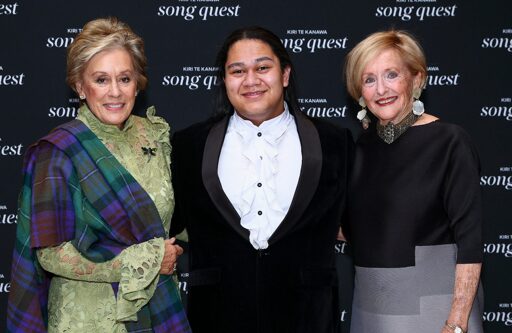

Samuel Mataele, 19, is flanked by Dame Kiri Te Kanawa (left) and Song Quest judge, American mezzo-soprano Frederica von Stade, at the finals, held at Michael Fowler Centre in Wellington on July 11. (Photo: Hagen Hopkins)
Teenage opera singer Samuel Mataele took the top prize in the Kiri Te Kanawa Song Quest last month. He tells Atakohu Middleton that life is about your stage, not your age.
It was the best of times. Last month, Auckland countertenor Samuel Mataele won the Kiri Te Kanawa Song Quest, the country’s top opera award. At 19, he’s the youngest winner in the contest’s 70-year history and took home a $50,000 prize.
Samuel had entered the biennial competition as a practice run and never expected to make the semifinals, so he was genuinely shocked when his name was read out.
In the livestream of the final, his mouth is open in a big O of surprise as he crosses the stage to receive flowers and a hug from Dame Kiri Te Kawana, who won the same competition in 1965 and became a celebrated international soprano.

Samuel (second from left) reacts to winning the Song Quest, with finalists Sarah Mileham, Faamanu Fonoti-Fuimaono and Samuel Downes behind him. (Photo: Hagen Hopkins)

Having just been announced as Song Quest winner, Samuel Mataele greets Dame Kiri Te Kanawa and international judge Frederica von Stade. (Photo: Hagen Hopkins)
Just seven days later, it was the worst of times when Samuel’s maternal grandfather, Napoleone Vaka Taimani, 97, died. Napoleone, a great supporter of his grandson’s music, lived with Samuel and his mother Ana Maile Taimani in Mt Wellington, Auckland. Napoleone loved to sing Tongan and church music with Samuel: “I would always sing with him at home.”
Napoleone’s death was devastating for Samuel, just as his father’s death had been seven years earlier. “You lose a part of yourself every time a loved one passes away,” Samuel says.
Napoleone was stubborn and true to himself, refusing to do anything that conflicted with his values. Samuel credits him with shaping his personality. “I take my grandfather’s grit, and I put it into my music, so I thank him for giving me a personality of steel to take into the music world,” says Samuel. “It’s actually very brutal and would crush a lot of singers.”
Losing his grandfather so soon after winning Song Quest was difficult, but farewelling him also gave Sam a break from the intense media attention that followed his Song Quest win. “I was sort of losing my mind, trying to keep up with the demand,” he says. “I’m not really a spotlight person outside of being on stage.”

Samuel, aged about 4, with his mum Ana. (Photo supplied)
Samuel’s mum, Ana, from the villages of Longoteme and Holonga in Tongatapu, and his dad, Talilotu Mataele, from Talafo‘ou and Lapaha, left Tonga for New Zealand at different times. They met and married in Auckland, and had four children. The family is Catholic and was heavily involved in church music at St Patrick’s Cathedral, and Samuel, the youngest of the Mataele children, was going to choir practices by the time he was one. “Mum or my aunts would take me. I’d sit there and just be engrossed in this music that was so beautiful and gorgeous.”
Samuel’s eldest sibling Agnes, 17 years his senior and a classical singer, was also a critical influence. “She is such a beautiful singer, and I wanted to be exactly like her.”
Samuel describes himself as “an interesting child” who loved opera and wore his hair long. “My mum always told me: ‘Be yourself, always.’”
From the age of six, Samuel was in the Auckland Boys’ Choir. All the Mataele kids learned instruments, because Ana wanted them not only to enjoy music, but to learn perseverance. “She always wanted us to have something to lean on if we were ever feeling down,” Samuel recalls. “She also wanted us to have a hobby that would keep us from causing mischief!”
Samuel started on violin and piano, then picked up the flute at Sacred Heart College in East Auckland. That’s where his turning point came. One day, 12-year-old Samuel was walking down a corridor in the music block singing the most virtuosic part of Mozart’s aria “Queen of the Night” from the opera The Magic Flute. On the other side of the wall, Fiona Ferens, a music teacher and soprano, was teaching a student, but she was immediately distracted.
“What I heard was the very highest part of his soprano voice, which was exceptional,” she remembers. “It was so incredibly unusual that even a boy soprano would be able to sing like that.” She excused herself and hurried into the corridor to see who it was. “I just looked at him and said: ‘Would you like singing lessons?’ And he said: ‘Yes, I would.’”
Says Samuel: “I was extremely grateful, because at that point I hadn’t had lessons and I really wanted them. She’s an angel.”
To this day, Fiona — still “Miss Ferens” to Samuel — teaches him for free. “Samuel’s intensely musical and it’s a joy as a teacher to enlarge on that,” she says. “I don’t think about it as a job. It’s just a pleasure.”

Samuel’s singing teacher, Fiona Ferens, is a soprano.
Samuel’s voice settled at countertenor, a rare male voice whose range is equivalent to that of the female contralto or mezzo-soprano. Range aside, what makes his voice unique? Fiona: “It’s like a really beautiful, rich chocolate cake or a very good Shiraz wine, really rich and red. It’s beautiful and mellow, and his voice has great expression. He just loves communicating from his heart and soul to the hearts of the audience.”
Samuel says the greatest gift Fiona has given him is the tools to unlock the music inside him. “I have a lot of musical ideas, and I know what I want out of the music I see on the page,” he says. “She has freed my voice up to allow me to do what I want to do, to give my soul to the music in a way that is authentically me.”
Opera is all about high drama, and Samuel says he sometimes finds it harder to connect with music about life experiences he hasn’t had yet.
“A lot of music talks about experiences that you only have as you grow up, for example, songs about age or songs about intense romantic love,” he explains. “If I feel like a song is too intense and requires you to have lived that experience or at least been around it, I don’t like to touch it. Of course, there are situations where you have a gig or something, and you just have to suck it up and sing it.”
He gets creative, too. “As a young singer, I give myself that grace that I haven’t had these experiences yet, so what I do is I lie to myself,” Samuel says. “I give myself fake scenarios in my head to allow me to get close to what the composer might have wanted without having experienced it myself.”
If a song is about a lover crying after a break-up, Samuel imagines an argument with a friend to feel emotional distress. Or he might be singing an aria set in Italy, a place he’s never seen. “But I have been to Greece. So I imagine myself overlooking the Parthenon, and it’s rocky, with marble everywhere. I smell the Mediterranean — the colours are brown and maroon. That’s what I do. I walk within the story.”

Samuel left Sacred Heart last year with a swag of awards. From left to right: Samuel’s brother Clinton, his aunt Lose, Samuel, his mum Ana, sister Agnes and brother Donald. (Photo supplied)
Samuel’s phone playlist is split between Tongan traditional music and classical, with a skew towards the Baroque composers of the 17th and 18th centuries, like Bach, Corelli, Purcell, Scarlatti and Handel. “Those two genres speak to me in a way that other music doesn’t.”
Last year, at 17 and in his last year of high school, he won the under-18 category of the locally run, international Nicholas Tarling Aria Competition singing “But Who May Abide” from Handel’s oratorio Messiah. This year, Samuel started a Bachelor of Music in vocal performance and a Bachelor of Arts in psychology at the University of Auckland.
It was Fiona who suggested Samuel enter the Song Quest, knowing he likes a challenge. “You know, another performance is good practice,” Samuel says. “That’s how she views every competition, and that’s how I view them too.”
He polished four songs in four languages, recorded them, and sent the clips. Fiona thought he might have an “outside chance” of making the semifinals. When Samuel got an email saying he’d been named one of 12 semifinalists, he thought it was a mistake.
After singing at the semifinals, held in June in Wellington, Samuel was one of six to reach the finals and one of three Pacific men, alongside Sāmoan brothers Jordan and Faamanu Fonoti-Fuimaono.
In the finals, Samuel sang a German classical lied (a poem set to music) called “Du bist die Ruh” (Schubert, 1823) and two Baroque pieces — the Italian aria “Rompo i lacci”, from Handel’s 1723 opera Flavio, and “Dido’s Lament”, from Purcell’s opera Dido and Aeneas, which was written around 1684.
Watching Samuel on the livestream, I wondered what was going through his head in the minutes before he sang. When we met, I asked him to give me a blow-by-blow account of how he handled “Rompo i lacci”, which translates as “I break the bonds”. It was Samuel’s encore after winning the Song Quest.
The context is that nobleman Guido is deeply in love with his new wife Emilia. However, a feud breaks out between their fathers and Guido has to avenge his father’s honour by facing his father-in-law in a duel, putting him in an impossible position. In the song, Guido tears away the emotional bonds that tie him to Emilia so he can induce the rage he needs to duel.
Throughout finals day, as on any performance day, Samuel says he was thinking about the characters he had to inhabit and their emotional states rather than the music itself: “I trust my preparation.”
Standing in the wings, Samuel summoned Guido’s emotional state by imagining how he would feel if he was torn between something his family wanted him to do and something his friends wanted him to do.
As he stepped to the front of the stage, he acknowledged the orchestra and then the audience. In his head, he made the auditorium Guido’s bedchamber and the audience his servants: “I take advantage of the space, and I make it my own, and I think that really helps my singing.”
While Samuel waited for his cue, what was going through his mind? “I’ve never been able to explain how I feel on stage and exactly how it felt on stage doing that particular performance,” he says. “It’s so unique to that day, that hour, that minute. I almost feel like I’m not on earth at that point.”

Samuel Mataele, 19, is the youngest winner of Song Quest in its 70-year history. (Photo: Hagen Hopkins)
Samuel is composed and softly spoken in person. He says he’s not given to drama unless he’s on stage. He’s bemused by people’s opinions of his work and tries not to read social media commentary. “I’m either glorified for my age, or I’m completely looked down upon,” he says. “There’s no middle ground. People either think it’s amazing, or it’s absolutely horrendous and I need to stop. So many people tell me that I’m moving too fast for my age.”
In the face of this, he says in a matter-of-fact way: “You have to have a heart of steel and the skin of a crocodile. I’m very much of the belief that it’s not about your age, it’s about your stage. If your voice is ready to take a step, you shouldn’t wait.”
The Song Quest final is online here. Samuel’s next concert is in Auckland on Saturday, September 12.
The post Samuel Mataele: A personality of steel appeared first on E-Tangata.
From E-Tangata via This RSS Feed.
You must log in or # to comment.