

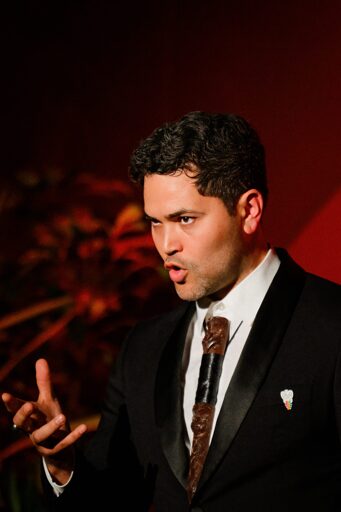

Baritone Kawiti Waetford is on a mission to create more opera pieces in te reo Māori.
Opera singer Kawiti Waetford (Ngāti Hine, Ngāti Wai, Ngāpuhi) is taking reo Māori opera to Kerikeri next weekend.
Such concerts are rare, and this weekend’s will be particularly poignant, as Atakohu Middleton reports.
A concert that fuses opera masterpieces in their original languages with te reo Māori is touring the regions and will be in Kerikeri next weekend for two performances, with a repeat at Waitangi planned before year’s end.
The show, called Toiere (sing), is presented by NZ Opera, guided and presented by Kawiti Waetford, a noted baritone and the company’s kaihautū Māori lead.
Kawiti, who lives in Kerikeri with his wife Jesse and two children, says the concert is part of a push to provide a wider repertoire of reo songs for opera singers, and delight the ears of opera fans.
A special feature in the concert is “Te Iere Tōiri” (the sound of singing), a tribute to Dame Kiri Te Kanawa, Aotearoa’s most famous opera export. Lyrics in te reo by Pānia Papa evoke the sweetest sounds of our native birds, while composer Robert Wiremu’s piano accompaniment cradles the harmonies of four singers.
The piece was commissioned for Te Ahurei Toi o Tāmaki Auckland Arts Festival, and premiered to a sold-out Auckland Town Hall Concert Chamber in March last year. (You can watch the concert here.)
I was in that appreciative audience as Katherine Winitana (soprano), Elisha Fa‘i-So‘oialo (mezzo-soprano), Emmanuel Fonoti-Fuimaono (tenor) and Joel Amosa (baritone) soared their way through six minutes of homegrown beauty accompanied by Juan Kim’s piano.
Probably the best way to describe it is to repeat what Robert Wiremu himself wrote for the programme. He described Pānia’s words as “rich with imagery of birds singing, soaring, departing, and returning, of birds reaching great heights and seeking rest”, and the foundation on which he’d built his music.
“Listen for the birds tweeting and trilling, darting and gliding, and then coming to rest. Hear the piano weep, as if longing for the bird’s return. Beneath it all, a driving, insistent rhythm pulses through the piece — a reflection of Dame Kiri herself, one of the most hardworking people I have ever known.”
Sadly, the performances of “Te Iere Toīri” next weekend will be a memorial to Robert. He died last month after a long illness, his loss keenly felt across the choral and orchestral worlds — and in Kawiti’s heart.
“Robert was a pou [stalwart supporter] of mine,” says Kawiti. “I’ll be doing a big mihi to him on those nights.”

Robert Wiremu (Photo supplied)
In 2008, when Kawiti was an 18-year-old torn between musical theatre and opera, Robert gave him a spot singing at that year’s Opera in the Pā concert in Rotorua.
That was Kawiti’s first public performance outside his home rohe of Northland, and it set him on the opera path.
Kawiti studied music at the University of Otago, and during that time he met Dame Kiri. With her mentoring, he sang internationally and did a master’s degree at the Wales Academy of Voice & Dramatic Arts.
To Kawiti, opera in te reo is “a really tangible coming together of te ao Māori and the art form of opera”.
“We are asking ourselves, what can NZ Opera do that no one else can do in the world? What does opera look like here in Aotearoa, as distinct from the rest of the world?”
*
For a reo speaker, it’s exciting to hear your own language on the tongues of these extraordinary singers — and to my ears, te reo works well in opera because every word ends in a vowel.
But it’s still a relatively rare treat to hear live opera in te reo, something NZ Opera has been working to change.
The whakapapa of Toiere stretches back more than a decade, to the Auckland Arts Festival in 2013. Reo experts Tīmoti Kāretu, Pānia Papa, Leon Heketū Blake, and Rāhui Papa translated a range of opera favourites into te reo for a concert titled Whaka-aria Mai.
Robert Wiremu arranged the music, with Kawiti, Deborah Wai Kapohe, Bonaventure Allan-Moetaua, Catherine Raeburn, and Christie Cook bringing those songs, along with some longstanding Māori favourites, to life.
Last year’s Te Ahurei Toi o Tāmaki Auckland Arts Festival extended the kaupapa by commissioning Toiere. NZ Opera is now taking the show to the regions as funds, venues and singer availability allow.

“Te Iere Tōiri” premiered in March last year. The creative team was, left to right, Pānia Papa, Elisha Fa’i-So’oialo, Joel Amosa, Kawiti Waetford, Robert Wiremu, Katherine Winitana, Ataahua Papa and Emmanuel Fonoti-Fuimaono.
The first regional show in Nelson, held in late June, sold out, and audience feedback was enthusiastic.
“First ever spontaneous full-audience standing ovation I have ever seen at Nelson Centre of Musical Arts,” wrote one.
Said another: “I found the bicultural concept particularly powerful. Hearing te reo Māori alongside the original languages created something uniquely New Zealand and gave the performance a strong sense of place and identity.”
And this: “Very moving, especially in the divisive times we are living in. The message transcending separateness.”
Next weekend, the singers are Katherine Winitana (soprano, Ngāti Kahungunu and Ngāariki Kaiputahi), Ipu Laga‘aia (tenor), Michaela Cadwgan (mezzo-soprano) and Joel Amosa (baritone), with Francis Cowan on piano. There will be subtitles so everyone can follow the lyrics, no matter the language.
A concert at the Waitangi Treaty Grounds is also planned, possibly in late November. Kawiti is excited at the prospect. “I just love the idea of having it in front of the whare there,” says Kawiti.
“Tourism-wise, it’s a great thread to add to the takapau [foundational reason] of the Treaty Grounds and the Waitangi National Trust . . . that whole birthplace of a nation and the coming together of te ao Māori and te ao tauiwi.”
Kawiti, a licensed Māori-language translator and interpreter, is putting more operatic pieces into te reo. He prefers the word “transcreation” for the process, as translation from any language into Māori is never word-for-word.
In the long run, he wants to create “a repository of operatic repertoire in te reo Māori for not only Māori, but for those who want to learn how to sing opera. If you don’t have the repertoire, you’re just gonna sing Pokarekare Ana over and over.”
- Toiere takes place at Kerikeri’s Toiwaka Turner Centre on Friday, August 29 (7.30pm) and Saturday, August 30 (2pm). Tickets are available here.
The post Taking reo-Māori opera to the regions appeared first on E-Tangata.
From E-Tangata via This RSS Feed.