

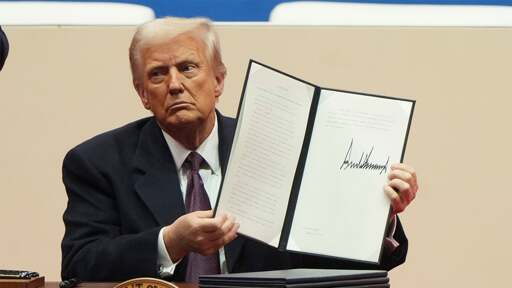
President Trump lost his first attempt to gut birthright citizenship, but he is trying again.
Earlier this month, Trump signed two new executive orders aiming to narrow the meaning and reach of birthright citizenship. One seeks to expand the categories of children the administration claims fall outside the protections of the Fourteenth Amendment. The other targets what the White House calls “birth tourism,” and would increase the government’s ability to deny or revoke visas, remove people from the country, and punish those it claims entered the United States for the purpose of giving birth.
Federal agencies have 30 days to issue public guidance explaining how they intend to implement the new categories, setting up another round of legal and political battles over how far the administration can push the exceptions to birthright citizenship.
So, what exactly is Trump asking people to accept?
Imagine two babies born on the same morning in the same hospital. They may grow up on the same block, attend the same public school, ride the same subway, speak the same languages, play in the same parks, and eventually work side by side. Neither, of course, chose where their parents were born or what immigration papers they possessed. But imagine that one has parents who are U.S. citizens, while the other is born to two international students. Or temporary workers. Or two people living in the United States without legal status.
Under Trump’s original executive order, those two children would have fundamentally different relationships to the country in which they were born — only one would be a U.S. citizen.
Without automatic citizenship, that second child would no longer have an unconditional right, as a citizen, to remain in their country of birth, receive a U.S. passport, vote, or be protected from deportation. Certain federal jobs and public offices would remain closed to them. And later in life, they would not possess the same rights as U.S. citizens to petition for certain close relatives, including their parents.
These differences would exist from the moment of birth because of these children’s parents’ immigration status. Trump’s original attacks therefore are far larger than immigration restrictions. They threaten to make immigration-related precarity inheritable.
Trump Lost This Fight Once Already
Trump’s January 2025 executive order went much further than the measures he signed earlier this month.
It sought to deny citizenship to children born in the United States when their mother was undocumented or temporarily present in the country, including on student, work, or tourist visas, and their father was neither a U.S. citizen nor a lawful permanent resident. That meant the attack wasn’t limited to undocumented immigration, and extended to, for example, workers who had children while legally employed on temporary visas.
On June 30, the Supreme Court rejected Trump’s interpretation of the Fourteenth Amendment and reaffirmed that children born in the United States to parents who are here unlawfully or temporarily are citizens at birth. But Trump only narrowed his legal argument and came back again. The administration is now emphasizing historically limited exceptions to birthright citizenship and using “birth tourism” as a political justification for further restrictions.
History Undermines Trump’s Case
Trump has insisted that birthright citizenship “was for the babies of slaves” after the Civil War, not for people who, according to him, come to the United States to “buy” citizenship for their children. But history clearly undermines this case.
The Fourteenth Amendment was adopted after the Civil War. Its Citizenship Clause came out of Reconstruction, in the aftermath of slavery and Dred Scott, the infamous Supreme Court decision that denied Black people citizenship.
Nearly thirty years later, the Court confronted the question in the middle of another xenophobic offensive. Wong Kim Ark was born in San Francisco to Chinese parents at a time when Chinese immigrants were barred from naturalization and targeted by the Chinese Exclusion laws. When the government tried to deny him reentry to the country, the Court held that his birth in the United States made him a citizen. The idea that birthright citizenship applies to the children of immigrants thus survived one of the most openly exclusionary periods in U.S. immigration history.
But that history points toward the opposite conclusion from Trump’s. The amendment does not say that only the children of formerly enslaved people receive citizenship. It says that “all persons born or naturalized in the United States, and subject to the jurisdiction thereof,” are citizens. The significance of that language was precisely its breadth. Reconstruction rejected a system in which the political status of a person born in the United States could be determined by ancestry and inherited social condition.
Trump points to the history of slavery to justify weakening that principle. But this history, and the Dred Scott decision, are precisely why the principle matters. A child should not enter the world carrying a politically inferior status because of the legal condition imposed on their parents.
From Immigration Precarity to a More Precarious Generation
For millions of workers, immigration status already shapes everyday life. It can determine whether losing a job means losing only a paycheck or also threatening a person’s ability to remain in the country. It can make interaction with police or government agencies more dangerous. It can make confronting an abusive employer, reporting wage theft, organizing a workplace, or simply becoming publicly visible carry risks that a citizen coworker does not face.
Legal differences are backed by an enormous material apparatus. The Republican-controlled Congress’s 2025 Reconciliation Law allocated tens of billions of additional dollars to ICE, including $45 billion to expand detention capacity. That money means more agents, vehicles, surveillance systems, deportation flights, detention centers, and contracts with private corporations.
It also means profits.
At the immigration detention center in Dilley, Texas, which can hold thousands of people, even children can be detained for long periods of time, and face unsanitary conditions, unsafe temperatures, and a lack of beds. CoreCivic, the private prison corporation operating the facility, has told investors that it could generate roughly $180 million in annual revenue.
The contrast between these profits and the horrible, dehumanizing condition for migrants is difficult to ignore and show the economic and institutional structure being built around detention, deportation, surveillance, and unequal legal status. They are the concentration camps of the 21st century.
Normalizing Divisions Among the Working Class
Trump presents this machinery as a way to protect U.S. workers from immigrants.
But consider what these differences mean inside a workplace: A citizen worker who loses a job faces unemployment, while a worker whose immigration status depends on employment may lose their income and also jeopardize their ability to remain in the country. An undocumented worker may know that confronting wage theft, participating in an organizing campaign, or becoming visible to authorities can carry an additional danger: detention or deportation.
These differences benefit the bosses, not the workers.
More than 150 years ago, Karl Marx confronted a related political mechanism when writing about the hostility between English and Irish workers. English workers, he argued, were encouraged to see Irish workers as competitors who lowered wages and living standards. An English worker could therefore believe that hostility toward Irish workers protected his own position. Marx argued that the opposite was happening: By accepting that division, the English worker was “strengthening their domination over himself.” The historical circumstances are different, but the political mechanism remains recognizable.
When one worker has fewer rights, the worker beside them does not become more powerful. If your coworker is afraid to confront the boss because they can be deported, your bargaining power has not increased. If another worker is afraid to organize because their immigration status depends on their employment, your workplace has not become easier to organize. If millions of workers can be threatened with detention or deportation, citizen workers have not gained more rights.
In other words, Trump and the Far Right’s attacks give employers and the state yet another weapon to divide the working class.
In this way, xenophobia performs a political function by making unequal rights appear reasonable. The citizen worker is told that undocumented immigrants are taking something from them. The immigrant with a visa is told that at least they came “the right way.” The permanent resident can be encouraged to distinguish themselves from people with temporary status. The temporary visa holder can be encouraged to distinguish themselves from the undocumented worker. And the undocumented worker, meanwhile, learns that survival may depend on staying invisible by, for example, not organizing or showing solidarity with their co-workers.
The task for socialists cannot simply be that people should be kinder to immigrants. Rather, we must demonstrate that these divisions weaken workers collectively, and that fighting xenophobia must be part of class struggle, and part of the fight to build the working class into a force capable of acting together — against the bosses, not fellow workers. No citizen worker becomes more powerful because their coworker can be deported. No union becomes stronger because part of its potential membership is afraid of ICE. No neighborhood gains power because some families are forced to hide. No worker gains rights because another worker has fewer.
Minneapolis Showed How These Divisions Can Be Broken
This winter, Minneapolis showed what this struggle can begin to look like. When the Trump administration flooded Minneapolis and St. Paul with federal immigration agents, people organized. Neighbors built rapid-response networks and patrols to warn communities about ICE activity. Workers delivered food and supplies to families afraid to leave their homes, and teachers and school workers defended immigrant students and parents. Students walked out, and workers began to discuss how to use their own economic power.
On January 23, tens of thousands of people marched in subzero temperatures during a day of “No Work, No School, No Shopping.” Hundreds of workplaces and businesses closed or participated. But one of the most significant developments came afterward. More than 300 unionized and non-unionized workers, including teachers, bus drivers, airport workers, and Starbucks workers, came together in a Workers’ Assembly to debate what the movement should do next.
They debated workplace organization, strike committees, and how to continue the struggle. That matters because class unity cannot simply be proclaimed. A citizen worker and an undocumented worker do not automatically overcome every political division because someone tells them they belong to the same class. Rather, unity has to be constructed through common struggle, like when union members treat the detention of an immigrant coworker as an attack on the entire workplace, and when citizens and immigrants defend a neighborhood together against ICE.
In the end, the powerful resistance in Minneapolis forced concessions from the Trump administration, including the end of Operation Metro Surge. But it’s not enough for cities to wage isolated battles against Trump and the Far Right. After all, Trump has national coordination: ICE is a federal agency, the detention system stretches across the country, and Washington provides billions of dollars for this infrastructure.
This is why the working class, too, must begin coordinating. Workers’ assemblies can offer one model: democratic spaces where union and nonunion workers, immigrants and citizens, and workers from different industries can discuss and decide together. Immigrant-defense committees and neighborhood networks can coordinate with workplaces instead of functioning on separate tracks. Rank-and-file workers can fight inside unions to make the persecution of immigrant workers a labor issue for the whole union. And struggles in different cities can begin preparing coordinated national actions, making sure that workers refuse to allow business to continue as usual while their coworkers and neighbors are being hunted by ICE.
That Movement Must Be Politically Independent
While Trump has intensified the attacks on immigrants, he did not create the deportation machinery from nothing. ICE, detention centers, immigration laws and courts, border enforcement, and the surveillance apparatus have been built and supported by successive administrations, led by Democrats and Republicans alike.
Barak Obama, after all, was known as the “Deporter in Chief.” Under Joe Biden, ICE deported more than 271,000 people in 2024, the highest annual number in a decade, and Biden continued, and expanded, many of Trump’s anti-immigrant policies. This is because the Democratic Party — like the GOP — is a capitalist and imperialist party. This means that Democrats are not our allies in the fight for our immigrant class siblings, and our fight against Trump, ICE, and the Far Right must be politically independent from both parties of capital.
Political independence doesn’t mean refusing to fight alongside people who identify as Democrats, or members of the DSA, or anyone else who’s fighting against ICE. But it does mean building other organizations whose strategy, demands, and actions are decided by the movement itself rather than subordinated to the electoral needs of the Democratic Party.
The working class needs an independent, socialist organization with a program, and a capacity to act that does not depend on which capitalist party controls the White House. Otherwise, the movement risks repeating a familiar cycle: mobilize when Republicans carry out the attack, then lower expectations and demobilize when Democrats return to office.
Breaking that cycle is part of building the force capable of actually winning.
Trump’s attack on birthright citizenship exposes where the logic of his immigration offensive can lead: toward a society in which the insecurity imposed on immigrant workers can reach their children from the moment of birth.
Minneapolis showed another possibility. The workers’ assemblies, immigrant-defense committees, rank-and-file networks, and neighborhood organizations emerging out of these struggles need ways to coordinate beyond individual cities, bringing delegates and organizers together to discuss a common national plan of action against ICE.
Citizens and immigrants; union and nonunion workers; students, teachers, and neighborhoods must act together against Trump’s offensive, discovering through that struggle that our power comes from acting collectively, not from defending the divisions imposed between us.
The task now is to spread that experience beyond one city. To coordinate it nationally. To build it independently of the parties that have maintained the deportation system. And to fight for full rights for all immigrants, an end to detention and deportations, and the abolition of ICE .
A worker does not become more powerful when the worker beside them has fewer rights. We become powerful when we refuse to be divided.
The post Trump’s Fight Against Birthright Citizenship Seeks to Enshrine Unequal Rights and Deepen Working-Class Divisions appeared first on Left Voice.
From Left Voice via This RSS Feed.
Reminder that this Tankie community isn’t mad about the news: they’re celebrating it.
