

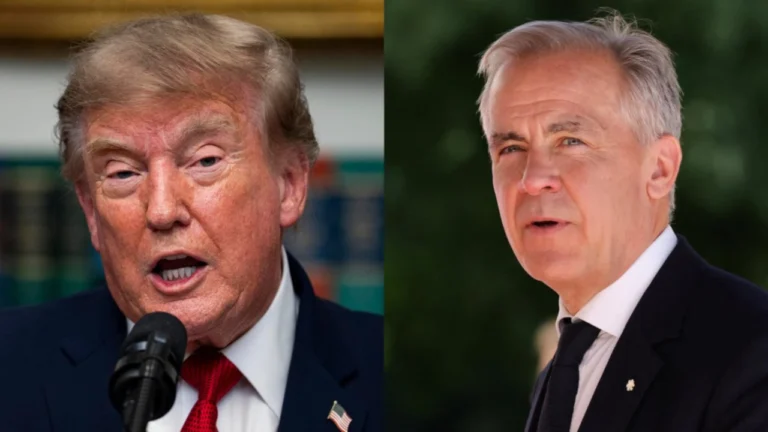
US Canada tariffs hit 50% after talks fail. Carney vows dollar-for-dollar retaliation. Explore impacted sectors, political fallout, and regional trade implications.
Related: Mexico Protests U.S. Deportations of Citizens Via Third Countries
US Canada Tariffs: Trade War Escalates After Negotiations Collapse
US Canada tariffs reached a new flashpoint on Saturday, August 22, 2026, as Washington imposed 50% duties on approximately $20 billion worth of Canadian imports following the collapse of last-ditch trade talks. The White House confirmed the measures would take effect immediately, targeting sectors including hockey equipment, construction materials, alcoholic beverages, and textiles.[reuters][axios][washingtonpost][news.cgtn]
Canadian Prime Minister Mark Carney responded swiftly, announcing the suspension of negotiations, recalling Ottawa’s trade team from Washington, and pledging dollar-for-dollar retaliation to protect Canadian workers and businesses. Carney labeled Washington’s last-minute proposals “unfair and economically unviable,” casting doubt on the reliability of any future agreement.[reuters][axios][theweek][news.cgtn]
US Canada Tariffs: Breakdown of Talks and Retaliatory Measures
U.S. Trade Representative Jamieson Greer placed responsibility for the failure squarely on Ottawa, stating that Canada refused to finalize the deal under terms allegedly agreed earlier in the week. In a late-night statement, Greer claimed Washington had offered “the best possible deal among major exporters to our market,” but accused Canadian negotiators of introducing new demands and failing to honor prior commitments.[reuters][axios][news.cgtn][biz.chosun]
For the official U.S. Trade Representative statement, see: USTR Announcement on Canada Tariffs
Carney countered that significant progress had been made during days of intensive dialogue, but last-minute modifications by the U.S. delegation prevented an acceptable agreement. He emphasized that Ottawa’s decision to suspend talks was not taken lightly, but was necessary to defend Canadian economic interests against what he described as unpredictable and destabilizing U.S. trade tactics.[reuters][indiatoday][theweek][news.cgtn]
The Office of the U.S. Trade Representative (USTR) estimated that the new tariffs would affect $20 billion in Canadian imports, though some reports suggest the figure could reach $28 billion depending on product classifications. Among the most visible targets are hockey sticks and gear, a symbolic blow to a culturally significant Canadian export, alongside cement, lumber, whiskey, and certain dairy products.[axios][washingtonpost][indiatoday][biz.chosun]
For a sector-by-sector breakdown of impacted goods, see Reuters’ analysis: US Hits Canadian Goods with 50% Tariffs
Carney affirmed that Canada would match the U.S. levies “dollar for dollar” on an equivalent value of American exports. The retaliation is designed to shield domestic industries and signal Ottawa’s willingness to endure a prolonged trade standoff. The Canadian government also hinted at additional support measures for affected workers and businesses, building on nearly $25 billion in relief and adjustment programs announced over the past 18 months.[indiatoday][theweek][news.cgtn][ckpgtoday]
No further negotiations are currently scheduled, according to senior U.S. administration officials. The breakdown marks a sharp reversal from earlier optimism, when President Donald Trump had postponed the tariffs by three days, citing a “preliminary deal” that ultimately failed to materialize.[reuters][axios][usnews]
Geopolitical Context: Trade Sovereignty, USMCA, and Regional Spillover
The US Canada tariffs dispute unfolds against the backdrop of broader trade sovereignty tensions and the fragility of the United States-Mexico-Canada Agreement (USMCA). While the USMCA was designed to stabilize North American trade, the use of Section 338 of the Tariff Act of 1930—a provision never before invoked by any U.S. president—signals a willingness to bypass multilateral frameworks in favor of unilateral economic pressure.[axios][theweek][biz.chosun]
This escalation also carries regional spillover risks, particularly for Mexico, which remains deeply integrated into North American supply chains. A prolonged trade war between the U.S. and Canada could disrupt automotive, agricultural, and energy sectors across the continent, undermining the economic stability that USMCA was meant to guarantee. Analysts warn that investor confidence in North American trade could erode if unilateral tariffs become a recurring tool of U.S. policy.[theweek][usnews][nytimes]
Globally, the US Canada tariffs episode reinforces a trend toward protectionist trade policies among major economies, echoing similar moves by the European Union, China, and India in recent years. For Canada, the crisis has accelerated discussions on trade diversification, including deeper ties with the European Union, Indo-Pacific partners, and Latin American markets to reduce dependency on the U.S.[theweek][news.cgtn]
Politically, the fallout strikes at a sensitive moment for both governments. In the U.S., the tariffs align with Trump’s “America First” agenda, but risk alienating key business constituencies and Republican lawmakers in border states dependent on Canadian trade. In Canada, Carney faces pressure to balance firmness with economic pragmatism, as prolonged retaliation could inflate consumer prices and strain small businesses reliant on cross-border commerce.[axios][theweek][nytimes]
The dispute also highlights the growing weaponization of trade policy as a tool of geopolitical leverage. By targeting culturally symbolic exports like hockey equipment and alcohol, Washington signals a willingness to inflict political pain alongside economic damage. Ottawa’s dollar-for-dollar response, in turn, underscores a doctrine of reciprocal sovereignty, asserting that Canada will not accept asymmetric economic coercion from its largest trading partner.[axios][theweek][news.cgtn]
From teleSUR English via This RSS Feed.