

Cuba defense strategy takes center stage as Díaz-Canel reviews local preparedness, urban challenges, and 176 reforms. Discover key actions and geopolitical implications.
Related: The United States has Imposed Nine Rounds of Sanctions on Cuba to Strangle Strategic Sectors
Cuba Defense Strategy: Díaz-Canel Reviews Local Preparedness and Urban Challenges
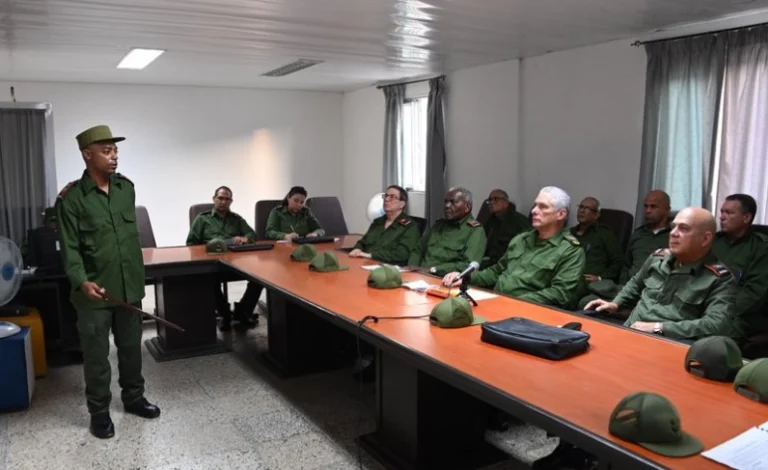
Cuba defense strategy was the focus of a high-level inspection led by President Miguel Díaz-Canel on Friday, August 21, 2026, as part of National Defense Day activities. The visit to the Cubanacán Zone Defense Council (CDZ) in Havana’s Playa municipality underscored the government’s emphasis on organizing local structures to face potential external threats while addressing deep-rooted urban and social problems.[en.cibercuba][cibercuba]
Díaz-Canel, who also serves as head of the National Defense Council (CDN), was accompanied by senior officials from the Political Bureau and the government, including Esteban Lazo Hernández, president of the National Assembly; Roberto Morales Ojeda, secretary of Organization of the Central Committee; and Bruno Rodríguez Parrilla, foreign minister. Also present were the ministers of the Revolutionary Armed Forces (FAR) and the Interior (Minint), Army Corps Generals Álvaro López Miera and Lázaro Alberto Álvarez Casas.[en.cibercuba]
Cuba Defense Strategy: Local Organization and Civil Protection
Under the CDZ Cubanacán’s practical exercise, President Reinier Lorenzo Reyes outlined warning and protection plans designed for a population of more than 17,000 residents spread across 6.8 square kilometers. He highlighted that a significant portion of residents are incorporated into over 30 production and defense brigades, reflecting the dual civil-military character of Cuba’s defense model.[en.cibercuba]
The CDZ structure is a cornerstone of the Cuba defense strategy, integrating civilian mobilization with territorial readiness. These brigades are intended to sustain basic production and community support functions during emergencies, blending defense preparedness with social resilience.
For background on Cuba’s civil defense framework, see the official Cuban government portal on National Defense Day: Cuba National Defense Day
Local authorities also presented a diagnosis of key urban and social problems fueling community discontent. Among the most pressing issues: frequent power outages, interruptions in potable water supply, and damage caused by sewage overflows. Additional challenges include the accumulation of solid waste and rising crime rates in neighborhoods.[en.cibercuba][cibercuba]
In response, Díaz-Canel ordered the installation of collective water deposits in areas with extended distribution cycles. He also announced that garbage collection in the municipality would gradually improve with the addition of trucks and large-capacity containers (ampirol boxes). The president further urged authorities to optimize cash payments to retirees, expand digital payment channels, and intensify action against speculative pricing.[en.cibercuba]
Economic Autonomy and the 176 Transformations
On the economic front, Díaz-Canel stressed the need to cultivate all available vacant spaces in the zone for food production, both at the state and family levels, leveraging the territory’s agricultural potential and traditions. The meeting included presidents of all CDZs in Playa, led by Lisara Corona Oliveros, head of the Municipal Defense Council.[en.cibercuba]
In this context, the head of state emphasized the importance of implementing the 176 economic and social transformations promoted by the executive branch to strengthen municipal autonomy. He noted that 134 of these measures already have the necessary legal backing, signaling an advanced stage of regulatory consolidation.[en.cibercuba][cibercuba][en.cibercuba]
For details on the 176 reforms, consult the official summary by the Cuban government: 176 Economic and Social Transformations
The 176 transformations, approved in June 2026, represent the most sweeping economic update since 1959. They include greater autonomy for state companies, foreign investment in the private sector without state intermediaries, flexibility in wage setting, authorization of private banks, and the end of universal subsidies. The reforms also open domestic and foreign private capital to sectors such as energy, while maintaining the socialist character of the system.[en.cibercuba][cibercuba][english.elpais]
Díaz-Canel concluded that state and private economic actors must actively contribute to local development strategies. He called for identifying idle productive capacities to restart them under a strict principle of social justice, avoiding increased inequalities and protecting the most vulnerable sectors of the population.[en.cibercuba][en.cibercuba]
For independent analysis of the reforms’ macroeconomic implications, see: Economist Pedro Monreal on Cuba’s 176 Measures
Geopolitical Context: Defense, Sovereignty, and Regional Tensions
The Cuba defense strategy unfolds against a backdrop of heightened U.S. sanctions and regional geopolitical friction. Just days before Díaz-Canel’s visit, Washington imposed new sanctions on Cuba’s metallurgy, mining, and trade sectors, described by Havana as a “failed obsession” aimed at undermining the island’s sovereignty. [telesurtv link in original article]
These measures reinforce a long-standing U.S. policy of economic pressure, even as Cuba advances its 176 transformations to attract foreign investment and diversify its economy. The dual track—internal reform and external resistance—defines Havana’s current strategic posture: deepening economic openings while reaffirming non-negotiable sovereignty in the face of external threats.[en.cibercuba][cibercuba]
Regionally, Cuba’s defense posture also signals continuity with its historical role as a key ally of leftist governments in Latin America and a vocal critic of U.S. hegemony. The emphasis on local defense brigades and municipal autonomy reflects a broader doctrine of “war in peacetime,” preparing civilian structures to withstand both external aggression and internal disruptions.[en.cibercuba][cibercuba]
Globally, the 176 reforms position Cuba as a test case for state-led economic liberalization without political pluralism. While the government insists the measures are “100 percent Cuban” and aligned with socialist principles, economists warn of risks such as inflation, currency devaluation, and social inequality if macroeconomic stabilization is not prioritized.[en.cibercuba][en.cibercuba][en.cibercuba]
Cuba hoy, 21 de agosto del 2026
– El Gobierno estadounidense decreta un nuevo paquete de sanciones a instituciones y personas vinculadas al Estado cubano.
– El presidente Díaz-Canel y la Cancillería se pronuncian en contra de dichas sanciones.
– Inició Festival Timbalaya 2026… pic.twitter.com/pZPMgQBxwE
— teleSUR TV (@teleSURtv) August 21, 2026
From teleSUR English via This RSS Feed.