

This article by Alonso Urrutia and Arturo Sánchez originally appeared in the August 21, 2026 edition of La Jornada, Mexico’s premier left-wing daily newspaper.
The director of the National Institute of Anthropology and History (INAH), Omar Vázquez Herrera, announced a new archaeological find in the Chiapas municipality of Cintalapa, where what is now called the Mundo Zoque Cave was found.
“A discovery we came upon from a report, where the INAH of course goes to the General Lázaro Cárdenas community in Cintalapa.”
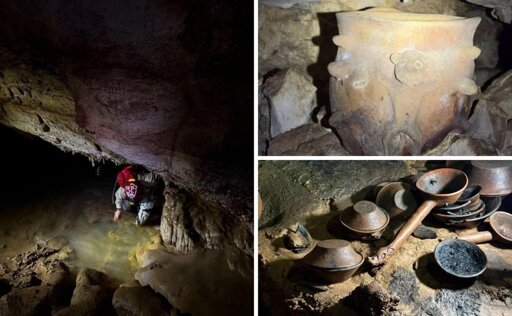
Archaeologists recorded hundreds of pre-Hispanic pieces in the cave.
During the press conference at the National Palace — from which President Claudia Sheinbaum was absent due to a cold — Vázquez reported that the find is a cave 20 meters underground and 100 meters long. It was a pilgrimage site where the Zoque people went to ask for rain and good harvests.
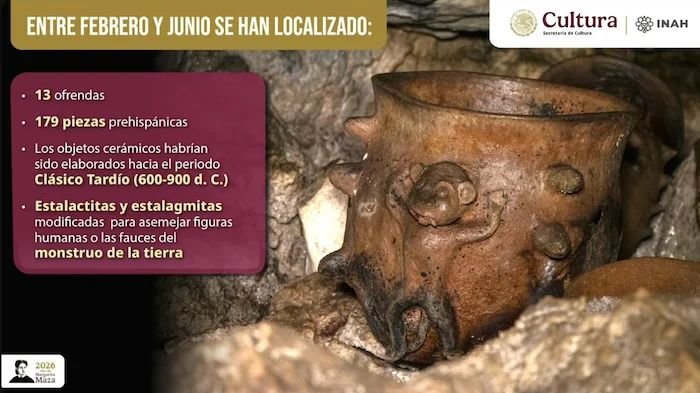
Between February and June, INAH recorded 13 offerings and 179 pre-Hispanic pieces in the cave, dated to the Late Classic period (600–900 AD). Stalactites and stalagmites were modified to resemble human figures or the jaws of the earth monster. Photo: INAH
He specified that between January and June, 13 offerings and 179 pre-Hispanic pieces have been located. The ceramic objects would have been made in the Late Classic period, that is, between the years 600 and 900 of our era.
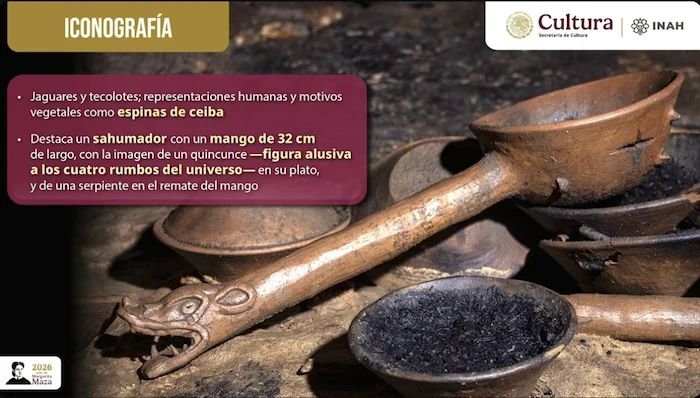
Among the iconography — jaguars, owls, and human figures — a standout piece is an incense burner with a 32-cm handle bearing a quincunx, a figure alluding to the four directions of the universe, on its bowl, and a serpent at the tip of the handle. Photo: INAH
In addition to these pieces, stalactites and stalagmites modified to resemble human figures or the jaws of a monster were found in the cave. Iconography with figures of jaguars and owls was also found, along with an incense burner with a 32-centimeter handle.
He said that studies will now be carried out to pinpoint the period in which these pieces were made.
Vázquez said the find was made possible by the guide Jairo Díaz, who, after locating the cave, informed the INAH of the site, to which the archaeologist Josué Losada then traveled.
In a video released of the cave, Díaz explains that during that period significant climatic changes were recorded that caused a lack of rain, which is why the Zoque took refuge in this cave. He also explained that there are still some Zoque communities today.
Descubren ofrendas prehispánicas de hace 1.400 años en el sureste de México
Una investigación de arqueólogos mexicanos logró el hallazgo de cientos de piezas prehispánicas labradas en el periodo clásico, del siglo VII al IX, en la denominada Cueva Mundo Zoque,… pic.twitter.com/3IpqYy2A9p
— Sputnik Mundo (@SputnikMundo) August 21, 2026

-
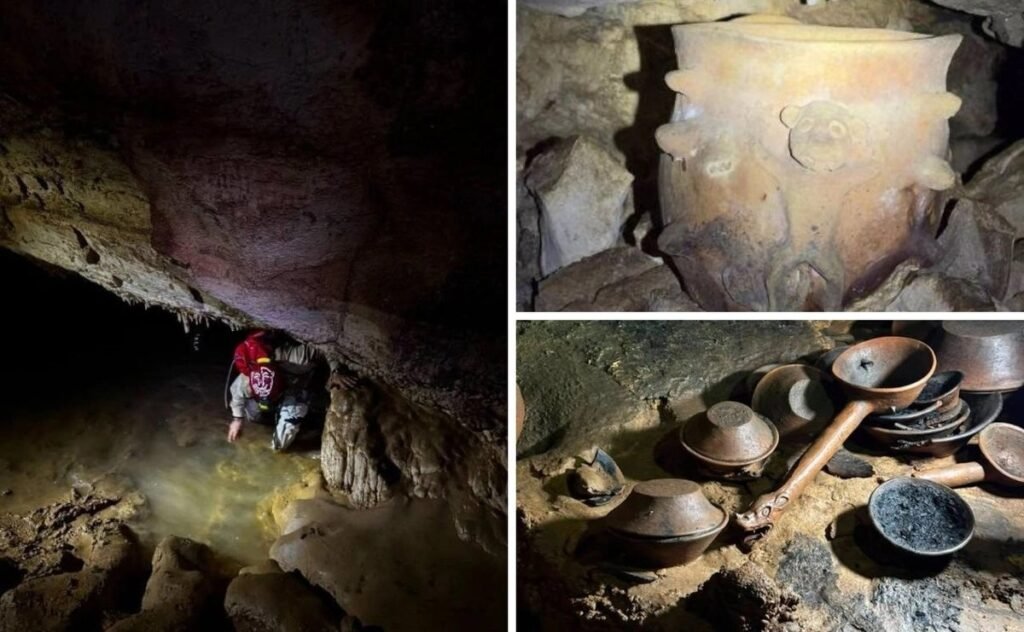
Mexico’s Archaeology Institute Reveals Findings in the Mundo Zoque Cave in Cintalapa, Chiapas
August 22, 2026August 22, 2026
Twenty meters underground and 100 meters long, the Zoque pilgrimage cave in Chiapas has yielded 13 offerings and 179 pre-Hispanic pieces from the Late Classic period (600–900 AD).
-
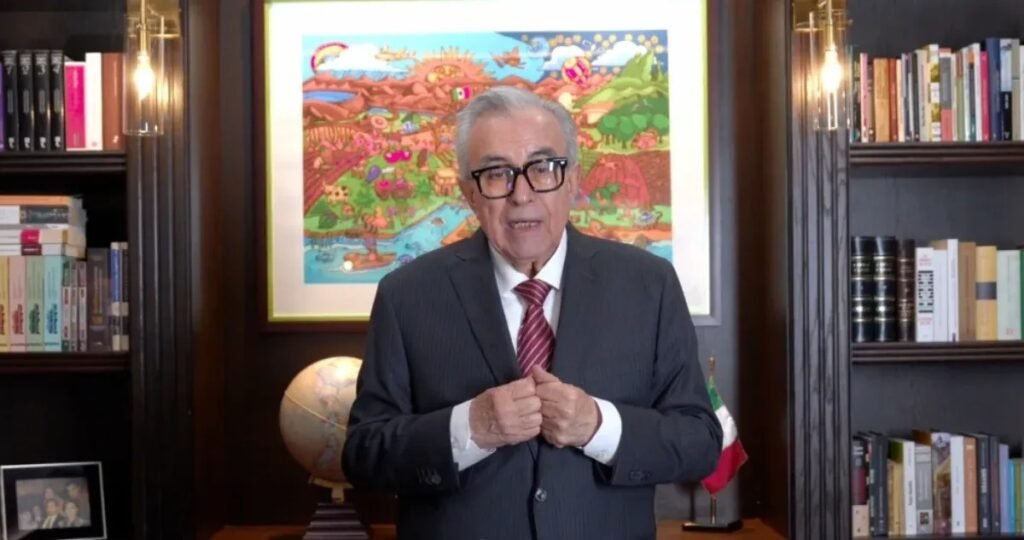
Morena Distances Itself from Rocha Moya. Opposition Revives the “Narco-Party” Narrative.
August 21, 2026August 21, 2026
Morena says it wasn’t told of the governor’s return and distances itself, as the PRI, MC and Somos México seize on it to renew their “narco-party” attacks.
-

Rubén Rocha Moya Returns as Governor of Sinaloa
August 21, 2026August 21, 2026
After a 112-day leave over US cartel accusations, Sinaloa’s Morena governor returns “with a clean forehead and head held high,” calling the charges far-right interference.
The post Mexico’s Archaeology Institute Reveals Findings in the Mundo Zoque Cave in Cintalapa, Chiapas appeared first on Mexico Solidarity Media.
From Mexico Solidarity Media via This RSS Feed.