


By Nikos Mottas
For more than six decades, the United States has attempted to disguise its aggressive imperialist policy toward Cuba as a question of “national security,” diplomatic pressure or concern for “democracy”.
Behind this sanitized vocabulary stands a far more brutal reality: economic strangulation, political coercion, extraterritorial intimidation and the deliberate worsening of the material conditions of life of an entire people because that people refuses to renounce its Revolution.
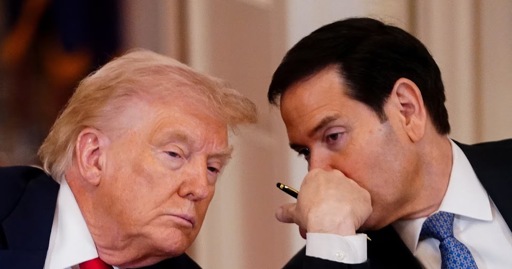
Under Donald Trump and Marco Rubio, this policy has entered an especially dangerous phase. Measures aimed at restricting Cuba’s access to fuel, finance and essential supplies are being tightened while their consequences for hospitals, transportation, electricity generation, food distribution, water supply and public health are already known. The question therefore arises with particular urgency: Can the deliberate imposition of such conditions upon the Cuban people potentially constitute genocide under international law?
This is too serious an accusation to be reduced to rhetoric. But it is also too serious a possibility to be dismissed simply because the weapons employed are sanctions, banks, financial prohibitions and fuel restrictions rather than bombs.
The 1948 Convention on the Prevention and Punishment of the Crime of Genocide is explicit. Article II© recognizes as one possible act of genocide the deliberate infliction upon a national, ethnic, racial or religious group of “conditions of life calculated to bring about its physical destruction in whole or in part.” The Convention applies in peacetime as well as in war, while Article IV makes clear that rulers and public officials are not exempt from responsibility1.
International jurisprudence has given concrete meaning to this provision. In its 2015 judgment in Croatia v. Serbia, the International Court of Justice explained that the “conditions of life” contemplated by Article II© may include deprivation of food, medical care, shelter and other necessities capable of bringing about physical destruction2. The Court did not find genocide established in that particular case because the necessary genocidal intent had not been proven. But the legal principle itself is clear: deliberate deprivation of the material necessities of life can constitute the physical element of genocide.
That distinction is decisive. Genocide requires specific intent: not merely knowledge that hardship will result, but an intention to destroy the protected group, in whole or in substantial part, as such. No serious argument should pretend that this intent has already been established judicially in Cuba’s case. But neither can the requirement of intent be transformed into a convenient shield preventing investigation when an entire national population is subjected to measures affecting resources indispensable for survival.
In the case of Cuba, the documentary record of U.S. policy is particularly damning. On 6 April 1960, U.S. Deputy Assistant Secretary of State Lester D. Mallory drafted a memorandum that remains one of the most naked expressions of imperialist policy ever committed to paper. Mallory acknowledged that the majority of Cubans supported Fidel Castro and that no effective political opposition capable of overthrowing the revolutionary government existed. His conclusion was therefore to recommend weakening Cuban economic life, denying the country money and supplies and bringing about “hunger, desperation and overthrow of government”3.
The significance of this document can hardly be overstated. Because the Cuban people supported the Revolution, the Cuban people themselves were to become the target of economic pressure. Hunger and desperation were not presented as unfortunate side effects. They were consciously identified as instruments for achieving political overthrow. This is the historical DNA of the U.S. blockade.
The names of presidents have changed and the mechanisms have become more sophisticated. Financial sanctions, banking restrictions, secondary sanctions and intimidation of third countries have expanded the arsenal. Yet the class objective remains recognizable: to make the material price of defending socialism so unbearable that the Cuban people are driven toward surrender and capitalist restoration.
The current escalation gives that historical continuity renewed importance. Measures aimed at restricting Cuba’s access to fuel strike not merely at government revenues but at the elementary functioning of civilian life. Fuel means electricity. It means functioning hospitals, ambulances, public transport, refrigeration, agricultural machinery, food distribution and water pumps. On an island already subjected to severe financial and commercial restrictions, deliberately choking access to energy means interfering with virtually every system upon which human life depends.
For a Cuban family, the blockade is not an abstract dispute between governments. It is experienced in hours without electricity, in medicines that cannot be obtained, in transportation that fails and in hospital treatments delayed because essential resources are missing. Economic warfare acquires flesh and blood precisely at this point.
United Nations experts have repeatedly warned of the impact of U.S. coercive measures on access to food, health, water, sanitation, education and development in Cuba. Such warnings matter because they establish that the humanitarian consequences of the policy cannot plausibly be described as unforeseen. Knowledge does not itself establish genocidal intent, but it becomes highly relevant when a government is formally warned that its measures are undermining indispensable conditions of civilian life and nevertheless chooses to tighten them.
Secretary Rubio’s own rhetoric therefore deserves particular scrutiny. His declaration that Cuba must be left without “escape valves,” combined with an administration determined to close avenues through which the island may obtain economic relief, cannot be brushed aside as political theatre. When such language accompanies policies affecting energy, finance and access to essential goods, it becomes necessary to ask whether civilian suffering is being regarded merely as an unwanted consequence or as the very mechanism through which political collapse is expected to be produced. That is precisely what a serious investigation should determine.
What humanitarian assessments reached Trump and Rubio? What were they told about the effects of fuel restrictions on hospitals, electricity, water supply and public health? Were humanitarian exemptions meaningful in practice, or neutralized by fear among banks, insurers, shipping companies and suppliers? Was deprivation tolerated reluctantly, or was it valued because hardship was expected to generate desperation and destabilization?
If evidence established that destructive conditions of life were imposed with the specific intent required by international law to physically destroy a substantial part of the Cuban national group, then the crime would have a precise name: genocide.
The legal case against Washington does not, however, begin or end there. The International Court of Justice has already established another principle of direct relevance to Cuba. In Nicaragua v. United States in 19864, the Court held that every sovereign state has the right to choose freely its political, economic, social and cultural system and that coercive intervention in matters belonging to that sovereign choice violates international law. The United States was found in breach of the principles of non-intervention and sovereignty through its actions against Nicaragua.
The implication for Cuba is obvious. Washington possesses no legal right to decide that socialism must disappear from the island. It has no right to use economic coercion in order to force another sovereign people to alter its political and economic system. The sovereign equality of states does not cease to exist when the White House dislikes the social order another people has chosen.
The World Court has already told the United States this.
Recent international criminal jurisprudence also reinforces the principle that deprivation itself can constitute a weapon. In the proceedings concerning Gaza5, the International Criminal Court treated the intentional deprivation of food, water, medicines, fuel and electricity as potentially criminal conduct capable of producing individual criminal responsibility. Cuba is legally and factually different, and no comparison should mechanically equate the two situations. But the underlying principle is important: the absence of bombs does not make deliberately imposed deprivation legally harmless.
The United States cannot even claim that such a principle is alien to its own legal order. Under 18 U.S.C. §1091, U.S. federal law criminalizes genocide through, among other conduct, subjecting a national group to conditions of life intended to cause its physical destruction, in whole or in substantial part6. The statute requires specific intent, as international law does. But Washington’s own criminal code recognizes the principle that destruction can be pursued through conditions of life.
Trump, Rubio and other officials responsible for the present escalation should therefore face investigation by any competent authority possessing lawful jurisdiction. Internal communications, humanitarian-impact assessments and policy deliberations should be preserved. The relationship between measures adopted in Washington D.C and their material consequences in Cuban hospitals, homes, workplaces and power stations should be established rigorously.
If the evidence proves the specific intent required by genocide law, prosecution should follow. If that threshold is not established, the conduct does not suddenly become lawful. Questions remain concerning prohibited coercive intervention, persecution, possible crimes against humanity under applicable jurisdiction and systematic violations of fundamental rights to life, health, food and development.
Legal precision does not weaken the indictment of imperialism. It strengthens it.
Communists harbor no illusions regarding the class character of the existing international order. International law functions within a world dominated by monopoly capital, military blocs and enormously unequal relations between states. Its application has repeatedly demonstrated a brutal double standard: weaker countries are threatened, sanctioned, invaded and prosecuted, while the great imperialist powers routinely claim privileges for themselves that they would never tolerate from others.
But that is no reason to abandon the legal terrain to imperialism. Washington endlessly lectures humanity about “international law,” “human rights” and a “rules-based order.” Its own actions must therefore be placed under the same microscope. The legal principles invoked against others must also apply to those who command the most powerful imperialist state on earth.
And when they are applied to Cuba, the contradiction is stark.
Cuba is not subjected to economic warfare because it threatens the existence of the United States. Such a proposition would be absurd. A Caribbean island of roughly ten million inhabitants does not pose a military danger to the most heavily armed imperialist power in history. The roots of Washington’s hostility lie elsewhere: in property, power and class.
The Cuban Revolution expropriated major capitalist interests, smashed the domination of the old bourgeois-landowner oligarchy, curtailed the privileged position of U.S. monopolies and proclaimed the right to construct socialism only ninety miles from Florida. That was the unforgivable crime!
Batista could torture, murder and imprison because capitalist property remained secure and U.S. interests remained protected. Revolutionary Cuba could eradicate mass illiteracy, create universal public health care, develop science and medicine, send doctors to peoples in need and shed Cuban blood in the struggle against apartheid; none of this could reconcile Washington to the Revolution because the decisive question was never humanitarian.
The decisive question was which class held power.
The blockade must therefore be understood for what it is: internationalized class warfare. Its strategic objective is not some abstract “democratic transition.” It is the reversal of the social outcome of the Cuban Revolution — capitalist restoration, the dismantling of socialist power and Cuba’s reintegration into the economic and geopolitical orbit of U.S. imperialism.
Its extraterritorial character exposes this imperial arrogance even further. Washington does not merely decide what U.S. corporations may do. It attempts to dictate the behavior of foreign banks, insurers, shipping companies, investors and sovereign governments, threatening them for maintaining economic relations with Cuba. The celebrated “rules-based international order” suddenly becomes remarkably flexible when the interests of U.S. imperialism are at stake.
The cynicism reaches its most grotesque form when Washington then points to the hardship generated by economic warfare as evidence of socialism’s failure. It restricts Cuba’s access to energy and points to blackouts. It obstructs finance and international transactions and then lectures Havana about inefficiency. It frightens suppliers away and subsequently presents scarcity as proof against social ownership.
Imperialism helps manufacture the wound and then points to the bleeding as evidence that the victim is diseased.
The Cuban people do not need humanitarian pity from Washington. They need Washington’s hands removed from their country. They need the blockade abolished, their sovereignty respected and their right to determine their own social system recognized without economic blackmail, threats or policies calculated to generate hunger and desperation.
Trump, Rubio and their associates must therefore answer for the policy they consciously intensify. The possibility that elements of that policy may fall within the legal framework of genocide must be investigated seriously, particularly where deprivation of indispensable resources is combined with an openly proclaimed strategy of eliminating Cuba’s economic “escape valves.”
But communists should not mistake the courtroom for the decisive battlefield.
Washington’s strategy has always rested upon a political calculation: make everyday life sufficiently hard, exhaust the population, transform scarcity into demoralization, turn demoralization into counterrevolution and achieve through economic strangulation what invasion, sabotage, terrorism and decades of subversion have failed to accomplish.
Its real target is not merely the Cuban government. It is revolutionary power itself.
For this reason, the ultimate condemnation of those responsible cannot be measured only in indictments or judicial decisions. It will be measured above all by the failure of their strategy.
The answer to an imperialism that weaponizes deprivation against socialism cannot be retreat from socialism. It must be the strengthening of workers’ and popular power, the defense of social ownership, more effective socialist planning, deeper popular participation and an unyielding mobilization of Cuba’s productive capacities in the service of working-class and popular needs.
In other words, more socialism, not less.
If the specific intent required by international law is established, Trump, Rubio and any other responsible officials must answer for genocide against the Cuban people. The evidence must determine that legal question.
History, however, will pronounce another sentence.
It will be the continuation of the Cuban Revolution, the resistance of the Cuban people, the defeat of every project of capitalist restoration and the deepening of socialist construction on Cuban soil.
For more than six decades, U.S. imperialism has attempted to prove that Cuba cannot remain sovereign, revolutionary and socialist. Its most devastating conviction will be a Cuba that proves, once again, that it can.
Notes
- UN — Convention on the Prevention and Punishment of the Crime of Genocide
- The ICJ states that “conditions of life” can include deprivation of food, medical care, shelter or clothing, lack of hygiene and exhaustion, provided the conduct is directed toward physical destruction.
ICJ — Croatia v. Serbia, Judgment of 3 February 2015 - https://history.state.gov/historicaldocuments/frus1958-60v06/d499
- https://www.icj-cij.org/node/100900
- https://www.icc-cpi.int/news/situation-state-palestine-icc-pre-trial-chamber-i-rejects-state-israels-challenges
- https://www.law.cornell.edu/uscode/text/18/1091
* Nikos Mottas is the Editor-in-Chief of In Defense of Communism.
From In Defense of Communism via This RSS Feed.