

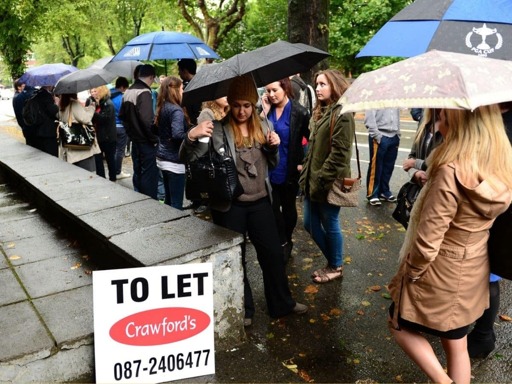

Community Action Tenants Union (CATU), a group organising Irish renters to fight for their rights, has laid out the disastrous effects of an Irish government housing bill, six months on from the president signing it into law.
At the time the Residential Tenancies Bill (RTB) passed, we quoted People Before Profit’s Paul Murphy saying:
This is a bill for rip-off rents. That’s the purpose of it. It’s not an accidental outcome of it, that’s the purpose. The government strategy explicitly is to get rents to rise higher in order to attract more investment.
That appears to have proven correct, with large corporate landlords being the main beneficiaries. Ires Reit, Ireland’s biggest private residential landlord, achieved:
…a tripling of pretax profits to €48 million for the six months to the end of June.
Its CEO Eddie Byrne boasted of how:
…the company’s average monthly rent in the six months to June rose by 1.7 per cent to €1,884.
Irish renters — Evictions at highest levels “since the 1850s”
This is at a time when rents were already unaffordably high. Byrne went on to say that the RTB has “unlocked renewed capital flows into the sector”. This has come as a result of large international investors entering the market, buying up properties sold off by smaller landlords.
The bill introduced stronger protections for renters, such as minimum tenancy periods of six years, and the near-total banning of no-fault evictions. This scared off many landlords with fewer properties. This shows that even policies that appear beneficial to tenants can have disastrous consequences, when housing is treated as a commodity almost entirely left to the whims of the market.
Landlords anticipating this policy change caused a major spike in evictions during 2025. RTÉ report that:
Figures from the Residential Tenancies Board show that 5,405 notices of termination were issued in the third quarter of 2025, a 35% increase year on year.
Disturbingly, current eviction rates are at the highest they’ve been since one of the darkest periods of Irish history – the famine inflicted on the country by Britain. Data from the Residential Tenancies Board shows:
…roughly one eviction notice per 100 households (and higher if we only consider rented households) in both 2023 and 2024.
Even during the Land War of 1879-1882, when landlords retaliated with mass evictions against tenant organising, the rate was much lower at 0.48 eviction notices per 100 households. That means you need to go back to the mid-1800s period of Britain’s mass forced starvation to see equivalent greed from landlords. RTÉ go on to say that:
…the scale of displacement now being recorded would not look out of place in post-Famine Ireland and arguably tenants today have less rights and customary advantages than their counterparts in the late 1800s and early 1900s. There can be little doubt but that evictions, now as then, are a destructive feature of Irish life.
1800s mass evictions came about as a result of the massive power imbalance between landlords and tenants. Yet, shockingly it seems that Ireland is recreating this inequality from one of the most notorious chapters in its history. It forms part of a general regression to the 19th century, with poverty in Britain often characterised as Dickensian, and US billionaires now hoarding wealth at a level that surpasses the infamous Gilded Age.
Irish government favouring “vulture funds” over tenants
CATU go on to cite the recent case of an approved housing body failing to acquire 140 Dublin apartments as social housing. Instead, the homes have gone up at exorbitant rental prices, ranging from €4,500 for a three-bed, to €2,400 for a one-bed. A person working full time on minimum wage earns about €29,900. Renting the lowest priced apartment would use up 96% of their income, leaving them €1,100 for all other expenses.
Housing spokesperson for the Social Democrats, Rory Hearne, agreed with CATU, saying:
Minister for Housing James Browne and his Government were warned that these rental laws would cause evictions to skyrocket, increasing homelessness and leaving our young people with little choice but to emigrate.
They rammed through these cruel and deeply flawed laws anyway, which represents a complete capitulation to large investor funds and landlords and a complete disregard for renters. It was made clear that these changes would cause not just record evictions but record rents, but the Minister paid no heed.
He continued:
Government policy prioritises institutional landlords and vulture funds at a time when there has never been more children living out their youth in homelessness. 5,620 children now comprise 32% of all homeless people. There has been a 60% increase in child homelessness since Fianna Fáil and Fine Gael formed a Government in 2020.
CATU conclude by urging Irish renters to join a tenants union, as the “strongest defence against the housing crisis”. It was only a massive collective effort of tenants that secured land reform in Ireland in the late 1800s and early part of the 20th century. As the country slides back to that period of massive entrenched power, a similar united effort will be required to bring it down.
Featured image via IrishTimes
From Canary via This RSS Feed.