

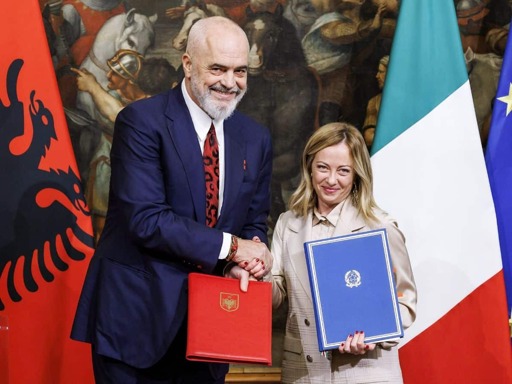

Amnesty International have released a statement claiming that Italy’s agreement to detain migrants and asylum seekers in Albania is a danger to people’s “safety, liberty and human rights”. The campaign organisation also held that the pact:
continue[s] to expose the dangers of long-standing European Union (EU) migration policies that centre on exclusion and containment.
Evading responsibilities
On 23 February 2024, the Italy-Albania Agreement established two Italian-run ‘migration facilities’ in Albania. The agreement will run for 5 years, with over €670 m earmarked to fund it. After that point, it will likely be renewed automatically.
Amnesty described the conditions in the Albanian detention centres as harmful, to the point that they have “driven several individuals to self-harm or attempt suicide”. Eve Geddie, the director of Amnesty International’s European Institutions Office, explained that:
Offshore detention is ultimately aimed at deterrence and trying to shift and evade both the responsibilities of responding to people migrating and the obligation to provide asylum to those who need it. Italy’s deal with Albania shows yet again the unavoidable human rights costs of this approach.
Just before the deal entered into force, Amnesty International sounded the alarm on the harmful impact it would inevitably have on the rights of people in distress at sea, and of people transferred to Albania. Clearly, these concerns have now materialized.
42 critical incidents in one month
Italy first began its use of the overseas centres by picking up 74 individuals in international waters and forcibly transferring them to Albania. However, multiple Italian court orders eventually ended the practice.
Then, in March 2025, Italy instead altered the agreement in order to permit the detention of men with expulsion orders in Albania. These individuals were already under detention in Italy, and were therefore subject to transfer across borders in a manner “outside of provisions in domestic and European law”.
The results were as rapid as they were devastating, as Amnesty explained:
As a result, hundreds (reportedly over 500) predominantly racialized men have been forcibly transferred to the Albanian detention centre in Gjadër over the past 15 months.
Between 11 April and 16 May 2025, 42 critical incidents were recorded in the Gjadër centre, including at least two attempted hangings, a protest where three people were injured from shattered glass, and various self-harm incidents.
The men detained in Albania also struggle to access legal help. Likewise, the Italian government has restricted both parliamentary and independent oversight for monitoring purposes.
The Ministry of Interior cited security and public order concerns when it denied Amnesty’s request for entry into the Albanian centres.
As such, the human rights organisation instead had to base its research on court documents, government correspondence, and information from the Tavolo Asilo e Immigrazione civil society network.
It also conducted interviews with representatives from UN agencies, along with lawyers acting on behalf of the detained individuals. One lawyer described being given no time to meet his client or prepare a defence. He also opined that the detainees showed signs of having been intimidated.
Amnesty — ‘A wake-up call’
Amnesty’s Eve Geddie stated that:
It is abundantly clear that the Italy-Albania model is impossible to implement in line with Italy’s human rights obligations. This reality must be a wake-up call for the EU to put any future plans to expand the use of offshore detention and other externalization tools, firmly on ice.
Italian authorities must immediately end the agreement with Albania, implement alternatives to migration detention, which under international law must remain the last resort, and ensure access to effective and non-discriminatory asylum procedures and dignified reception on Italian territory to all people seeking international protection. All refugees and migrants should be able to access effective legal safeguards and benefit from independent monitoring.
In a UK context, it’s hard not to hear the echoes of the Tories’ infamous Rwanda migrant deportation plan. Earlier this month, August 2026, Kevin Hollinrake — the chair of the Conservative Party — had the nerve to call for the renewal of that failed, deeply racist scheme.
At the same time, Reform UK proposed a Trump-like scheme to transfer ‘foreign national’ prisoners to hellish jails in El Salvador. However, even ‘left-wing’ Labour’s hands are far from clean. The party reportedly considered its own Rwanda-style deportation deal with — wait for it — Albania, just last year.
These politicians, whether in Italy, the UK or the EU, know that the migrants and asylum seekers they deport will face shocking conditions and the degradation of their human rights.
For some, this cruelty is the point. Others simply don’t care, as long as they can make these fellow human beings another country’s ‘problem’.
This distinction, however, is pure semantics — the effect they have is identical, and the blood stains both hands all the same.
Featured image via HumanRightsWatch
By Grace
From Canary via This RSS Feed.