


This story was originally published by Nebraska Examiner.
Cindy Gonzalez
Nebraska Examiner
McCOOK — The sun was still rising as nearly 60 “mothers and others” boarded an Omaha bus and headed across the state to protest what goes on at the ICE detention facility in rural McCook.
Their nearly 10-hour round trip marked a year since Gov. Jim Pillen announced the deal he made with U.S. Immigration and Customs Enforcement to convert the state’s rehabilitative-focused Work Ethic Camp into a 300-bed jail for migrants. The bus passengers, set to join other like-minded rallygoers Saturday, wanted McCook, the state and nation to know that time had not dulled their contempt for that decision or concern for those detained.
They carried signs: “We have not forgotten.”
Despite attempts by some state lawmakers and a lawsuit by 13 McCook residents to halt the plan, the ICE jail began accepting foreign-born detainees in November and the daily population count through March fluctuated between about 100 and 171, according to the Deportation Data Project, a repository of immigration enforcement data maintained by the University of California Berkeley Law School and obtained through the Freedom of Information Act.
Pillen last year said he expected the feds would pay the state a $2.45 million “base” fee each month. But to date, the state has received $14.6 million: $9.3 million based on occupied beds and $5.3 million for one-time costs such as vehicles and equipment, said a spokesperson for the Nebraska Department of Correctional Services.
Spokesperson Dayne Urbanovsky, in an email to the Examiner, said the higher amount could come when the facility is able to house 300. She said renovations are to be completed later this summer.
Responding to the rally, Pillen spokesperson Laura Strimple said the governor remains committed to the ICE partnership and to “safe and secure detention of illegal detainees accused of either criminal or civil violations of our nation’s laws.”
The “McCook detention center has served that purpose for ICE and the Department of Homeland Security and will continue to do so throughout its contract with the state,” Strimple said. The contract is valid through at least September 2027.
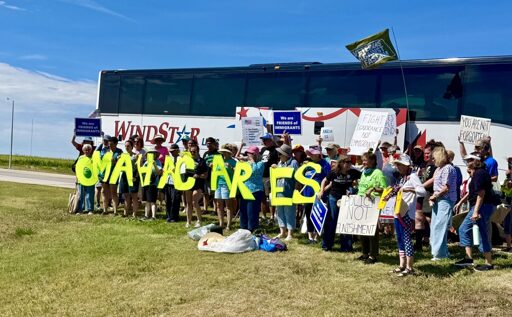
As the Omaha bus pulled up to the rally site, a private lot within eyeshot of the detention facility, passengers held up letters that spelled “Omaha Cares.” The bus was hosted by “Mothers and Others: Justice and Mercy for Immigrants,” but carried representatives of assorted organizations, including a Nebraska lawmaker.
They joined a rally that grew to about 300 people. Lead organizers — including McCook-based Nebraska Voices, Lincoln-based Taco Tuesday Familia and American Civil Liberties Union Nebraska — said the turnout, higher than previous protests, signaled a continued resolve to fight for due process and legal reform for migrants.
Organizers said participation, spanning the state, reflected a growing network of advocacy entities watching actions of ICE and the McCook facility.
“It’s galvanized people’s sense of injustice,” said Nebraska Voices’ Lorri Sughroue, who helped form the McCook group last year.
‘This began in 1492’
Kevin Abourezk, a Lakota elder whose journalism career documented stories of indigenous people, kicked off the rally’s lineup of speakers, saying the only people who aren’t immigrants are Native Americans.
Abourezk touched upon U.S. history and said the reason for Saturday’s gathering did not begin just last year. “This began in 1492, when Columbus landed …”
He told demonstrators that perhaps it is “good and right to have standards by which people are allowed to come here” to carve out homes for their families. He pointed toward the nearby McCook detention center: “But in terms of smart immigration reform — it ain’t that.”
The two-hour program that unfolded without incident also included musicians, bilingual poets, red-robed Handmaids of Nebraska, hatted “Pissed Off Grandmas,” words from Las Voces Nebraska, clergy and local McCook residents.
Most wore shirts with immigrant-friendly messages. Dozens held signs and waved to passing motorists on U.S. Highway 83 in the Red Willow County town of about 7,500.
Co-organizer Holly Burns spoke of her Latino family’s Nebraska roots, which started with her grandparents’ farm work in Scotts Bluff County and led to Lincoln where she and sister Tiffany last year formed the Taco Tuesday Familia advocacy group.
She spoke of how certain U.S. states were once part of Mexico. “Truly in my family’s history, the border crossed us,” said Burns.
State Sen. Margo Juarez of South Omaha got one of the louder reactions when recounting a meeting she and another lawmaker had the prior week with state officials about “isolation rooms” under construction at the McCook facility. She said she has asked for an accounting of how they are used.
Mindy Rush Chipman, executive director of ACLU Nebraska, harked back to Pillen’s August 2025 announcement that the state would convert the Work Ethic Camp into an ICE jail.
“Those plans were shrouded in secrecy,” she told those sitting in lawn chairs, on the ground and under tents.
Out of 49 lawmakers in an officially nonpartisan Nebraska Legislature, a group of 13 Democrats and one independent demanded more transparency and questioned whether Pillen violated the Nebraska Constitution by repurposing the state correctional facility without direct legislative approval. Pillen has argued that he is doing his duty to help the federal government enforce immigration laws.
A Red Willow County district judge ruled in favor of the governor and later dismissed a lawsuit filed by Nebraska Appleseed on behalf of a group of McCook residents and former State Sen. DiAnna Schimek. The judge said that the Legislature had previously tasked the executive branch with managing state prisons, and that the Pillen administration legally entered into the ICE contract. Appleseed has appealed the decision.
Rush Chipman also told rallygoers that most ICE detainees are not dangerous or criminals, though held for civil violations of being in the country without authorization. The Transactional Records Access Clearinghouse at Syracuse University (TRAC), a nonprofit that tracks immigration trends, showed about 70% of migrants in ICE detention have no criminal convictions.
“They’re people that are being taken away from their families, taken away from their jobs and taken away from the communities they call home,” Rush Chipman said.
ACLU attorney Grant Friedman said that in his experiences, the McCook detention center provides the “worst lawyer-client accommodations.” He said, for example, he can’t get a message to an inmate without a full name and immigration identification number, which he said detainees don’t always have.
At the same time Pillen announced the facility, he disclosed a new 287(g) pact between ICE and the Nebraska State Patrol — a move Rush Chipman said essentially turned the state agency into an extension of immigration enforcement.
Initially, six troopers were trained as 287(g) task force officers. A patrol spokesman confirmed that the number has grown to 16.
Spokesman Cody Thomas said that since August, state troopers have assisted in about 275 immigration-related detentions or transports in 30 Nebraska counties, and that Homeland Security has reimbursed the patrol $277,037.
A few recent encounters he cited included a case when a trooper detained an undocumented migrant with several prior convictions including disorderly conduct and DUI, and another in which the person had a prior child sexual assault.
Thomas said the near tripling of troopers trained for immigration duties was due to unpredictable scheduling demands and new state participation in a program to “locate and ensure the safety of unaccompanied children.”
No detentions have resulted in the program to find unaccompanied children, he said, but the task force helped find over 10 youths “and ensured they were safely with family.”
Nationally, 287(g) partnerships have increased from 135 to 2,179 since the beginning of President Trump’s second term, a Homeland Security spokesperson said.
Solidarity appreciated
For some residents of McCook, a High Plains town historically tied to railroads and agriculture, the weekend gathering was a welcome sign of solidarity.
Sughroue said many locals are fervent in their support for toughened ICE enforcement, though she also believes a good chunk don’t want the detention facility in their backyard. She believes they’re silenced by potential “repercussions” in the largely conservative area.
Indeed, a few asked not to be identified in a story.
John and Deborah Walters are registered Republicans who said they won’t hold back their objections.
The couple owns ag land in the area, including the few acres on which the rally was held. They said they learned about the plan for the McCook ICE facility on a national newscast while eating breakfast at a hotel in Iowa.
“We were shocked,” said John, born in McCook 79 years ago. He believes state officials did not weigh future effects on the area. Deborah described as “our neighbors” most of the immigrants arrested in President Donald Trump’s mass deportation movement. Both were disturbed when federal and state officials dubbed the facility the “Cornhusker Clink.”
“Everything’s been so secretive, that’s what bothers us,” Deborah said. “It’s a perfect location, right? Rural Nebraska, nobody is going to complain.”
The couple viewed Saturday’s turnout as “tremendous.”
Gary Power, 84, said he endured the afternoon heat to register support “for democracy” and against inhumane tactics. He said he was somewhat surprised to see so many McCook folks.
“Six months ago I would never have seen something like this,” said Power. “They woke up. They’re paying those gas prices, wouldn’t that wake you up?”
McCook resident Diane Lyons told the group that part of her anxiety is not knowing what will come later of the converted facility now surrounded with new “rows and rows and rows of barbed wire.” She said she valued its previous use as a work ethic camp whose inmates helped set up various community events, including Santa Claus Lane.
“We feel your fear,” she told the group. “We feel the anxiety. We feel the anger about the people that are being wrongfully detained there … we also have lost a lot.”
Helping hands
Looking back over the past year, advocates said they are encouraged to see a stronger network emerge to help respond to immigration-related needs.
The connections played out in a recent situation when a former McCook detainee from Minnesota called a North Platte advocacy group about his friend newly released from the McCook facility. The friend, a Spanish-speaking Venezuelan, wound up in Omaha without a phone, food or resources. The North Platte advocate called a representative of Omaha Welcomes the Stranger nonprofit, who contacted a member of Mothers and Others, who found the former detainee (via help of a photo) sitting alone in a lot near the Omaha immigration court complex. Volunteers at Omaha Welcomes the Stranger provided the Venezuelan a place to stay and helped him return to his family and friends in Minnesota.
Looking ahead, rallygoers in McCook are seeking to build a fellowship program that interacts with detainees. Appleseed continues its legal quest to close the facility.
“Working together helps protect our communities and encourages others around us to demand better from our elected officials,” Rush Chipman told the rally. “If Florida can close its detention center, so can we.”
As the Omaha bus returned about 8 p.m., riders were signing up for another protest at a Council Bluffs ICE detention facility.
Juarez was planning another visit with McCook detainees. She had asked to do so the day of the rally, but was told more notice was needed.
“We need to continue to monitor what goes on at the facility especially now that they have those isolation rooms,” she said.
The South Omaha lawmaker, a member of Mothers and Others, said she will work to end the McCook ICE partnership when the current contract ends in fall 2027. She said she left the rally energized by the geographic representation, diversity and number of young participants.
“There were so many young people there who saw the wrong in the facility — that’s inspiring to me,” she said. “I hope they continue with their concern and leadership and always speak out on issues they don’t feel are humane.”
NE lawmakers question new ‘isolation’ area at McCook
McCOOK — State Sen. Margo Juarez, an outspoken critic of immigration enforcement tactics, said she is worried about “isolation rooms” being built at the state-owned McCook ICE detention facility, and wants to see records kept on usage.
The South Omaha lawmaker and Sen. Terrell McKinney of North Omaha met last week with Nebraska Department of Correctional Services staff. She said they were told the solitary confinement space was a requirement of the Department of Homeland Security, which oversees U.S. Immigration and Customs Enforcement.
On Monday, Aug. 17, a Correctional Services representative confirmed that additional space is part of a federal agreement.
Dayne Urbanovsky, the spokesperson, said in an emailed statement that the McCook facility has had a “short-term observation area” for individuals with self-harm thoughts or combative behavior and those who request separation. She said additional spaces are expected to be finished this summer as part of the expansion.
“I told them I want accountability for them being used,” Juarez said during a weekend address in McCook. A peaceful protest was held Saturday on private land near the McCook facility, which before its conversion last year served as the state’s rehabilitation-focused Work Ethic Camp.
McKinney said he wants to know “why people are being placed in those rooms in the first place.” He said most ICE detainees are not being held for violent offenses and are in removal proceedings based on civil violations for being in the country without authorization.
McKinney, known as a watchdog of the state prison system, called ICE enforcement overall “super concerning.” Of possible isolation of McCook-based migrant detainees, he said: “What’s the purpose?”
Juarez first learned of a planned solitary confinement area during a repeat visit to the McCook facility in March. She said state escorts at the time “spinned” the space as where detainees would go if they needed a “time out” or a spot alone.
In an interview this weekend, Juarez said increased concern led her and McKinney to meet with state officials. The McCook facility is owned by the state but operates under federal rules.
Juarez said she wants a record of who is kept in isolation and for how long.
“Absolutely I am worried about it,” she told the Examiner. “My main concern is how long somebody would be confined in one of the rooms.”
Of Juarez’s call for accountability, Urbanovsky said “room usage documentation is maintained in alignment with Department of Homeland Security ICE standard procedures.”
EDITOR’S NOTE: Kevin Abourezk is a national correspondent for ICT
The post One year after Pillen announced McCook ICE jail, protests continue, governor doubles down appeared first on ICT.
From ICT via This RSS Feed.