

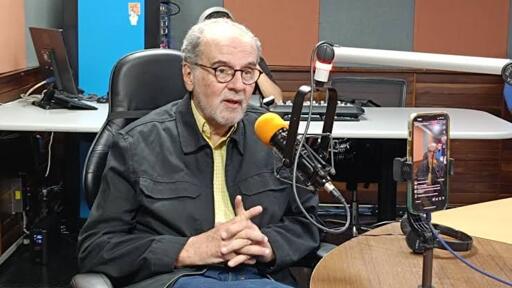
Caracas (OrinocoTribune.com)—Venezuela’s National Assembly (AN) authorized the appointment of veteran opposition politician Enrique Ochoa Antich as the Bolivarian Republic’s ambassador to the Swiss Confederation, with concurrent accreditation to the Principality of Liechtenstein.
The appointment was approved during an extraordinary parliamentary session on Friday, August 21. It places Ochoa Antich in the diplomatic post previously occupied by longstanding Venezuelan diplomat Roy Chaderton.
The decision represents another significant appointment of an opposition figure to Venezuela’s foreign service amid the political and diplomatic change initiated since the January 3 US military aggression against the country.
Diplomatic changes following US aggression
The appointment comes less than eight months after Washington bombed Venezuela to kidnap President Nicolás Maduro and his wife, National Assembly Deputy Cilia Flores, killing over 100 people in the process.
Following that unprecedented imperialist attack, the Venezuelan government initiated a sui generis political and diplomatic program that many analysts have described as being conducted under intense US pressure or even Washington’s tutelage.
Weeks after the aggression, Venezuelan Acting President Delcy Rodríguez announced the restoration of diplomatic relations with Washington. Months later, her government agreed to resume consular coordination and technical cooperation with the genocidal Zionist entity of ‘Israel,’ despite Venezuela’s historic support for Palestine and the Bolivarian Revolution’s anti-Zionist and anti-colonialist legacy.
The rapprochement has generated intense debate within Chavismo. Some analysts characterize the policy as a tactical retreat designed to protect Venezuela’s institutions, restore economic activity, and gain time to correct the security failures exposed by the January 3 attack.
Other Chavista voices warn that Washington is using dialogue, diplomatic normalization, economic concessions, and opposition appointments to progressively weaken the Bolivarian Revolution before attempting the final blow against Chavismo.
Another opposition appointment
Ochoa Antich’s appointment follows several other decisions incorporating opposition figures into Venezuela’s diplomatic apparatus.
Before nominating Ochoa Antich, Acting President Rodríguez appointed Olivar Blanco, a member of Democratic Action (AD), a right-wing opposition party, as deputy minister for foreign affairs.
On May 26, the government appointed opposition politician Timoteo Zambrano as Venezuela’s ambassador to Spain. The National Assembly described Zambrano’s designation as an expression of political coexistence and plural participation within the public administration.
Ochoa Antich, 71, is a Venezuelan politician, writer, columnist, and human rights activist with a political career spanning more than five decades.
He was a founding member of the Movement Towards Socialism (MAS), a party historically associated with Venezuela’s progressivism, later serving as its secretary general. He was also elected twice to the former National Congress, representing Táchira from 1984 to 1989 and Caracas from 1994 to 1999.
Ochoa Antich was particularly active in defending human rights following the Caracazo massacre of February 1989. He subsequently participated in several opposition organizations and electoral coalitions after the rise of Chavismo, including Un Nuevo Tiempo and the far-right Democratic Unity Roundtable (MUD).
However, he eventually distanced himself from the opposition’s most extremist sectors and advocated for peaceful, constitutional, electoral, and negotiated solutions to Venezuela’s political disputes.
His support for dialogue with the Venezuelan government and his rejection of abstentionist or insurrectional strategies have drawn fierce criticism from sectors of the far-right opposition, which accuse any opposition politician advocating for democratic solutions and opposing US intervention of accommodating Chavismo.
Debate within Chavismo
The appointment nevertheless raises questions among Chavista activists about the strategic direction of the Venezuelan government’s reconciliation policy.
Critics contend that political coexistence cannot mean transferring institutional power to representatives of opposition forces that supported sanctions, foreign intervention, the theft of Venezuelan assets, and successive regime-change operations.
They argue that reconciliation must strengthen popular power and the Bolivarian Revolution rather than rehabilitate political sectors historically connected to Washington’s destabilization strategy.
Supporters of the government’s approach respond that incorporating opposition figures who accept constitutional and electoral politics can isolate the extremist sectors demanding foreign intervention while broadening the country’s political stability.
National Assembly Approves Opposition Deputy Zambrano as Venezuela’s Ambassador to Spain
The central concern for many Chavista activists is that US imperialism has not abandoned its objective of destroying Chavismo and regaining complete control of Venezuela. From this perspective, Washington may be using the current diplomatic opening to construct the political, institutional, and economic conditions for a final offensive against the Bolivarian Revolution. Whether the government’s reconciliation strategy neutralizes that threat or inadvertently enables it remains at the center of Venezuela’s increasingly urgent political debate.
Special for Orinoco Tribune by staff
OT/JRE/SF
From Orinoco Tribune via This RSS Feed.