

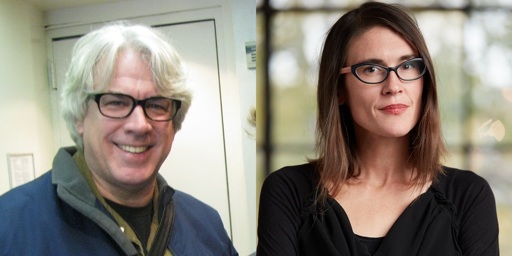
The August 14, 2026, episode of CounterSpin included an archival interview with FAIR’s Isabel MacDonald and Steve Rendall on Islamophobia, originally aired on October 10, 2008. This is a lightly edited transcript.
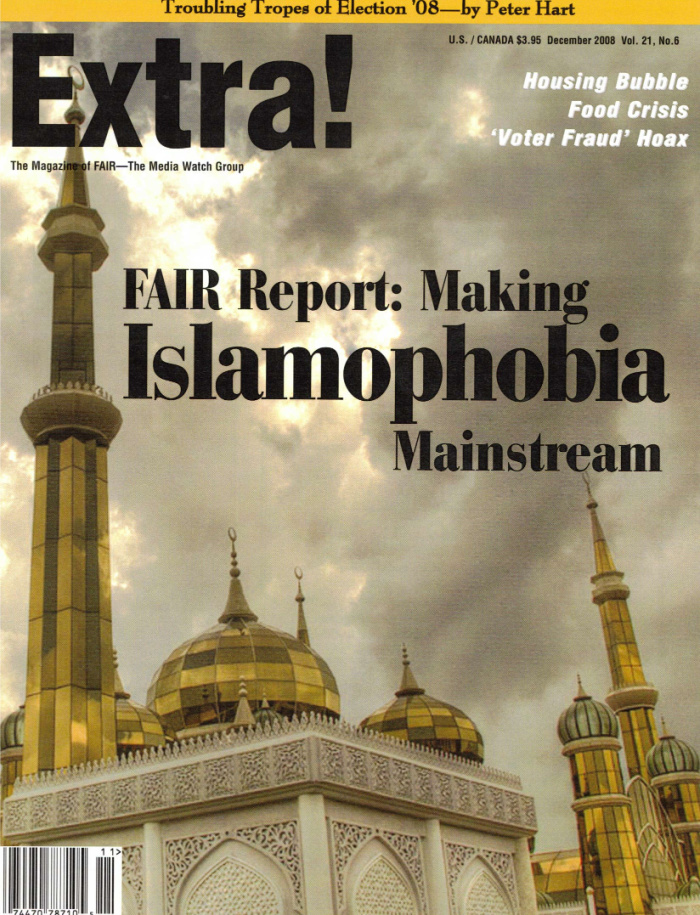
Extra! (11–12/08)
Janine Jackson: In February 2007, the highbrow National Book Critics Circle nominated, for Best Book in the Field of Criticism, a book called While Europe Slept: How Radical Islam Is Destroying the West From Within, widely viewed as denigrating an entire religious group, including by previous nominee Eliot Weinberger, who called it “racism as criticism.”
The book didn’t win, but its serious recognition in high literary circles highlighted the mainstreaming of Islamophobia. FAIR produced a report looking at the media. We called it Smearcasting: How Islamophobes Spread Fear, Bigotry and Misinformation. CounterSpin talked with FAIR’s then–communications director, Isabel MacDonald, and our senior analyst, Steve Rendall, about that report. Here’s that conversation.
***
Janine Jackson: On October 8, [2008,] FAIR, the media watch group that produces this show, published a major report on the American Islamophobic movement, its leading figures and the prominence of their bigoted views in mainstream corporate media. The report has several parts, including a list of the “Dirty Dozen” Islamophobes, or, as the report dubs them, “smearcasters.” That word describes a loosely connected network of the leading anti-Muslim bigots in America, who are able to get their message into the corporate press with remarkably little resistance.
Joining me now is Isabel MacDonald, FAIR’s communications director, and CounterSpin’s Steve Rendall, who, along with Veronica Cassidy and Dina Marguerite Jacir, co-authored FAIR’s report, Smearcasting: How Islamophobes Spread Fear, Bigotry and Misinformation. Welcome to CounterSpin, Isabel MacDonald. And welcome back, Steve.
Isabel MacDonald: Thanks very much, Janine.
Steve Rendall: Thank you, Janine.
JJ: Isabel, let’s start with you. Why now? What is it about the state of Islamophobia and anti-Muslim bigotry that moved you to undertake this study, just at this moment?
IMacD: In terms of the timing of the report’s release, we really could not have anticipated it, but I don’t think we could have asked for a more compelling demonstration of the need for this study. Over the past several weeks, 17 newspapers, including the New York Times, have participated in a mass distribution of some 28 million copies of an anti-Muslim propaganda film, Obsession, to voters in swing states. And what we’ve found is that this latest instance of mainstream expressions of Islamophobia, of anti-Muslim hate, is only the very tip of the iceberg when it comes to corporate media complicity in what amounts to an Islamophobic smear machine.

Penguin Random House (2007)
Just last year, a book that is called While Europe Slept: How Radical Islam Is Destroying the West From Within, was nominated for one of the most prestigious literary prizes, through the National Critics Circle. And it didn’t win the prize, but the fact that it was nominated at such a high level of a highbrow literary circle, I think tells us something about the moment that we’re in.
Also of great concern has been the rise of a number of bigoted, anti-Muslim books to the New York Times bestseller list. So for instance, on the New York Times bestseller list, you can find Mark Steyn’s book America Alone, which argues that demographic decline posed by Europe’s emerging Muslim population is a grave threat facing the West, and actually suggests that there are lessons for Europeans in the Balkan example of ethnic cleansing. What we’re talking about is a problem that has percolated up to the highest levels of publishing.
At a more base level, in terms of the vast world of talk radio, we can find people like Michael Savage, who have an audience of 8.5 million listeners making a call on air for the killing of a hundred million Muslims.
JJ: Steve, Islamophobia is not brand new. We’ve talked about the scope of the problem. There is a smaller angle within it that folks may have noticed. Can you tell us a little bit about the election angle?
SR: No, certainly Islamophobia has been with us for a long time. It’s increased since the September 11 attacks in 2001.
The report has several different parts. One of them deals with Islamophobia and the elections. And one of the aspects that we deal with in there is the familiar trope that Barack Obama is a “secret Muslim.” Now, the way that journalists deal with this is to just fact-check it and come back and say, “Well, actually it’s untrue that he’s a secret Muslim.” And they leave it at that. They don’t look more deeply into it. If this were a charge that he were a secret Jew, we know that the press would look more deeply into it.
JJ: You mean into the motivations for the charge?
SR: They’d look into the motivations. They would make it first a factchecking story; of course, it has to be that. But they’d also make it a story about antisemitism.
Now, how do we know that they would do that? Because in 1990, when the Roman Catholic prime minister of Poland was running for reelection, there was a whispering campaign about him that he was a “secret Jew.” And back here in the United States, journalists took great umbrage. The Atlanta Journal Constitution said, it’s lucky we’re not like that. And Richard Cohen of the Washington Post said that it demonstrated a “peculiar” Polish “virus,” meaning that Poland had this special problem with antisemitism.
But it’s not that peculiar, because we have it here in the United States in 2008. Only in this case, we have a campaign that’s actually risen to a level of mass media, suggesting that Barack Obama is a member of another religious minority, in this case, a Muslim.
JJ: And, of course, that campaign is premised on the idea that to say someone is a Muslim is a slur.
SR: And that’s the problem with the reporting on it, is it sort of takes for granted that there’s something suspicious or bad about being Muslim. They don’t dig into the deeper societal problem of Islamophobia that the story should evoke.
JJ: Some of the names that are mentioned as high-profile Islamophobes are going to be familiar to our listeners: Glenn Beck, Michael Savage, Bill O’Reilly. But these are folks who have a record of making outrageous, bigoted, racist statements about a range of different groups. I wonder, why did you think you wanted, in this report, to focus specifically on what folks like that have said about Muslims?
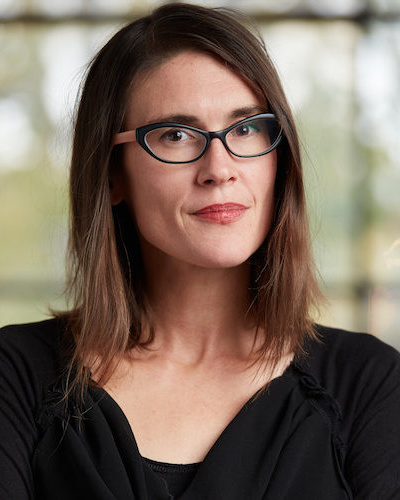
Isabel MacDonald: “Journalists should use standards that would ensure that the public is getting information rather than hate.”
IMacD: I think, first off, it’s important to recognize that hateful statements about any group are appalling, and journalists should use standards that would ensure that the public is getting information rather than hate. But I think that there is something very interesting that goes on in media discussions of Muslims that we see on these same talk radio programs, where there’s often quite a lot of hate percolating, it has to be said.
One thing that really jumped out at me doing research for this report was the similarity between the kind of narrative that these media figures are constructing around Muslims and the narratives that have historically been used to demonize Jews, which are widely recognized in the media—not by all of these talk radio pundits, but by most mainstream media figures—as being abominable and unacceptable.
Specifically, when you hear somebody like Michael Savage talking about how “we know you want to take over America,” referring to Muslims. Or when you hear Debbie Schlussel, who broadcasts on a CBS radio station in Detroit, and has also been published by the Wall Street Journal, talking about how “they are here on our shores, pretending to be loyal Americans, and they’re plotting to take over our country.” There’s something that is distinctive about this kind of hate speech that I think needs to be recognized as really profoundly dangerous.
SR: We do know also after the attacks in September 2001, there was a huge spike in hate crimes targeting Muslims in the US, according to the FBI. The number rose to about 800% of what it had been in 2000. It’s tapered off some since then, but every year it’s still about four times as high as it was in the year 2000. So what we’re looking at is a continuing problem with actual violence against Muslims, which can’t help but be exacerbated by the presence of these Islamophobes in the national media.
JJ: We’ve been speaking with Isabel MacDonald—she’s FAIR’s communications director—and with CounterSpin’s Steve Rendall. They’re two of the co-authors of Smearcasting: How Islamophobes Spread Fear, Bigotry and Misinformation. You can read the entire report at FAIR’s website. Isabel MacDonald and Steve, thanks for joining me today on CounterSpin.
IMacD: Thanks a lot, Janine.
SR: Thanks, Janine.
From FAIR via This RSS Feed.