

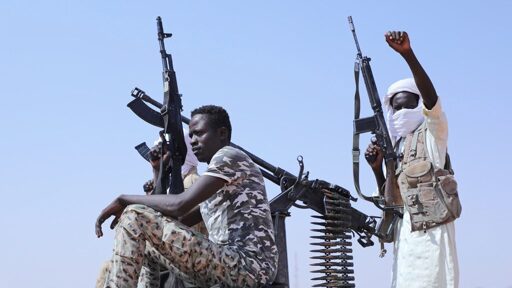

At least 5,355 people from more than a thousand families have been displaced from the Geisan locality in war-torn Sudan’s Blue Nile state between August 12 and 15, the International Organization for Migration (IOM) said on Monday. Most of them have arrived in the state’s capital, Damazin.
Lacking food, medicine, and shelter, their condition (especially of the women, children, and elderly) is already dire, and could worsen with heavy rains, the medical group, Sudan Doctors Network, warned on Tuesday, August 18.
They are fleeing Sudan’s paramilitary, the Rapid Support Forces (RSF), at war with the army, the Sudanese Armed Forces (SAF), since April 2023.
Earlier on August 11, the RSF, in coalition with a faction of the Sudan People’s Liberation Movement–North (SPLM-N), led by Abdel Aziz al-Hilu, launched an attack on this border locality from Ethiopia, whose support for the RSF on behalf of the UAE is widely documented.
The SAF was at the time in control of the neighboring town of Kurmuk, and the main road north to Damazin, with positions along the route. Pointing out that an attack on Geisan from within Sudanese territory would have required the RSF to break through the SAF-controlled Kurmuk-Damazin axis, which had not happened, the Sudan War Monitor reasoned that the attack came from Ethiopian territory – only a few kilometers south of Geisan. Other reports also referred to RSF’s attack on Geisan as a “cross-border offensive.”
The takeover of Geisan “is only one stage and a new launching point on the path toward complete victory,” the RSF-led coalition said in a statement.
Later, on August 12, after three days of drone strikes and artillery bombardment, the RSF advanced into Geisan’s neighboring town, Kurmuk, while the SAF retreated and repositioned their troops around it.
Control over Kurmuk secures the RSF a cross-border supply route, crucial to enable its advance into this southeastern region of Sudan where it historically had no significant presence.
However, it has advanced here by allying with the SPLM-N, which has a regional history of fighting the Sudanese state.
Also crucial is the support from neighboring Ethiopia, which is not only allowing the RSF troops to use its territory to launch attacks into Sudan, but also facilitating the transfer of equipment provided by the UAE across its territory to the RSF.
Using these advantages as leverage, the RSF made its first breakthrough in this region in March by capturing Kurmuk and several nearby localities. The SAF retook Kurmuk in July. A month later, on August 9, the commissioner of Kurmuk announced the discovery of a mass grave in the town with 25 bodies, including women, children, and the staff from a nearby hospital. Only three days later, the RSF was back in town again.
From Darfur in the west to Blue Nile in the east
The notorious force, created by coalescing the Janjaweed militias – which, during the Darfur civil war in the 2000s, committed massacres, mass rapes, burning of villages and other atrocities in coordination with the SAF – was created in 2013, a decade before they turned on each other.
After the December Revolution forced the overthrow of dictator Omar Al Bashir in 2019, the SAF and the RSF seized power, unleashing together a violent crackdown on the mass pro-democracy protests. The protests nevertheless continued until April 2023, when the two forces in the military junta turned on each other and hurled the country into a civil war.
By the end of last year, the RSF had expelled the SAF from most of the vast region of Darfur, except some small towns on the remote frontiers of Sudan’s western border with Chad. In October 2025, it overran North Darfur state’s capital, El Fasher, which was SAF’s last major holdout in the region.
It then went on to depopulate the city, killing what is estimated to be tens of thousands, in a campaign which had all the “hallmarks of genocide,” according to a UN investigation.
Read more: RSF has burnt and buried tens of thousands of corpses in El Fasher, says Yale report
It has since been pushing eastward, shifting the war’s center of gravity to the Kordofan region, especially along the road from El Fasher to Khartoum, with North Kordofan state’s capital El Obeid emerging as a major flash-point on this axis.
Read more: As attacks intensify in Kordofan, fighting once again threatens Sudan’s capital
Another major front advancing over the last months in the Blue Nile state on Sudan’s southeastern border is a reminder that the war, now in its fourth year, is far from over, and at an ever greater risk of spilling into Ethiopia (itself on the verge of returning to war in Tigray).
The death count has been lost after crossing 150,000 as early as 2024. It has displaced nearly 13 million, and hurled over 40% of the population into “high levels of acute food insecurity” – unleashing the world’s worst humanitarian crisis in the country.
Read more: The war in Sudan is “between two wings of a comprador parasitic capitalist class”
From BT News via This RSS Feed.