

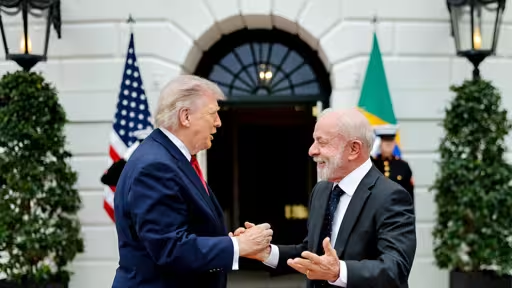

Brazilian President Luiz Inácio Lula da Silva and his U.S. counterpart Donald Trump agreed this Friday to continue negotiations over the 37.5 percent tariffs imposed recently on Brazilian products.
The telephone conversation between both Presidents, which lasted one hour and twenty minutes, took place in a “cordial” tone and also addressed the fight against organized crime, bilateral cooperation and global conflicts, according to a version released by the Presidency of Brazil.
During the exchange, Lula questioned the arguments used by the Office of the U.S. Trade Representative to apply the levies. The Brazilian head of State maintained that those justifications are “unfounded” and defended the continuity of dialogue between both governments.
RELATED: Lula Promises A Fourth Term Based on Security and Social Programs
Lula affirmed that remaining at the negotiating table is the best option for Brazil and the United States, noting that both countries can be affected by trade restrictions. “After observing that tariffs negatively affect both Brazil and the United States… remaining at the negotiating table is the best option for both countries,” he stated.
The Government of Brazil specified that the U.S. investigations mentioned issues such as deforestation, preferential agreements, intellectual property, anti-corruption efforts, the Pix payment system, ethanol and imports of products made with forced labor. The tariffs announced in July derived from probes into alleged anticompetitive practices and Brazilian imports of goods made with slave labor, allegations that Brazil has rejected.
Telefonei, nesta manhã (21), para o Presidente dos Estados Unidos, Donald Trump. Conversamos por uma hora e vinte minutos sobre temas do relacionamento bilateral e da agenda global.
Sobre a recente imposição de novas tarifas ao Brasil em decorrência das investigações conduzidas…
— Lula (@LulaOficial) August 21, 2026
Trump, for his part, agreed on the importance of “preserving strong commercial ties” between the two largest economies of the continent. He also proposed that teams from both countries meet “as soon as possible” to advance conversations on the commercial relationship and tariff measures. Both Presidents held a previous meeting in early May, when they brought positions closer after months of ideological tensions.
Security and Cooperation
The Presidents also discussed the fight against organized crime. Lula reaffirmed the “interest” of his Administration in cooperating with the United States, although he noted that Brazil possesses its own instruments to confront criminal organizations.
The Brazilian head of State maintained that the country can combat the factions “without need” for them to be classified as terrorists. Trump’s government recently granted that designation to Comando Vermelho (CV) and Primeiro Comando da Capital (PCC), considered the two main criminal gangs of the South American nation.
Lula mentioned among Brazilian measures the strategy of financial asphyxiation of criminal organizations and the plans to create new maximum security prisons. Trump expressed willingness to strengthen bilateral cooperation on this matter and announced that he would appoint “high-level officials” to follow up on the issue.
In international matters, Lula and Trump agreed on the “urgency” of reaching a “negotiated solution” to the conflict between Russia and Ukraine, after almost five years of hostilities. The conversation consolidated a pragmatic approach between the two leaders, who in May had already narrowed their differences during their meeting in Malaysia.
Brazil thus maintains its diplomatic autonomy while seeking to protect its commercial interests before the new U.S. tariff scenario.
From teleSUR English via This RSS Feed.