

Janine Jackson interviewed Free Press’s Jessica Gonzalez about the Paramount*/Warner attempted merger for the August 14, 2026, episode of CounterSpin. This is a lightly edited transcript.*
https://media.blubrry.com/counterspin/content.blubrry.com/counterspin/CounterSpin260814Gonzalez.mp3
Wall Street Journal (10/13/25)
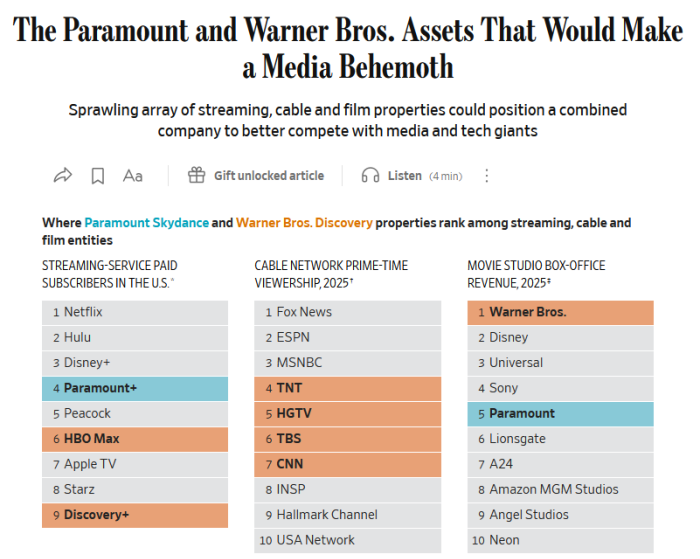
Janine Jackson: In June, Trump’s Justice Department gave an unsurprising thumbs up to Paramount Skydance’s $111 billion takeover of Warner Bros. Discovery. Nothing antitrust to see here, they said, about a deal that would join HBO, CNN and other Warner companies with CBS, Nickelodeon and MTV, creating a vast film, cable and streaming empire.
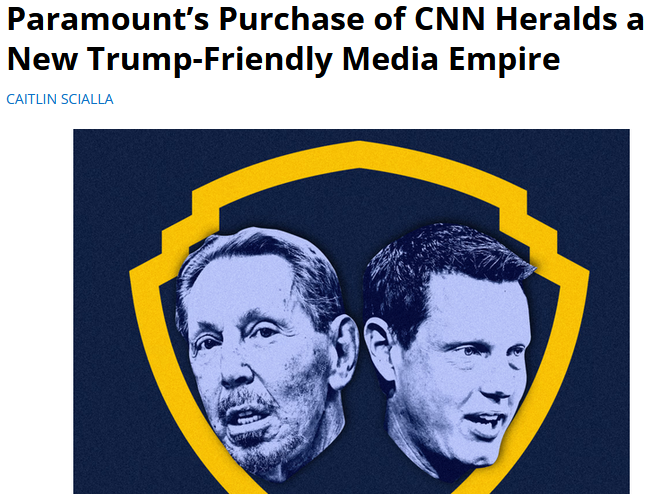
A number of attorneys general, including California’s Rob Bonta, continue to oppose the deal. And the latest seems to be an offer from Paramount owner David Ellison to maybe sell off CNN or create an editorial board to, in the Wall Street Journal’s words, “ease concerns over its news operations independence.” Those concerns stemming, in good part, from the fact that Ellison’s dad, Larry, is a Trump bestie, and founder of cloud company Oracle—which, in a side note, is busy planning a new round of job cuts, says Business Insider, as their way of addressing billions in debt they’ve accrued from funding AI infrastructure.
Washington Post (8/10/26)
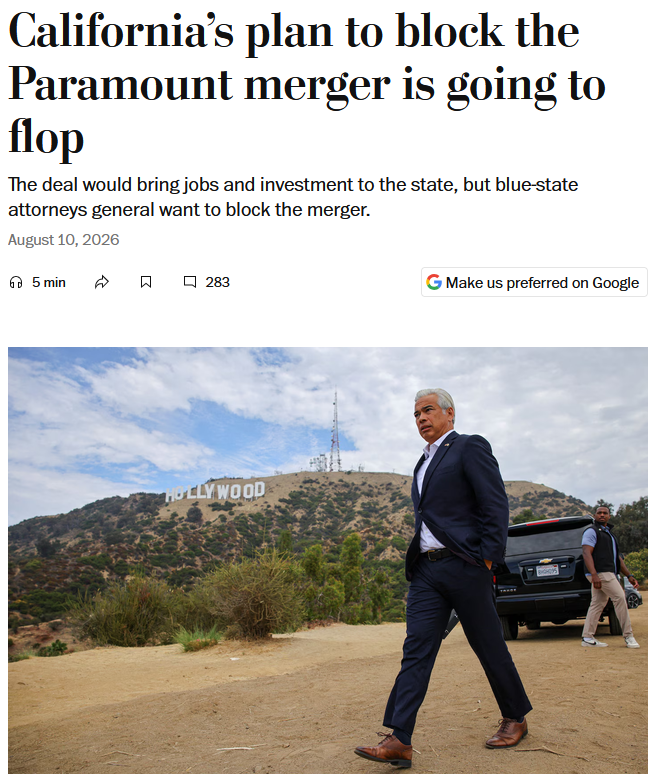
The Washington Post published an op-ed by the evidently very invested AG of Alabama, Steve Marshall, who says the anti-merger effort
plays well with activists and Hollywood elite who oppose corporate consolidation on principle, no matter what it costs the working people who actually build movie sets, run cameras and staff productions.
The DoJ, Marshall says, concluded that the merger would “increase competition across the media and entertainment ecosystem, with benefits for American consumers and workers.” “Only in California,” he says, “do a handful of loud celebrities get to stall the merger at the expense of the far less visible production crew members.”
Our guest is not a loud celebrity, whatever that means. She’s Jessica Gonzalez, co-CEO at the public advocacy group Free Press. She joins us now by phone from Los Angeles. Welcome back to CounterSpin, Jessica Gonzalez.
Jessica Gonzalez: Thanks for having me, Janine.
JJ: I want you to go into details on the current state of play, but first of all, I just feel like it used to be, like maybe a minute ago, that we just understood that more power in fewer hands is a bad thing; it’s to be avoided. Now it feels like we’re reduced to picking which gigantic conglomerate we’d prefer to control the majority of, in this case, film, cable, streaming, news and entertainment. We’re fighting for the same principles, but it sort of feels like the terrain has shifted under our feet, and not for the better. Or is that just me?
JG: I think that’s right. Look, what we’re seeing right now is a massive attempt, through this merger, but through a number of other media and tech mergers as well, to consolidate power over our information ecosystem, to consolidate power in the hands of very few people who want to control what we see and what we understand about the world around us.
So you mentioned that Larry Ellison is very good friends with Donald Trump, and we’ve already seen the results of the first Ellison merger that happened under this regime. David Ellison, who was the lead at Skydance, bought Paramount last year. It brought CBS under his control. And we saw, time and again, that he is willing to use his perch to censor content that the president doesn’t agree with, to shield the public from important news and information that Paramount-owned journalism outlets were producing. And so we see the danger to our democracy when too few people control what we hear.
I take issue with what the gentleman from Alabama said. It’s not just the California AG who’s taken issue with this merger: It’s Arizona, Colorado, Connecticut, Massachusetts, Minnesota, Nevada, New Jersey, New Mexico, New York, Oregon, Washington.
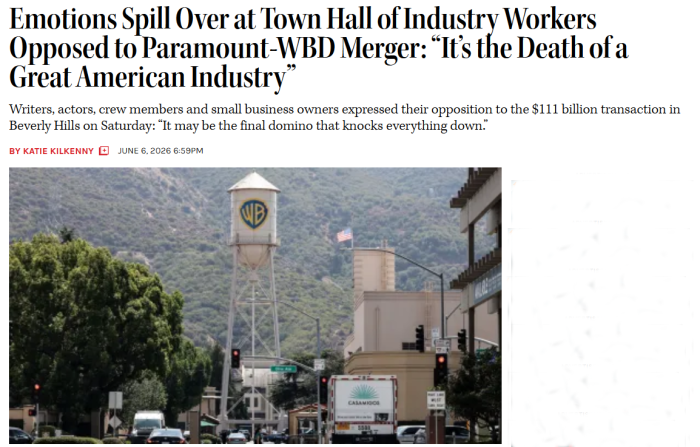
Hollywood Reporter (6/6/26)
And it’s not just the Hollywood elite. There was a letter that was circulated by the #BlockTheMerger coalition that Free Press is a part of, that was signed by over 5,600 creatives.
And those weren’t just A-list celebrities and wealthy people. That included gaffers, writers. That included Teamsters. I grew up in a Teamster household, and my dad drove a truck for a living, and the Teamsters are very concerned about the impact of this merger on working people.
My colleague, Alvaro Bedoya, he used to be an FTC commissioner, went on the road and did three town halls. One was here in Los Angeles. There was another one in New York, another one in Atlanta. And here in LA, we heard from people who’ve been out of work, who are struggling to make ends meet and who no longer have medical care because they have not been able to work on production, because of the squeeze the consolidation has already put on the industry.
So I find it extremely offensive when, especially, people who have no idea how my town operates and how the business operates suggest that this doesn’t have an impact on working people. These people are my neighbors, the hairdressers who work on set, the makeup artists, the people who help with props. These are not wealthy elites. These are people who are seeing their job options dry up, and are seeing the impact of these mergers, not just on our democracy, but on their ability to earn a living. So I think there’s a few folks out in the world who want to control the narrative, and Paramount certainly wants to control the narrative about what this merger is about, because they’re losing.
The court issued a temporary restraining order blocking the merger from going through; that’s the district court here in California. The judge in that case didn’t really need to go into the specifics in that temporary restraining order, but she did. And she essentially indicated that she sees that the attorneys general would likely prevail on the merits. That’s the way I read her order. I believe that’s the way that Paramount read her order as well, because they immediately pivoted their strategy in trying to put pressure on the AGs to make concessions, or to not carry forth with the lawsuit.
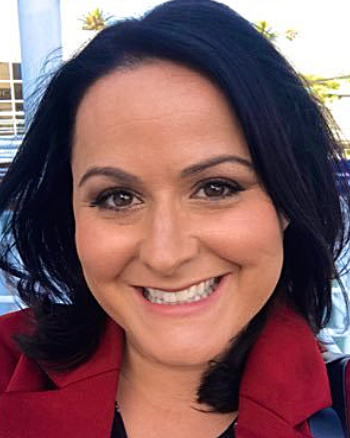
Jessica Gonzalez: “It’s about antitrust, and how much power, how many media outlets, can one person or one entity control?”
I think they’re in trouble, frankly. They’re trying to make it look powerful. They’ve bought a lot of public faces off. They’ve bought a lot of our elected officials off, to support the merger and to repeat their talking points.
But the reality is that Rob Bonta and Leticia James and their coalition of state attorneys general have a really solid case that isn’t really about CNN. It isn’t really about democracy. It’s about antitrust, and how much power, how many media outlets, can one person or one entity control? And they have some really solid arguments. I think that’s the way the judge saw it. And that’s why she issued the TRO and extended additional commentary on the likelihood of success.
And I think Paramount agreeing, a couple weeks ago, to not merge until the end of the court proceeding, or until June of 2027, indicates that they were really nervous. They didn’t want the judge to get into the merits of the case, because when a judge issues a more permanent injunction, which is what would’ve been the next step in the case, it looks really bad when you lose preliminary injunction. Because to secure a preliminary injunction, the AGs would’ve needed to show a likelihood that they would’ve won the case if it goes to trial, but also that there is real and immediate harm that would happen.
My read is that the Paramount lawyers said, “Yikes, we’re in bad shape. We need to regroup.” They’ve regrouped. And now what they’re doing is working to put pressure on AG Banta, other AGs, but also people who they see having sway over those AGs, to make a deal with Paramount.
JJ: I think it’s interesting how bold the claims of this AG from Alabama are. You could almost go through it and put “not” next to everything. In other words, he didn’t say this won’t harm workers. He said, “This is the way to protect workers.” He said very much, “Everything you’re concerned about, this merger’s going to do the opposite of that,” which seems like a wild overreach, but sort of says, as you’re suggesting, that they’re just going to try to throw it all at the wall because they’re fidgety.
JG: Listen, if Paramount believed they were right on the facts, they might not be pushing so hard to cut deals and make concessions to the AGs. So the Alabama AG can say whatever he likes, but at the end of the day, the court’s job, and the AGs who are suing here’s job, is to argue this case on the merits and on the facts. And the facts have Paramount nervous.
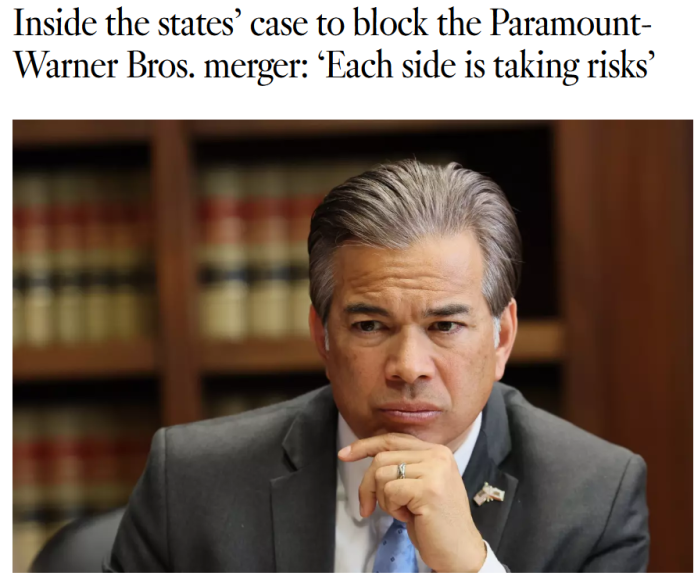
LA Times (7/15/26)
JJ: Let’s talk through the particular concerns, and you’ve certainly indicated them; these AGs have concerns, but you at Free Press also have concerns, as public advocates, about this deal that are not just about antitrust in general, which is obviously concerning enough, but about antitrust when it comes to information. What are the concerns that you’re trying to uplift for people about this potential merger?
JG: Sure. I’ll start with the ones that are in the four corners of the antitrust case, and then I’ll move on to the broader concerns that are not represented in the case. The AGs, I think, have made a good case that combining Warner Brothers and Paramount Studios would combine to account for 27% of the wide-release theatrical film distribution in the United States. This would mean that only three distributors control 75% of these films, and only four distributors would control 86% of them. So that’s massive consolidation.
They also go into great detail about licensing of basic cable television channels. Warner Brothers is the second-largest and Paramount is the third-largest in this market. And, combined, they would control 27% of the market. This gives them an unfair, anti-competitive bargaining advantage.
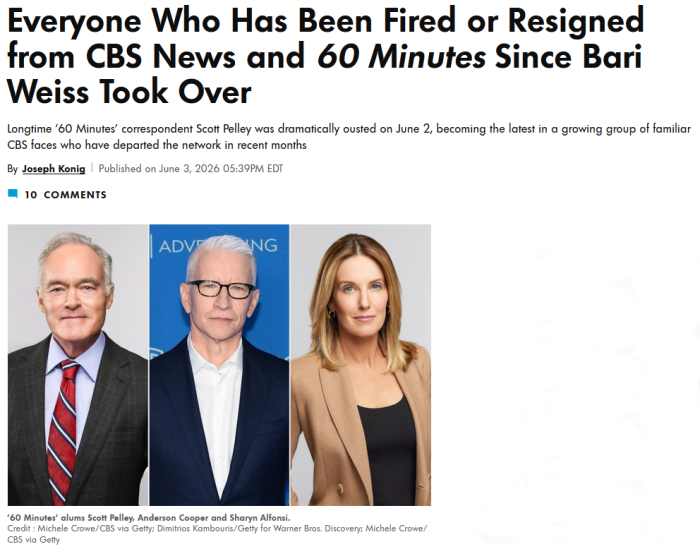
People (6/3/26)
But what’s in the four corners of the antitrust case really only scratches the surface of the harms that we are worried about if these two entities merge. I spoke earlier about the concern about what’s already been happening at CBS News. We’ve seen massive resignations of high-profile journalists. We’ve seen 60 Minutes essentially fall apart. And many of the folks who used to work there, who resigned under pressure to essentially censor content that the administration wouldn’t agree with, have said, “We lost editorial control over the newsroom. We don’t feel that we can still do quality journalism from this perch.” So we’re concerned, obviously, about something similar happening at CNN.
Some of our allies in this fight have also brought up that both Paramount and Warner Brothers own massive archives. And so there’s a concern about who controls the history of content, and whether we’re going to have access to all this important archival content that these two companies currently own. What will be the impact on creativity and free expression?
Reuters (3/2/26)
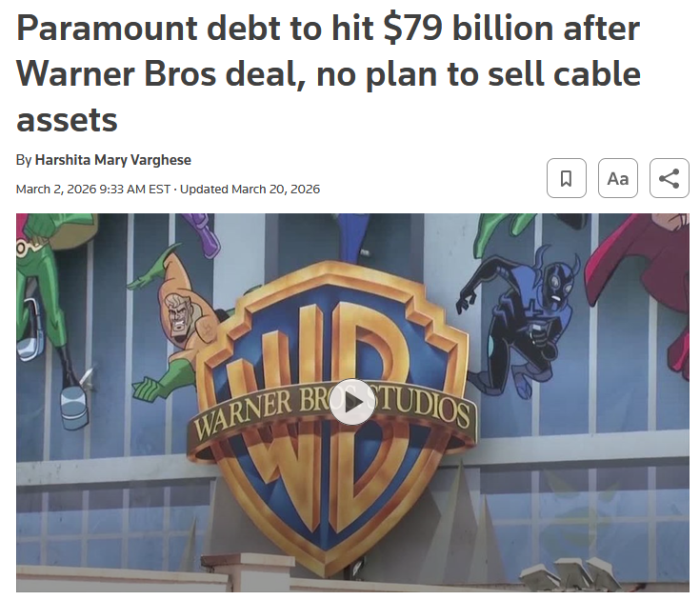
And what will be the impact on jobs and affordability? We know in past media mergers that layoffs always come; jobs will be lost. This merger, in particular, will reduce opportunity for storytelling. The company’s promise that they’ll release 30 films a year—that is in no way financially feasible based on the amount of debt load that they’re taking on, and the amount of cost savings they’re promising. That math doesn’t math, as the kids say.
But, in addition, we know that there will be rising costs as a result of the merger, that don’t just hit people and workers in this industry, that hit all of us. All of us who subscribe to basic cable, who watch streaming and networks, who go to the movies and so forth.
So the harms are quite prolific. And that’s why you’re seeing a lot of people who don’t typically say much about media mergers getting involved here, because there’s a lot of different interests, a lot of different types of people who are going to feel the impact of this merger.
JJ: We’ve been speaking with Jessica Gonzalez, co-CEO at the public advocacy group Free Press. You can find their work on this merger and many other things online at FreePress.net. Jessica Gonzalez, thank you so much for joining us this week on CounterSpin.
JG: Thanks for having me, Janine.
From FAIR via This RSS Feed.