

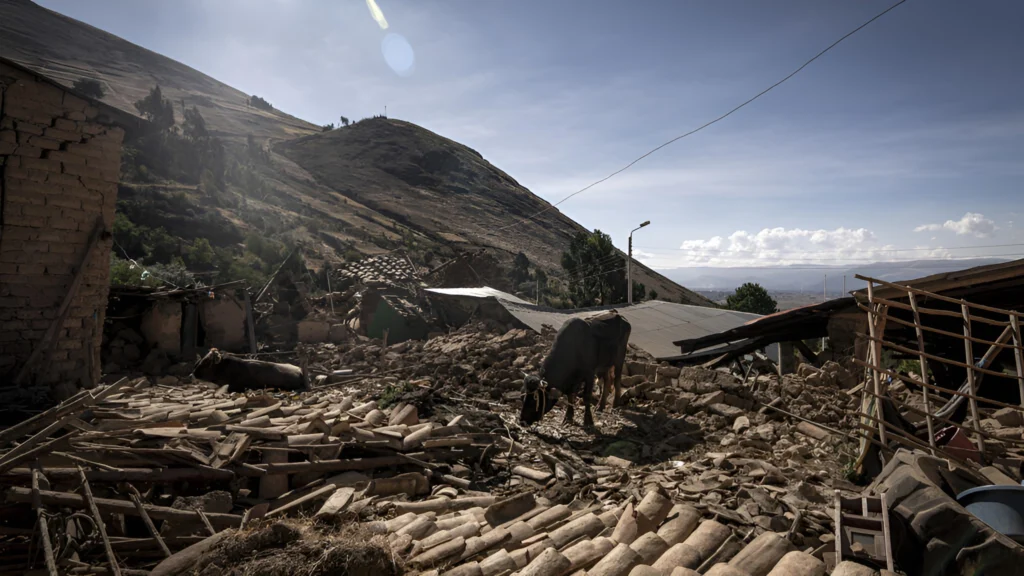
Scaled-back civil protection budgets leave Andean towns exposed to Peru’s next natural disaster.
The southern Andean region of Peru experienced a major earthquake on August 20, 2026. The seismic event affected communities in the departments of Ayacucho, Arequipa, and Ica.
RELATED:
Powerful 7.2 Earthquake Shakes Peru and Activates Emergency Monitoring
Peru is geographically located on the Pacific Ring of Fire, a major tectonic boundary where the Nazca Plate subducts beneath the South American Plate. This geological position makes the territory highly susceptible to frequent earthquakes and tsunami risks along the coast.
In addition to seismic activity, Peru faces regular hydrometeorological hazards caused by the El Niño-Southern Oscillation (ENSO) cycle. These climate phenomena bring heavy rainfall, flash floods, and debris flows, locally known as huaicos (mudslides), which affect both coastal cities and rural Andean valleys.
Decades of unmanaged urban growth, variable compliance with building codes, and administrative centralism have shaped how communities experience and recover from natural events.
Examining disaster management in Peru requires looking at both the natural triggers and the long-term governance structures responsible for public infrastructure and civil defense.
The August 2026 Ayacucho Earthquake
An earthquake occurred on August 20, 2026, with a magnitude of 7.2 and an epicenter located in the southern province of Parinacochas, near Coracora in the Ayacucho region. Monitoring agencies registered the event at a depth between 80 and 100 kilometers.
Due to its intermediate depth, the seismic waves were felt across a broad area, including parts of the neighboring departments of Arequipa, Ica, Apurímac, and Cusco, as well as high-rise buildings in the national capital, Lima.
Initial assessments coordinated by the National Institute of Civil Defense (INDECI) and regional authorities indicated structural damage concentrated in rural districts and small urban centers.
Local reports transmitted by news outlets documented damage to unreinforced masonry structures and traditional adobe houses. According to preliminary reports, 50 homes, 6 schools, and 4 health centers have been affected in rural districts.
Key regional transportation routes, including mountain passes connected to the Interoceanic Highway, were temporarily blocked by rockfalls and landslides triggered by the ground shaking.
In many communities, residential structures are built with traditional, unbaked mud bricks or low-cost masonry lacking reinforced concrete pillars. While adobe provides thermal insulation suitable for high-altitude climates, it possesses low tensile strength and breaks easily during horizontal seismic movement.
PERU | M7.2 EARTHQUAKE STRIKES AYACUCHO
A powerful magnitude 7.2 earthquake struck Peru’s southern Ayacucho region on August 20, 2026 at around 1:00 PM local time.
According to Peru’s Geophysical Institute (IGP) the epicentre was located 35 km north of Coracora in… pic.twitter.com/fm7etp6CIm
— contentkikamii (@contentkikamii) August 21, 2026
A 15-Year Timeline of Recurrent Disasters (2011–2026)
Over the past fifteen years, Peru has faced a sequence of recurring natural events that have tested the capacity of its national infrastructure and emergency management institutions.
In early 2017, Peru experienced an anomalous coastal warming event known as the Coastal El Niño. This localized phenomenon caused intense rainfall along the northern coast and inside the Lima basin, leading to widespread flooding and severe mudslides.
The 2017 disaster affected over one million people, destroyed tens of thousands of homes, and damaged critical transport networks, including bridges and main arterial highways across Piura, La Libertad, and Lambayeque.
In response to the 2017 crisis, the Peruvian government created the Authority for Reconstruction with Changes (ARCC) to manage a multi-billion-sol budget to rebuild public infrastructure and install comprehensive flood prevention systems.
However, investigative reporting by outlets tracked long-standing delays, administrative bottlenecks, and contract cancellations within the ARCC framework.
By the time extreme weather returned to Peru in early 2023 with Cyclone Yaku, an unusual tropical low-pressure system, many planned river containment works and urban drainage networks remained incomplete.
Cyclone Yaku destroyed northern Peru and parts of Lima, resulting in 72 casualties, displacing over 40,000 individuals, and damaging 859 health centers and 450 schools.
Beyond climate-driven rainfall and flooding, Peru has experienced several major seismic events over the same fifteen-year period.
In May 2019, a magnitude 8.0 earthquake struck the Loreto region in the northern Peruvian Amazon, affecting rural communities across multiple departments and causing localized ground collapse and structural damage.
In November 2021, another powerful magnitude 7.5 earthquake occurred in the Amazonas region, destroying roads, damaging historical infrastructure, and displacing thousands of residents.
Each of these events followed a similar post-disaster cycle: temporary emergency shelter distribution followed by slow long-term structural reconstruction, leaving communities vulnerable to subsequent hazards.
Centralism, Reactive Politics, and Fiscal Constraints
The structural frameworks governing disaster management in Peru are defined by Law 29664, which established the National System for Disaster Risk Management (SINAGERD).
Within this system, INDECI handles immediate disaster preparedness and emergency response. At the same time, the National Center for the Estimation, Prevention, and Reduction of Disaster Risk (CENEPRED) oversees technical planning and risk reduction strategies.
Despite this formal dual structure, official response efforts consistently prioritize post-event emergency relief over long-term hazard mitigation and urban risk prevention.
When the August 2026 earthquake struck Ayacucho, the national executive branch responded using standard crisis protocols. High-level ministerial delegations were dispatched to inspect damaged zones, and localized states of emergency were declared to allow executive agencies to bypass standard procurement procedures for immediate aid delivery.
Media coverage documented the mobilization of military transport planes carrying humanitarian supplies, medical personnel, and temporary shelter kits to affected districts in Parinacochas.
While initial emergency deployments provide immediate relief, long-term administrative challenges persist at the regional and municipal levels. Public financial reporting chronic under-execution of Budget Program 0068 (PREVAED), the dedicated national fund for disaster prevention and emergency reduction.
Municipal governments in Peru often lack the specialized technical teams required to design, clear, and execute complex engineering projects aimed at river stabilization, hillside containment, or seismic retrofitting.
Combined with administrative centralism, where capital allocation decisions remain concentrated in national ministries in Lima, regional authorities frequently return unspent prevention funds at the end of each fiscal year, leaving structural hazards unaddressed prior to the next natural event.
At least 50 killed and dozens missing in Cyclone Yaku in #Peru. pic.twitter.com/Z7nTGEHWFa
— C14 News | EN (@c14english) March 19, 2023
Urban Informality, Economic Priorities, and Structural Vulnerability
The human and economic toll of natural disasters in Peru is closely linked to patterns of urban expansion and spatial inequality. According to reports from the Peruvian Chamber of Construction (CAPECO), approximately 70% to 80% of housing units nationwide are constructed informally through self-building processes without engineering oversight, architectural blueprints, or municipal permits.
Rapid internal migration over recent decades drove rapid urban growth into geologically unstable locations, including steep hillsides, dry riverbeds, and uncompacted riverbanks.
In urban centers along the coast and throughout the Andes, informal land distribution networks and limited access to formal credit markets leave low-income households with few options outside of purchasing unserviced plots in high-risk zones.
At the same time, national public investment priorities show a persistent gap between major economic infrastructure and local civic safety nets. While substantial capital flows into major export projects, mining corridors, and agricultural transport routes, essential municipal infrastructure in rural regions remains underdeveloped.
In communities affected by the August 2026 earthquake in Ayacucho, basic public services such as paved secondary roads, modern health facilities, and resilient municipal water networks were already under-resourced before the seismic event.
This structural disparity means that when a natural event occurs, remote and working-class populations bear a disproportionate burden of physical displacement, connectivity loss, and economic dislocation.
Disaster Resilience and Structural Requirements
The impact of the August 2026 earthquake in Ayacucho, alongside the recurring floods and seismic events of the past fifteen years, illustrates that natural hazards in Peru become disasters primarily through structural vulnerabilities.
While physical geography determines the location and frequency of earthquakes, landslides, and torrential rains, the resulting extent of damage is determined by public infrastructure quality, urban planning standards, and institutional execution capacity.
Emergency distributions of humanitarian supplies and temporary shelter kits continue to address immediate survival needs following major events, but they do not alter the underlying exposure of vulnerable communities.
Without long-term structural changes in housing policy, territorial planning, and public budget execution, future seismic and climate events will continue to pose severe risks to vulnerable populations throughout the country.
Sources: Tv Perú – Radio Nacional del Perú – Agencia Peruana de Noticias – RPP – El Comercio – La República – Latina Noticias – IDL-Reporteros – La Encerrona – El Foco – Dilo Fuerte – Prensa Alternativa – TeleSur
From teleSUR English via This RSS Feed.