

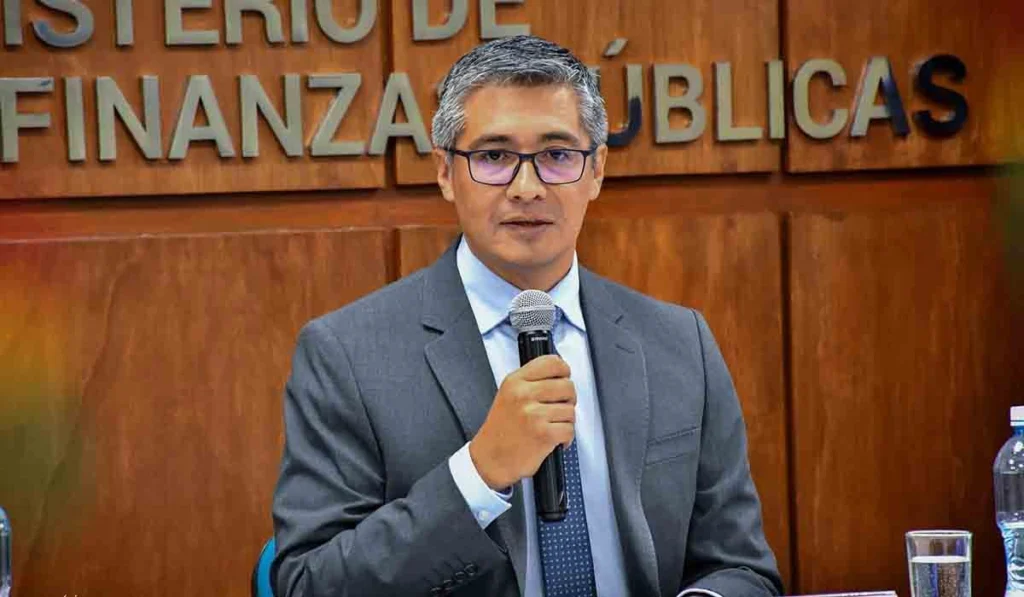
Bolivian President Rodrigo Paz dismissed Economy and Public Finance Minister José Gabriel Espinoza on Friday after he was censured by the legislature on Tuesday for failing to attend a hearing regarding the government’s policies to address the country’s economic crisis.
RELATED:
Bolivian President Paz Slashes Two Ministries, Appoints New OAS ambassador
The dismissal was carried out through a decree published in Bolivia’s Official Gazette, which appointed Oscar Mario Justiniano, the Minister of Sustainable Production, Environment, and Water, as interim Economy Minister.
Espinoza was censured last Tuesday by Congress after failing to appear for a summons to explain the government’s policies regarding the national economic crisis, which would imply his dismissal, according to the Bolivian Constitution in force since 2009.
The minister requested a rescheduling of the interpellation, arguing that he had planned trips to the eastern department of Santa Cruz and to Brazil to attend to official matters, but his request was rejected by 91 of the 129 parliamentarians present at the session, who voted in favor of censuring him.
Law 1350, which regulates the effects of censure, establishes that, once resolved and formally communicated to the president, the president must dismiss the censured minister within a maximum period of twenty-four hours.
#Política | Diputado Pino insta a Paz a cambiar al ministro de Economía
El diputado de Alianza Libre, Antonio Pino, pidió al presidente Rodrigo Paz cambiar al ministro de Economía como una señal de voluntad para corregir el rumbo económico del país.
Pino afirmó que la… pic.twitter.com/Ifukwkk6Ln
— EL POPULAR BOLIVIA (@popularbolivia) August 20, 2026
The text reads, “Congressman Pino Urges Paz to Replace Economy Minister. Congressman Antonio Pino of the Free Alliance party urged President Rodrigo Paz to replace the Economy Minister as a sign of willingness to correct the country’s economic course. Pino stated that the current minister’s continued tenure sends the wrong message amidst the crisis and maintained that a change would help restore public confidence.”
On Tuesday, the government maintained that the censure resolution issued by the legislature is unconstitutional, interpreting the Constitution as requiring a two-thirds majority of the members of the Assembly and not just the parliamentarians who attended the session. Using the same argument, Espinoza announced a consultation with the Constitutional Court regarding the legality of his censure.
The decree signed by Paz confirms that a constitutional protection action was filed and that the Third Constitutional Chamber of the city of El Alto scheduled a hearing for August 24 to address the matter.
The decree explains that, nevertheless, the background information does not specify the existence of any precautionary measure, determination, or express provision that suspends the effects of the aforementioned resolution.
For these reasons, upon the expiration of the term established in Law 1350, the decree states that it is appropriate to order the dismissal of the censured Minister of Economy and Public Finance, without prejudice to any determinations made by the Constitutional Chamber, and also to guarantee the continuity of the functioning of that State ministry.
#FromTheSouth News Bits | In Bolivia, the government led by President Rodrigo Paz has officially reduced the cabinet, cutting the central administration from 14 to 12 ministries. pic.twitter.com/PM89EkVhHY
— teleSUR English (@telesurenglish) August 19, 2026
From teleSUR English via This RSS Feed.