

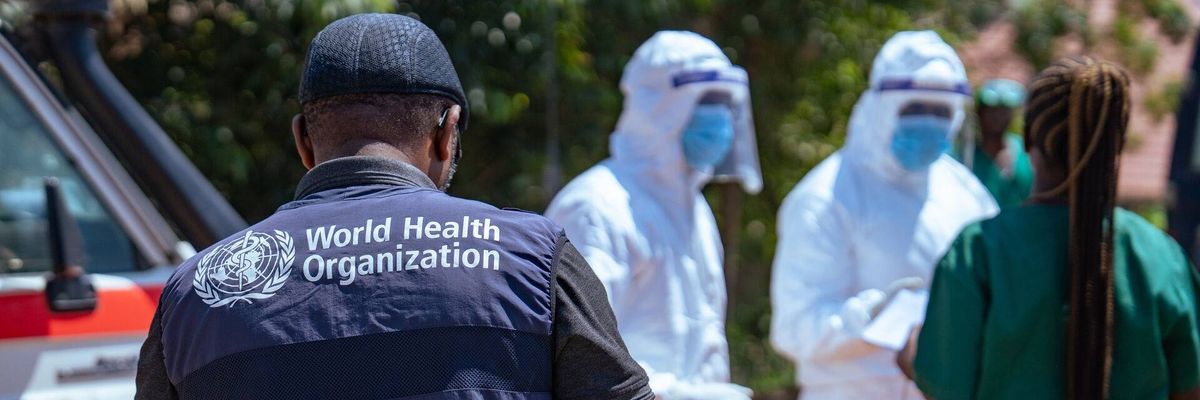
It’s been nearly 100 days since authorities in the Democratic Republic of Congo declared the Ebola outbreak and, as a key United Nations humanitarian official said Friday, the disease has now killed over 2,500 people and continues to rapidly spread.
“The Ebola outbreak is growing exponentially,” said the UN’s senior Ebola coordinator, Julien Harneis. “In the last three months, 2,500 people have died, and half of those in the last 20 days.”
“The epidemic is spreading widely,” he continued. “It’s now covering an area that is bigger than France.”
Harneis acknowledged the outbreak’s toll on healthcare providers, with 160 having contracted Ebola—43 of whom have died. He said that “apart from the threat from the virus, healthcare workers and frontline workers have been attacked by youths, ambulances have been burned and stoned, and the healthcare facilities have been attacked.”
“Conditions on the ground are extremely difficult,” the official said, “but we will continue deploying all the humanitarian and medical assistance needed until the job is done.”
“We’re only covered for the next weeks, and very soon funding will run out,” he noted. “Every delay in funding and implementation makes this epidemic more deadly, more difficult to stop and more expensive. So, we need that international support immediately.”
As the outbreak has worsened, US President Donald Trump has faced renewed global criticism for withdrawing from the World Health Organization (WHO), dismantling the US Agency for International Development, and cutting public health funds.
Harneis nodded to those moves on Friday, according to UN News:
Although the United States has contributed $80 million to the DRC government to boost bed capacity and safe burial practices, among other support, cuts to aid work—especially in the last two years—have reduced the capacity of humanitarian organizations by more than 30%, he added.
Despite these challenges, multiple specialist UN agencies continue to work alongside the DRC authorities to push back Ebola. They include the World Health Organization, the World Food Program, the UN Children’s Fund (UNICEF), the UN migration agency (IOM) and partners including Médecins Sans Frontières.
“This epidemic continues to spread, moving faster than the response can keep up,” Dr. Javid Abdelmoneim, international president of Médecins Sans Frontières (MSF), also known as Doctors Without Borders, said in a Friday statement. “Treatment centers remain essential for saving lives, but this response needs more than extra beds.”
“It needs better detection, safe isolation for sick people and their contacts, and support to health workers,” Abdelmoneim said. “People seeking care in existing health facilities also need to be protected from infection. Crucially, the response must be built with communities, not around them.”
Trish Newport, the group’s emergency program manager in Ituri province, said that UN agencies, humanitarian organizations, and the Congolese Ministry of Health “must urgently expand” training and support so that workers and community leaders can “help detect cases early, refer people safely, reinforce infection prevention and control, and protect themselves and others from infection.”
WHO said Thursday that “Ituri province remains the epicenter, but ongoing transmission, spread to new areas, a high case fatality ratio (47%), and increasing infections among healthcare workers indicate that the outbreak remains severe and difficult to control.”
“Imported cases have been reported in Uganda, France, and Germany, demonstrating the potential for international spread, although no sustained transmission has occurred outside the DRC,” the agency continued. “The overall risk remains very high in the DRC, high for neighboring countries, particularly those sharing land borders with the DRC, and low at the regional and global levels, where preparedness and rapid detection measures are helping to prevent wider spread.”
While the DRC infections are being caused by the Bundibugyo virus, the government recently requested a release of Ervebo vaccines from the global stockpile, given that, as WHO explained Thursday, “early laboratory and animal data suggest it may provide some protection.”
The UN agency said that the International Coordinating Group on Vaccine Provision, which manages the stockpile, informed the DRC of an immediate initial release of 70,000 doses, including 50,000 for frontline and health workers, and 20,000 “for a Phase 3 clinical trial to understand the impact of the vaccine on the Bundibugyo virus.”
From Common Dreams via This RSS Feed.