

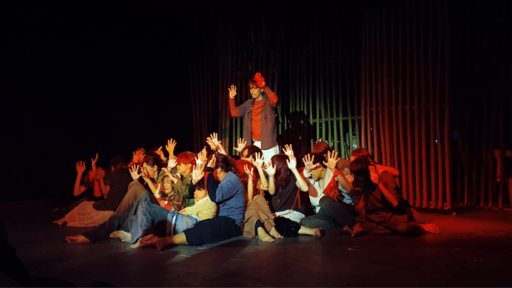
By exposing the hunger and systemic oppression endured by the peasant masses of Negros the play acts as a vital form of resistance against historical distortion and romanticized tourism.
MANILA — You finally arrive in Sugarlandia. Thrilled by the advertisements playing on loop across television screens in Bacolod Airport, you eagerly anticipate seeing ancestral houses, rolling hills, majestic cathedrals, and luxury resorts.
Carrying your luggage out into the open, your heart beams in excitement, “Negros, here I come!”
But reality quickly takes a turn. Behind the government’s polished tourism narratives lies an undeniable truth: the scent of blood and the heat of sunburned skin belonging to the Sakadas linger in the air. While airport screens attempt to sanitize a long history of feudalism, massacres, and peasant resistance, the true conditions eventually hit your senses.
This stark contrast lies at the heart of Sining na Naglilingkod sa Bayan’s (SINAGBAYAN) “Tiempo Muerto: Paghulat sang Dugwak” which ran from July 18-19. By exposing the hunger and systemic oppression endured by the peasant masses of Negros—the country’s sugar bowl and massacre capital—the play acts as a vital form of resistance against historical distortion and romanticized tourism.
A story of struggle for land and life
Before the stage lights turned on, a heavy silence settled over the theater. This silence was broken by the chirping of crickets, immediately transporting the audience to the Negros countryside during tiempo muerto (dead season) where farmworkers are left with no work, no income, and no choice but to wait. The silence gave way to the haunting melody of “Mahapdi sa Mata,” setting a somber, immersive tone for the rest of the play.
Behind the scenes, bringing the play to life was an act of solidarity in itself. Production Manager and Defend Negros Convenor Emman Acosta shared that the production, first staged in 2022, was revived as a tribute following the recent massacre in Negros. “The system expects the farmworkers to simply sit around and wait through four to six months without work, which is completely impossible,” Acosta said, explaining the meaning of the play’s title. “While farmworkers might seem like they are just waiting—much like the dugwak bird—they are not idling by. Resistance brews, driven by hunger, unemployment, and fascism.”
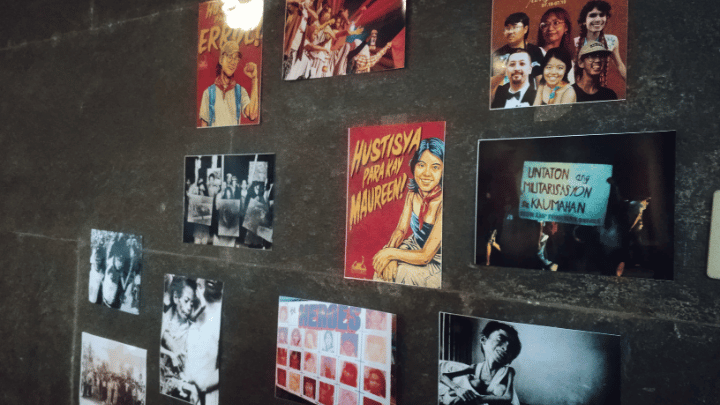
Photo by Jian Zharese Joies Sanz/Bulatlat
To tell this story, the production relied on raw, minimalist stagecraft. Taking inspiration and maximizing the simplicity of minimal props like bamboo poles and simple wooden box chairs, which are transformed by dynamic red lighting into prison bars, mansions, and barricades. The live band behind the stage successfully anchored every scene, amplifying the show’s emotional weight—giving out a raw, heartfelt touch to the performance.
Tiempo Muerto interweaved the lives of characters across numerous classes to prove that systemic injustice spares no one. Take example, Rhoger, who first seemed an apolitical tour guide simply trying to keep his job and who embodies how state-sponsored tourism glosses over local struggles—eventually stood up to defend the reality of Negros amid pressure in a quiz bee scene. While Ma Rosa, a middle-class curator, despite the usage of terminologies barely understandable to the masses, argues that art and museums exist not to cover up history but to preserve it. Meanwhile, sugarcane workers like Agripina and Ka Butch are forced into exhausting side hustles just to survive the dead season.
Sinagbayan’s John Paul Villa, who played Ka Butch, shared that putting the production together demanded sacrifice, with cast members sometimes sharing simple meals of bread during long rehearsals. Having long stood alongside peasant communities, connecting with his character came naturally. “Ka Butch is a farmer who ended up working as a janitor in a mansion just to survive the dead season,” Villa shared. “For newer cast members, it took discussions to help them understand the real weight of these roles.”
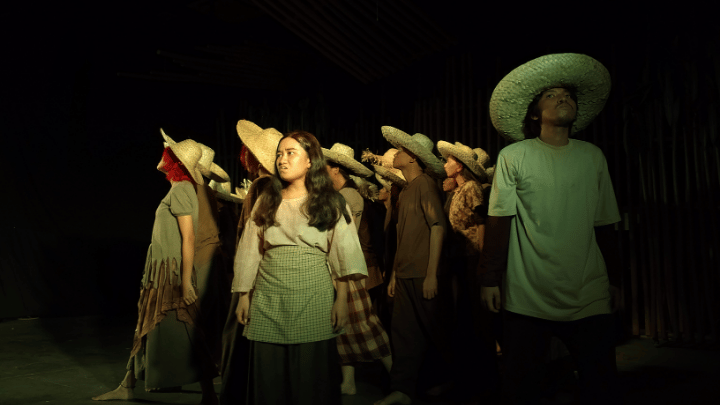
Photo by Jian Zharese Joies Sanz/Bulatlat
Other than stark tableaus and even satire surrounding popular festivals, Tiempo Muerto stripped away the decorative masks of Negros through depicting how militarization in the guise of counter-insurgency continuously breeds resistance. Moreover, it depicted how the state counters the masses’ demand for land and life with fascism, trumped-up charges, and at worst, massacres like the infamous Escalante massacre. It reminded audiences that behind the island’s grand mansions and colorful tourist displays lies a continuous, courageous fight for land, justice, and human dignity.
‘Tell the reality of Negros’
Sinagbayan’s Tiempo Muerto: Paghulat sang Dugwak achieved two powerful feats on stage: it unveiled the raw, unvarnished struggle of peasants in Negros and tied their hardship directly to a broader systemic crisis. Reiterating that Negros is a microcosm of a semi-feudal and semicolonial system. It strips away the state-sponsored sheen of grand festivals and sanitized tourism campaigns—tools long used to obscure state violence and oppression—to show how hunger has been the default condition in the countryside.
The production went beyond merely representing oppression—it broke through the bourgeois background of theatre plays, calling on the audience to propagate the story of Negros, as Emilia had said with urgency.
By delivering its message in the most excruciatingly vivid ways, Tiempo Muerto transformed theatre from a passive spectacle into a protest against the system’s ills. It directly invited the viewer to step out of the role of a bystander, stand with the toiling masses, and stand firmly until the system that sets hunger, death, and oppression as default changes. (RVO)
The post Resistance amid the never-ending dead season in Sinagbayan’s ‘Tiempo Muerto’ appeared first on Bulatlat.
From Bulatlat via This RSS Feed.