

A new analysis published Thursday argues that President Donald Trump’s claims about prescription drug price reductions under his administration fall into one of three categories: “fake,” “exaggerated,” or “probably won’t happen.”
The analysis, released by the consumer advocacy group Public Citizen, came after Trump recently—and buffoonishly—tried to take credit for what was described as the largest year-over-year price drop in more than 60 years, even as experts said a Biden-era policy allowing Medicare to directly negotiate the prices of some drugs was likely the most significant driver of those cost reductions. Data from the US Bureau of Labor Statistics indicates that drug prices fell 3.1% last month compared to the previous year, apparently the biggest decline since 1963.
But Public Citizen emphasized that the Trump administration “did not publish the methods they used for their analyses so that their work can be independently verified.”
“For example, because the [Consumer Price Index for Prescription Drugs] is indexed to 1982, the administration would have had to recalculate the index in earlier years to make proper comparisons dating back to the 1960s, and we don’t have information on how this was accomplished,” the group’s analysis notes. “We also don’t know where they started the time cut offs for presidential administrations in their graph comparing Trump’s supposed achievements to other presidents. Team Trump has a history of misleading Americans using CPI-Rx data by for example picking arbitrary baselines that make their achievements look better. Their lofty claims were disproven in the past.”
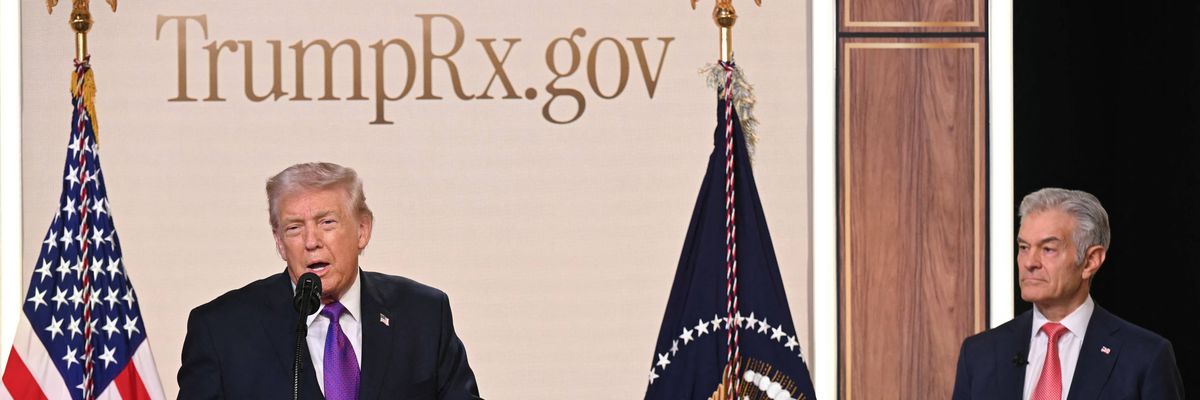
Public Citizen also took issue with the Trump White House’s assertion that the president’s “most favored nation” (MFN) deals with pharmaceutical companies are responsible for falling drug prices. The group observed that the only element of Trump’s MFN agenda that has been fully launched is TrumpRx, which has not exactly delivered blockbuster savings.
“That’s in part because most Americans have health insurance and will do better purchasing drugs through their insurance plans,” Public Citizen said. “TrumpRx may also cause consumers to overpay on brand drugs, as many of the medicines on the site have cheaper generic competitors available at lower price points.”
The more likely cause of falling drug prices overall, according to Public Citizen, were “the genericization of expensive branded drugs,” the Biden-era Medicare price negotiation program that Trump and congressional Republicans have worked to sabotage, and regulatory changes that took effect in 2024, prior to the start of Trump’s second White House term.
“Trump has three kinds of drug pricing policy: fake, exaggerated, and not-real-yet, probably-won’t-happen,” Peter Maybarduk, access to medicines director for Public Citizen, said in a statement. “Prescription drug corporations are raising the prices of new medicines every year, and the CPI doesn’t even count that cost. It’s more likely that patent cliffs and Medicare price negotiation, which took effect this year and saved billions, drove changes in the CPI."
“Trump’s claim to have lowered drug prices amounts to distortion and stealing credit from past administrations whose policies actually made a difference,” Maybarduk added.
Last weekend, Trump showcased to reporters a printout of a Washington Post story headlined, “Prescription drug prices record sharpest drop in more than 60 years.”
“I told you that was going to happen,” the president said.
Trump didn’t mention that the Post’s story highlights experts’ view that “a Biden-era policy that requires Medicare to negotiate prices for some popular prescription drugs is more likely to be driving down costs.”
Richard Frank, a senior fellow at the Brookings Institution and professor emeritus of health economics at Harvard University, told the newspaper that “if I was a betting guy on what mattered most, it would be probably stuff around the Inflation Reduction Act,” Democratic legislation that included the Medicare drug price negotiation changes.
Trump’s policies, Frank added, “wouldn’t be where I’d place my money.”
The president’s attempt to take credit for falling drug prices came as his administration actively worked to undermine the price negotiation program that’s helping drive costs down.
A Public Citizen investigation published earlier this month revealed that “a quiet change in policy interpretation” that the Trump administration wants to make permanent allowed AbbVie’s pancreatic enzyme medication Creon to escape Medicare price negotiations for at least another seven years.
“The Trump administration wants to make permanent a costly Medicare mistake, which creates windfalls for AbbVie and other drug corporations by excluding some expensive biologic drugs from negotiations for years,” said Maybarduk. “Medicare price negotiation already is far too generous to drugmakers, which gouge Americans for many years before negotiated prices kick in.”
From Common Dreams via This RSS Feed.