

By Tony Chamas – Aug 18, 2026
A Theory of the Two Lefts
This essay serves as the fourth and final essay in my Genealogy of Wokeism series. But you don’t need to read those essays first before reading this one. For those who want a rigorous, historically grounded definition of what wokeism is, I would direct them to Part 1 of this series. It is highly influenced by (and a complement to) American sociologist Musa al-Gharbi’s book We Have Never Been Woke, which is by far the most detailed and empirically grounded study of wokeism that exists to date. After deconstructing the history of wokeism from the past to the present, I conclude with this final piece on what to do about it.
This final installment is directed not so much at “woke people” themselves, but at what I believe is a more politically consequential group: those who already see through woke politics and have nonetheless decided to live with it. To this crowd of people who may consider themselves “neither woke nor anti-woke,” I pose the following challenge: if wokeism is truly a fringe phenomenon driven by an overrepresented minority, then a question immediately follows: why does the left not simply reject it? If it truly is so insignificant, then why do leftists, including many self-proclaimed “class-first” leftists, continue to accommodate the dogmas of woke people and allow them to define the cultural politics that have become associated with “the left”? As I will show, the Bernie Sanders campaigns of 2016 and 2020 exposed an underlying civil war within the left, which has had grave consequences that much of the left still has not learned from. There has always been a divide between woke leftists and class-first leftists who find the woke stuff annoying, embarrassing, and who quietly roll their eyes at the pronoun rituals and the cancel culture performance, who prefer to focus on economics while treating the cultural absurdities as a self-limiting nuisance. I argue that wokeism’s greatest structural asset is not its popular appeal; it is the tolerance it receives from people who know better yet choose, for reasons of social comfort or strategic calculation, to do nothing about it. This essay argues that this tolerance is not a neutral position. It is, in effect, the condition that keeps wokeism alive, allowing it to continue derailing any serious left political project interested in large scale structural change.
Memory-holing Wokeism
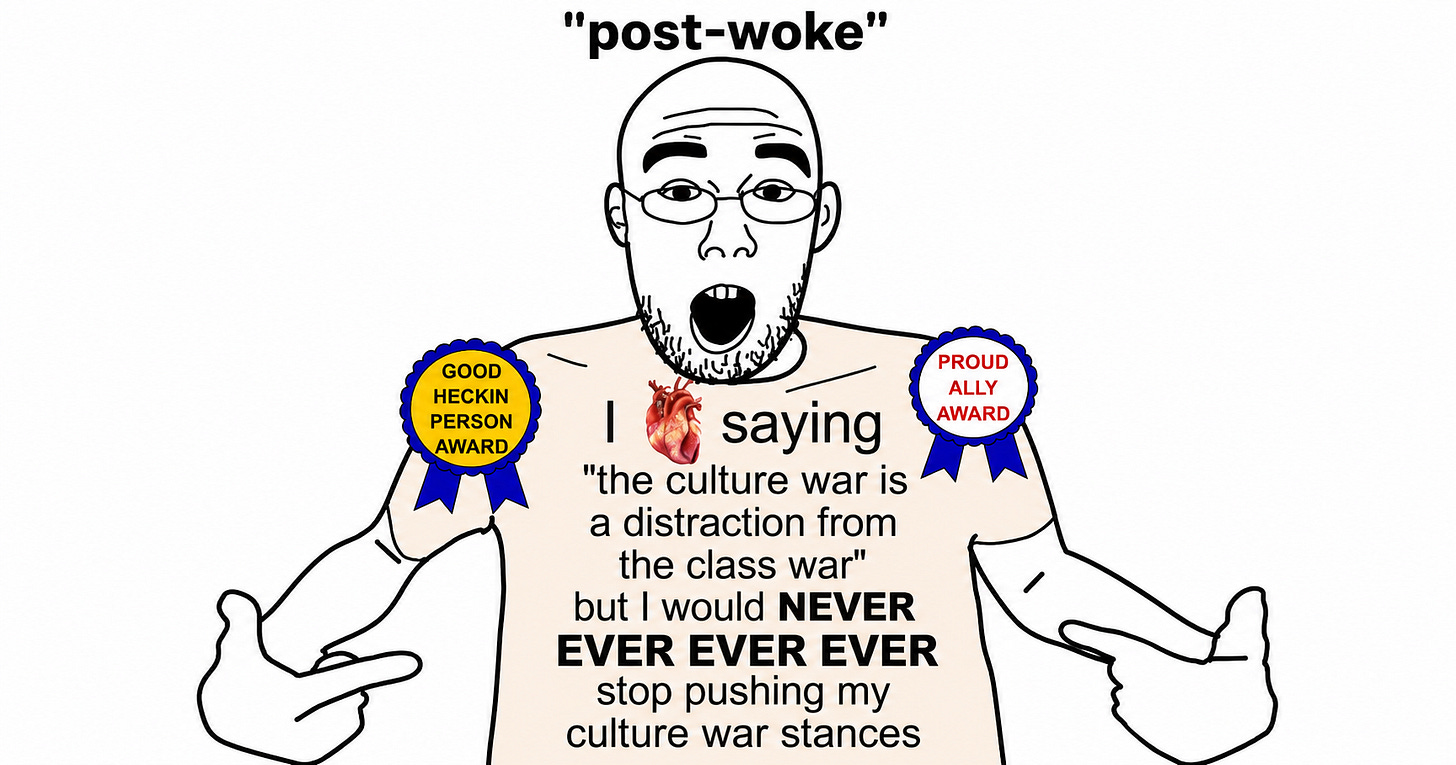
Whenever people take a surface look at what I have written and said about wokeism (without really reading), they often assume that I take the standard class-first lefty conclusion that “the culture war is a distraction, and that we must just focus on class and economics.” But that is not my argument. The “culture war is a distraction” framing is a very limited narrative that stops people short of grasping the full scope of the problem.
The “post-woke” left approach to wokeism is captured in a familiar narrative that is increasingly standard among class-first leftists that sounds reasonable on its face. Consider a statement from Graham Platner, at the time a left-leaning Senate candidate in Maine: “I just have no patience for getting dragged into, frankly, culture war issues that are being invented by the people that don’t want us talking about raising their taxes. That’s why it exists.”1 The posture is recognizable. It is the standard agnostic response to the culture war among class-first leftists: the culture war is a manufactured distraction, conjured by billionaires and the right to keep ordinary people from focusing on economic questions. This would be a strong narrative for the left if it were true. The problem is that it simply does not reflect reality. What that narrative gets correct is that the right does benefit from keeping the culture-war terrain active, and concentrated wealth does have an interest in keeping workers divided. These are real phenomena.
What this narrative gets profoundly wrong is the order of cause and effect. Action precedes reaction. The culture war was not invented by the people who oppose woke politics. It was generated by the same symbolic-capitalist overproduction this series has documented from the beginning, and the right-wing anti-woke industrial complex was an entirely predictable response to it. To act as if the right fabricated the culture war from nothing is to pretend that the woke left did not exist, or that the decade of language policing, institutional capture, and consciousness politics that preceded the conservative backlash was simply not a real phenomenon. This version of events may be convenient for those who want to distance themselves from the woke tendency without examining their relationship to it. It does not fool anyone who watched what actually happened.
The evidence against this account is not difficult to find. Was it right-wing billionaires who pressured institutions to adopt gender-neutral language, substituting terms like “birthing persons” for mothers in official government communications? Was it right-wing media that structured certain public-sector hiring processes to advantage applicants who identified as women or people of color? Was the left’s embrace of open borders, accompanied by slogans like “no human is illegal,” merely a conservative fabrication? These were left-generated political developments. The right reacted to them, cynically and effectively. But the raw material was real, and asking people to disbelieve what they observed between 2015 and 2022 is not a political argument. It is an insult to their memory.
The correct formulation is the inverse of what the class-first agnostic typically offers. It is not that right-wing propaganda creates an image of the left that does not correspond to anything real. It is that the woke left’s attempts to impose a cultural revolution, on a public that did not invite one, are what supply right-wing propaganda with its most effective material. The left’s most embarrassing representatives are the right’s most effective recruiters. Class-first leftists who genuinely want to demonstrate that the left is more than its woke faction have one option: stop treating the woke tendency as an unfortunate footnote and start disciplining it. The reason most have not done so is not strategic calculation. It is a failure of nerve.
The truth is that “the culture war is a distraction” narrative is itself a distraction, specifically from the fact that it was the left’s own symbolic-capitalist class that generated the culture war in the first place, and that many of the people now insisting we ignore it were content to tolerate it, and in many cases enable it, right up until it became politically costly. The pivot from cultural maximalism to economic agnosticism is not a principled intellectual development. It is a retreat made under conditions of losing. The narrative functions not to redirect attention toward economics but to shut down scrutiny of the left’s own recent history. It works only on people who have already decided not to think about it; to anyone who remembers what the left was doing between 2014 and 2020, it reads as precisely what it is.
There is a meaningful distinction between rejecting woke politics as wrong and simply declining to engage with it as if it does not exist. The second is a fundamentally different intellectual posture, and a substantially less honest one. When faced with a concrete cultural question, the agnostic politician freezes, because silence is not a philosophy. It is an evasion, and a costly one: accepting the woke frame by default while pretending not to engage with it at all. The agnostic approach of casually disavowing woke or laughing off as well-meaning but “went a bit too far” (as AOC did in a recent interview where she said “woke” was “a little crazy”) is a convenient way of distancing oneself from it without actually confronting it or holding the people who pushed it (and still push it) accountable.
Culture War as Class War
While the culture war is a distraction insofar as it does not bring real progress in material terms, and changing minds does not necessarily change things, the culture war is not entirely divorced from the economic war. For the economic war to be overturned and won by a pro-working class force, it would require a political movement that is not actively hostile and at odds with the working class it seeks to galvanize. Understood structurally, the culture war is downstream of elite overproduction: a form of class conflict in which PMC symbolic capitalists, who use oppressed minorities as human shields for their own class advancement, contest institutional terrain against the fraction of concentrated wealth whose dominance they nominally challenge. But the contemporary left is precisely such a hostile force, which is why the culture war is not merely a distraction; it is a hindrance to the economic project. The way to deal with it is not just to say that it does not matter and that we should stop thinking about it.
The more important point, however, is that the left’s cultural failures are not solely failures of strategy or optics. Some woke positions on cultural questions are substantively wrong, not merely politically inconvenient, and a serious left should be willing to say so. The Nordic countries, which built the most successful social democratic institutions in the modern world, have in several cases arrived at conclusions about cultural-political questions that contradict the dominant positions of the Anglo-American woke left on the merits. Denmark’s Social Democratic Party, governing from the left on economic policy, has imposed some of the most restrictive immigration controls in Western Europe, not as political triangulation but as a policy response to the labor-market and social-cohesion concerns of its actual working-class constituency. Several Nordic countries, following systematic review of the clinical evidence, have rolled back the routine prescription of puberty blockers for youth gender dysphoria, concluding that the evidence base does not support the intervention at the scale it was being administered.2 These are not concessions to the right. They are examples of a mature social democratic politics willing to follow evidence and constituent interest even when doing so conflicts with the ideological commitments of its symbolic-capitalist professional strata. The contrast with the Anglo-American woke left, which treats any deviation from the dominant progressive position on immigration or trans medicine as a form of moral betrayal, is instructive. The goal is not to win by holding whatever positions are most culturally palatable. The goal should be to have the correct ideas, the ideas that actually improve people’s lives, and to build movements serious and disciplined enough to implement them.
Recognizing the failures of woke politics is a necessary starting point, but it is not sufficient. Being post-woke, in the sense of declining to engage with the cultural politics of the prior cycle, is not the same thing as rejecting the woke mode of politics as the organizational and strategic threat it actually represents. The first posture, treating wokeism as something that will fade on its own if ignored or gently discouraged, underestimates the structural dynamics that sustain it. Some on the left object that fighting wokeism is itself just another culture war, and that anti-wokeism is merely wokeism inverted. Applied to right-wing media, which has no stake in class politics, the charge is largely fair. Applied to the left it collapses, because the two sides do not have the same interest in the outcome. The right loses nothing by leaving the woke tendency intact, since an opponent that easy to caricature is an asset to it. The left is the only side with a material stake in defeating wokeism, which is why treating opposition to it as a distraction from class politics gets the relationship exactly backwards. Anyone who genuinely believes in the left’s stated goals, whether economic justice, reduced poverty, better healthcare, or effective climate policy, should be the most forcefully anti-woke, precisely because the woke tendency has demonstrably driven those goals backward. The woke left did not merely fail to advance working-class interests. It actively alienated the working-class constituencies without whose support no anti-establishment politics can succeed.
No amount of redirecting to economic issues works when the thing being redirected away from is visible, immediate, and real.
And it is real. It is not merely an online phenomenon or a product of right-wing media amplification. The pronoun rituals, privilege-checking procedures, and representation performances that characterize many DSA meetings and, as was visible at the NDP convention, mainstream party conferences,3 are genuine organizational realities that real people must conform to or fight against in order to participate in left-wing political spaces. Many people conform out of politeness rather than conviction, and complain about it behind closed doors. What is perpetually baffling is the number of people on the left who insist these things no longer exist, or are so marginal as to be irrelevant, when they are demonstrably present and operative. The fact that these tendencies are driven by a loud minority is not a reason to dismiss them. It is the most compelling reason to reject wokeism and stop capitulating to the expectations of woke people.
The deep and largely unspoken division between the cultural left and the class-first left was exposed most dramatically during the 2016 and 2020 Democratic primaries, and specifically in the two Bernie Sanders campaigns. Those elections revealed that there are different lefts operating under the same banner, with genuinely conflicting priorities, and that many who appear to be on the same side are not aligned on anything that matters politically. The lessons produced by those campaigns have still not been learned.
The Lesson of Bernie Sanders 2016–2020
Everything this essay has argued in the abstract, the Sanders campaigns of 2016 and 2020 proved empirically. They functioned as a litmus test for the American left, and the results were unambiguous. What those campaigns exposed was the depth of the division between two fundamentally incompatible political formations operating under the same banner: a genuine class-first left committed to socioeconomic transformation, universal public goods, and the material interests of working people, and a synthetic woke left, rooted in the professional-managerial class and the symbolic-capitalist aspirant strata described in Part 1, whose actual priorities are cultural sensibility, identity-based recognition, and the preservation of the institutional terrain on which their careers depend. These are not two wings of the same movement. They are structurally opposed projects, and the Sanders campaigns proved it by forcing the contradiction into the open.
Above all, the Sanders experience demonstrates that the woke left, and specifically this PMC faction, is the primary internal obstacle preventing the left from winning. It was not the Republican Party that stopped Bernie Sanders. It was not Fox News. It was the Democratic establishment and its woke-adjacent professional class: the staffers, the activist organizations, the media professionals, the NGO operatives, and the symbolic-capitalist intelligentsia who could not tolerate a politics that did not center their cultural priorities. Sanders had the policies, the cross-class appeal, and the grassroots energy to capture the Democratic Party and advance a genuine social democratic agenda. What he did not have was the willingness to destroy the internal opposition that stood in his way. Unlike Donald Trump, who ruthlessly dismantled his Republican primary opponents in 2015 and 2016, humiliated the party establishment, and forced the entire apparatus to conform to him, Sanders chose accommodation. While Clinton supporters attacked him and his base as “Bernie Bros” and framed the choice between a woman candidate and a class-first candidate as inherently sexist, Sanders pulled his punches, deferred to the unity imperative, and tried to coexist with forces whose structural interest was his defeat.
The Day Sanders Stood Still
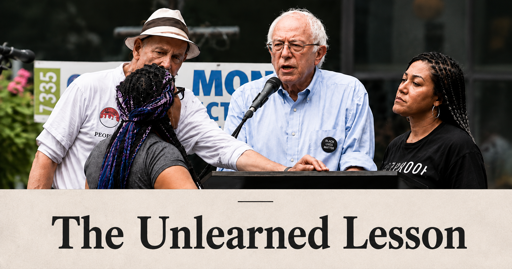
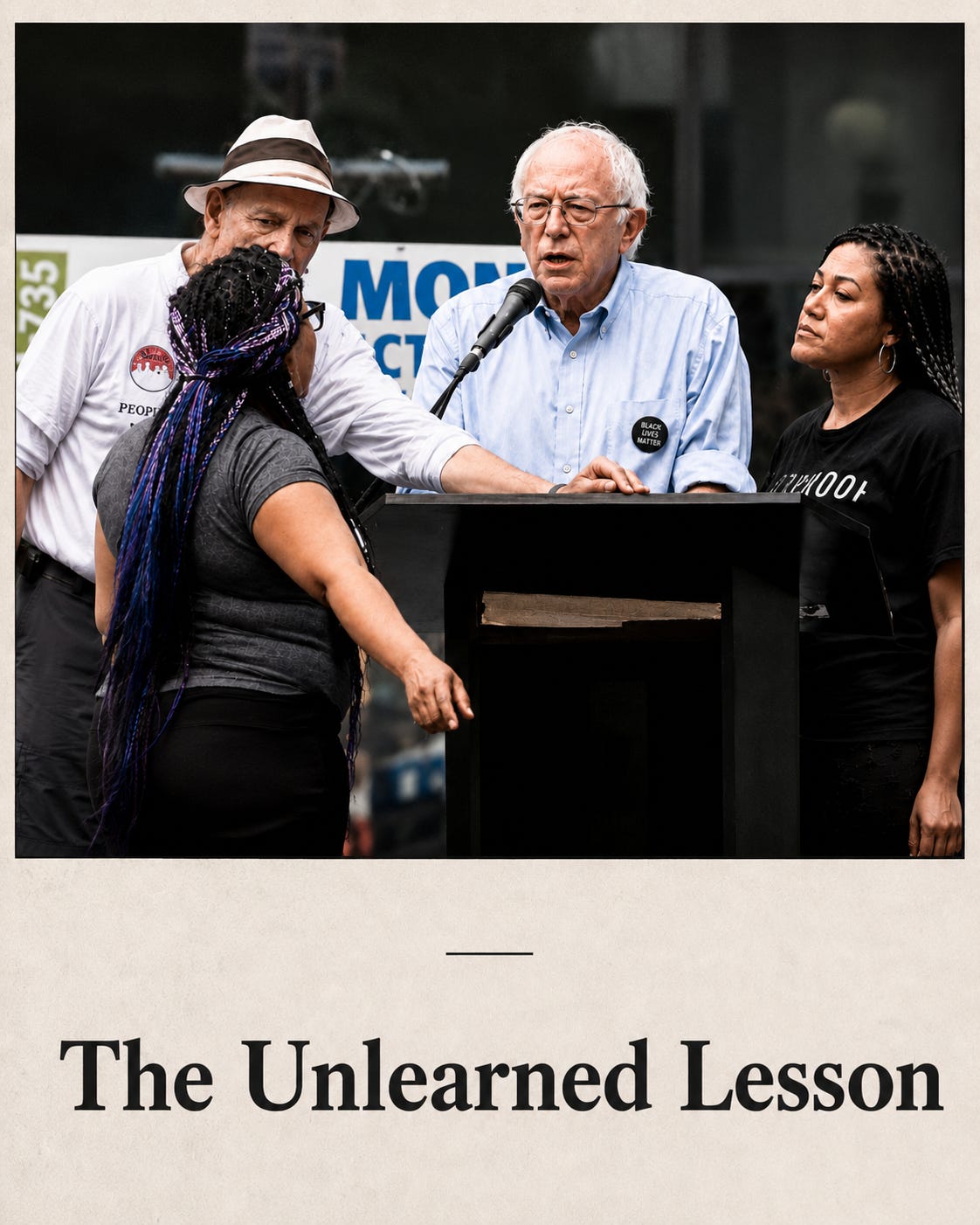
There was one event in particular that many of us probably remember, which I believe was a symbolically defining moment for the nascent class-first left in America. It was the day in which the Bernie Sanders movement marked its total capitulation and submission to the woke minority, allowing the left to become totally captured by the woke, which had already culturally captured the more centrist/establishment liberal left. On August 8, 2015, Bernie Sanders arrived at Westlake Park in Seattle to address a Social Security rally. He was drawing crowds that had surprised even his own campaign staff, and his candidacy had demonstrated an early cross-class reach the Democratic establishment had not anticipated. Before he could speak, two Black Lives Matter activists rushed the stage and seized the microphone. One of them told the crowd, which had begun to boo the disruption, that they were “white supremacist liberals.” She spoke for several minutes. Sanders and his people stood to the side, visibly too weak-willed to assert control of their own event. Organizers eventually ended the rally, and Sanders left without delivering his speech.
The incident was not primarily notable for what the protesters said. It was notable for what Sanders did not do. The Sanders team did not have the balls to simply kick them out. They feared the potential backlash of woke outcries over “kicking out a black woman” from their event. But backlash from whom, and at what cost? No sane person looking at that spectacle would have thought that the two BLM activists weren’t obviously in the wrong. As a result of the inability to stand up to this nonsense, Sanders was not able to defend his platform or the audience that had shown up to hear him. He stood aside, and then he ceded it. The image was widely circulated and understood by those watching as exactly what it was: a signal that this movement would accommodate disruption rather than confront it, that the symbolic-politics faction could command the attention of the working-class left simply by invoking the right moral vocabulary loudly enough.
That signal set the trajectory for everything that followed.
It is almost hard to believe today that Bernie Sanders, prior to running in the Democratic primary, was not a Democratic politician. He had been an independent his entire political career, serving as mayor of Burlington and then in the House and Senate without affiliating with either major party. He did not register as a Democrat until 2015. His reasoning was explicit: he had drawn the lesson from Ralph Nader’s 2000 campaign that third-party runs in the American electoral system produce nothing except the spoiler effect. The Democratic primary was not his natural home. It was the only viable vehicle for a social-democratic agenda in a system structurally hostile to independent candidacies. That outsider status was not incidental to his appeal. It was the source of it. The 2016 Sanders campaign was remarkable in ways the left has since worked hard to forget. Sanders was not simply appealing to Brooklyn socialists, campus activists, or the already-converted professional-progressive base. His campaign was genuinely cross-class in its reach precisely because it was not primarily framed through the idioms of identity politics. He spoke in a class-first language about wages, inequality, healthcare, Wall Street, trade, corruption, and the domination of political life by concentrated wealth. The results bore this out. Sanders won or performed strongly in states that were not liberal enclaves, across the industrial Midwest and the rural interior, while making the race against Hillary Clinton far more competitive than the political class had expected. The 2016 campaign demonstrated that class-first language could reach voters the left had been told were unreachable.
This is also why the so-called “Bernie-to-Trump” phenomenon, however overstated in some versions, was real enough to matter politically. Some voters who supported Sanders in the primary subsequently voted for Trump in the general, which made no sense if you understood politics through the symbolic coordinates of liberal progressivism. It made perfect sense if you understood that many of those voters were not looking for “left” or “right” in the professional-managerial sense. They were looking for someone who seemed to be against the system, against the donor class, against trade deals that hollowed out their communities, against a political order that treated them as disposable. Sanders could reach that voter because, at his best, he was addressing the same material anxiety through a different vocabulary.
These voters did not become far-right. They moved away from the left. The distinction matters because the standard left response to the Bernie-to-Trump phenomenon is to characterize it as radicalization, framing the departure as a rightward conversion when the more accurate account is that the left lost these people rather than the right capturing them. A politics that alienates people it already had is a different problem from a politics facing a new ideological adversary, and it requires a different diagnosis. The right did not conjure these voters. The left drove them out.
His 2019 Fox News town hall illustrated this directly. Sanders appeared before an audience that had been told for years that he was a dangerous radical, and received sustained applause when he made the case for Medicare for All. The audience was not applauding because they had suddenly become socialists. They were responding to a material argument framed in universal terms, about healthcare costs, medical bankruptcy, and the insurance industry’s grip on the political system, rather than as a boutique moral performance for the already-enlightened. That moment contained within it the entire blueprint for a cross-partisan working-class politics: frame material demands in terms that speak to shared conditions rather than to the symbolic hierarchies of progressive respectability, and the audience is there. The opening was real. What happened next was its squandering.
The electoral arithmetic of 2016 and 2020 tells this story precisely. In 2016, Sanders lost California to Clinton, a state generally perceived as the most progressive in the country. He lost it to a Southern Democrat with deep regional ties and every structural advantage of name recognition and establishment support. Yet he won Michigan, Wisconsin, West Virginia, Indiana, Oklahoma, and Kansas. When the 2020 campaign set about analyzing the 2016 loss, the diagnosis it arrived at was that Sanders had failed to appeal to minority voters and women sufficiently, that losing California was evidence of a coalition problem. This was almost certainly the wrong lesson. What the 2016 numbers showed was not a coalition failure but a class strength: his weakness was with the educated, socially liberal, PMC-adjacent vote that California concentrated. That was not a deficiency to be corrected by adopting identity politics messaging. It was a sign of what made his politics distinct.
What drove the 2020 shift was not only the changed political environment but the changed composition of the campaign itself. The 2016 operation had been run largely by professional strategists whose primary brief was winning votes. The 2020 operation brought in a substantially different kind of staff: people who were themselves committed leftists rather than professional electoral strategists, many of them radicalized by Trump and what followed. It was this staff that persuaded the campaign the 2016 loss had been a minority-outreach failure. A neutral analyst looking at the same data might have reached the opposite conclusion. A staff whose politics were shaped by identity frameworks was structurally unlikely to.
The 2020 results confirmed what the misdiagnosis predicted. The campaign softened its class edges, leaned into representation and coalition politics, and attempted to appeal to the Warren voter and the Buttigieg voter on their own terrain. It won California. And it lost Michigan, Wisconsin, and most of the Midwest to Joe Biden. What the geographic shift makes unmistakable is that his support moved in exactly the wrong direction for general-election viability: away from the states that decide federal elections and toward the states that were already reliably Democratic. That is precisely backwards for a movement that claimed working-class politics as its reason for existing. He should have focused on what separated him from the rest, not on what united him with them.
The claim that Sanders won California in 2020 because the identity pivot worked does not survive scrutiny. He won California not because his appeal to identity groups succeeded, but because the centrist and progressive opposition that had consolidated behind Clinton in 2016 was divided in 2020 among Buttigieg, Warren, Harris, and Biden. Clinton had swallowed up the entire socially liberal, fiscally moderate vote in 2016. In 2020, that vote was split. California, moreover, is not a left-wing state in the class sense; it is a progressive state in the PMC sense. Winning it proved nothing about electability in a general election. If Sanders were ever to demonstrate electability against a Republican, the evidence would have to come from swing states and the Midwest, which is exactly where his 2016 campaign had shown real strength and his 2020 campaign forfeited it. There was nothing strategically better about the 2020 campaign. He lost by a wider margin overall. The only result of the pivot was gaining more woke support at the cost of his swing-state appeal. Trying to capitulate to woke progressives rather than challenge and defeat them, as Trump did to his Republican opposition, ultimately set social democratic class politics backward, and we are still suffering from it today. There was a path. A class-first left could have said: we are not the cultural left, not the HR department, not the NGO class, not the people yelling at you online about your language and your privilege. We are on the side of better wages, healthcare, unions, family stability, public goods, and national economic populism. That was the offer Sanders was best positioned to make. It was not the offer his 2020 campaign ultimately delivered.
On immigration, the capitulation was especially revealing. Previously in 2015, when Ezra Klein pressed Sanders on open borders, Sanders dismissed the idea as a “Koch brothers proposal,”4 arguing that it would expand the labor pool and suppress wages. That was not a right-wing aberration. It was historically normal labor politics. The political terrain shifted dramatically after Donald Trump descended the escalator at Trump Tower in June 2015 and made mass immigration the organizing theme of his campaign. In 2018, at close to the peak of the Trump derangement cycle, the writer Angela Nagle published a piece in a left-wing magazine5 making the straightforward labor-left case against open borders, citing not right-wing theory but the historical position of figures like A. Philip Randolph and arguing that cheap imported labor suppresses wages. This was not a fringe position. It was, for most of the history of the American labor movement, the default one. For that piece, Nagle was doxxed, harassed, and effectively erased from serious consideration on the left. That is what you got, in 2018, for holding a position that Bernie Sanders himself had held for most of his career. That is how far this stuff went. A labor movement that takes wages seriously cannot treat immigration purely as a moral question of humanitarian openness while ignoring the employer interest in an expanded labor supply. But after Trump, positions that had once been ordinary within the labor left became suspect if they sounded even remotely like something a Trump voter might say. This is how the woke tendency disciplines the left into impotence: not through argument, but through association. It does not ask, “Is this true?” It asks, “Could this be associated with the right?”
In 2020, Sanders tried to play on the woke left’s terms, and it didn’t work whatsoever. The most telling case was South Carolina. Biden crushed Sanders among Black voters by approximately four to one, according to exit polling.6 Sanders, who had moved his campaign substantially toward the language of identity and coalition management, did not produce the Black working-class breakthrough the strategy was supposed to deliver. The Black voter in South Carolina was not the Black activist in a graduate seminar. Many wanted the candidate they associated with stability, familiarity, and the Obama legacy, not the candidate whose campaign vocabulary had been shaped by progressive professionals who believed they understood Black political interests better than Black voters themselves.
The consolidation behind Biden was not organic. Barack Obama played a well-documented coordinating role in pressuring other candidates to drop out and endorse Biden,7 and a concerted effort among Black Democrats and Black PMC figures to campaign heavily in the South spread the narrative that Bernie was too white. Prominent figures in Black media and popular culture, who had initially shown interest in Sanders, fell in line behind establishment Democrats. This pattern repeated from 2016, when the same dynamics played out on behalf of Clinton. It was documented. Few lessons were learned.
The professional-class theory of representation is false, and South Carolina proved it empirically. The left persistently confuses demographic categories with ideological blocs, then acts shocked when ordinary people inside those categories do not vote the way university activists expect. The Black working class is not the same as the Black PMC. The Latino working class is not the same as the Latino activist class. First-world feminist activists and girlboss corporate careerists don’t represent all women. Gay voters are not the same as queer-theory academics. This confusion is not a purely intellectual error. It is a structurally motivated one: the professional-class operatives who shape left strategy benefit from treating themselves as the authentic voice of the communities they claim to represent. They are not. They are the professional apparatus that sits between those communities and genuine political representation.
There is an objection to all of this that deserves to be taken seriously. Some analysts have argued that Sanders performed as well as he did in 2016 not because of any groundswell for socialism but because a great deal of his support was driven by animosity toward Hillary Clinton. The evidence offered is that Sanders, who had been an independent before he entered the Democratic primary, brought large numbers of people into the party who had never been Democrats and who registered specifically in order to vote for him. This cannot be the whole explanation for his support. But there is a rational kernel in it, and that kernel supports my argument rather than undermining it.
Political support is very often driven more by what people oppose than by what they support. The appeal of Donald Trump was in large part a reaction: a hatred of the Democrats, a sense of betrayal by them, and a contempt for what Chris Hedges called the liberal class. Most of the people who voted for him had no firm expectation that he would deliver on his promises. What they knew was that he was against the people they disliked, which made him the lesser evil. The same logic runs in the other direction. A great deal of Democratic support in the post-Trump era, across the Clinton, Biden, and Harris campaigns alike, has been driven by hatred of Trump rather than by enthusiasm for Democrats. People frequently vote on the basis of what they want to stop.
So the fact that a portion of Sanders’s 2016 support was anti-Clinton is not a weakness of that campaign. It is how political coalitions actually assemble, and it points to the opposite of the conclusion progressives drew in 2020. They had internalized the accusation that criticizing Clinton was sexist, and advised him toward a softer, rainbow-coalition posture in which he competed on his opponents’ terms rather than his own. The correct lesson was to intensify the 2016 approach, not to abandon it: to go after the Democratic establishment harder and more explicitly, and for the leftists campaigning for him to mark the distinction between themselves and the left they were opposing rather than dissolving it into left unity. He softened instead. He lost his grit, a great many people noticed, and the map of states he won and lost in 2020 reflects it.
This bears directly on the objection that will be raised against the argument of this essay: that a class-first left which confronts the woke tendency openly will alienate minorities and drive left-wing people away. That objection counts only the people already inside the left’s imagined constituencies and ignores everyone outside them. A class-first left that was openly and vehemently antagonistic toward the synthetic PMC liberal left would attract people precisely because of that antagonism, including a great many who currently vote for nobody at all. A large percentage of people do not vote in most elections, and many of them despise both sides. If you believe left-wing candidates win by first converting everyone to leftist principles, you have misunderstood how politics works.
The Left’s Civil War
The 2016 and 2020 democratic primaries were two revealing instances that exposed the underlying civil war within the left, which leftists tried to forget about later. Perhaps the most concentrated single illustration of where the PMC-left had arrived by 2020 was the endorsement choices of Angela Davis and Judith Butler. These are self-described communists, people who have built entire careers on critiquing capitalism and its cultural apparatus, who chose to support Kamala Harris over Bernie Sanders in the primary.8 Their stated rationale amounted to the claim that a woman president was a prerequisite for social democracy, that the symbolic representation question had to be answered before the material one could be addressed. The fact that two of the most prominent intellectuals on the far left could not bring themselves to support the most left-wing candidate in the race, in part because he was too old and too white, is a testament to what the PMC-left’s actual priorities were beneath their radical posturing. Nor is this simply a case of late-career accommodation to liberalism. Davis had already demonstrated the priority of symbolic ideology over material outcomes much earlier. In the 1970s, she vehemently opposed the Wages for Housework movement, which proposed compensating women directly for domestic labor, in effect a basic income that would have expanded women’s economic independence from both husbands and employers. Davis rejected this on the grounds that it would “entrench gender roles” and “send women back to the kitchen,” preferring the communist prescription of collectivized childcare and mass female workforce participation, which she argued would expand the proletariat and accelerate the conditions for revolution. Whatever the merits of the Wages for Housework proposal, Davis’s rejection of it was not a materialist argument. It was an ideological one: it prioritized the symbolic meaning of women’s labor over the concrete economic independence of actual women. The fact that Angela Davis endorsed Kamala Harris, a former prosecutor with one of the most hawkish incarceration policies in California, tells us a lot about why we shouldn’t take someone seriously just because they say they care about class. One of the most infamous “communist” icons in the United States, a lifelong advocate of prison abolition, endorsed a top prosecutor over the man who had the most left-wing economic agenda says a lot.
During the 2020 Democratic primary, I observed that self-described progressives consistently preferred Warren or Buttigieg over Sanders, offering rationalizations about Sanders being too old, too white, or insufficiently electable. When the field narrowed to a contest between Sanders and Biden, the same people migrated to Biden on electability grounds, despite the fact that their previously preferred candidates had no credible path to a general election and Sanders had demonstrated actual crossover appeal. The rationalizations shifted with the field; the conclusion remained constant. What presented itself, on the surface, as principled concern about identity and representation was, structurally, a class preference. These were people whose political priorities aligned with the professional-managerial strata, and Sanders, whatever his policies, was not the candidate for them.
Sanders repeatedly held back. He refrained from going hard after Warren when she functioned as his most dangerous ideological competitor. Warren declined to exit the race until the last possible moment, functioning as a vote-splitter long after any plausible path to the nomination had closed for her. She was waiting, as subsequent events suggested, for a position in the Biden administration, which, in the end, she was never offered. A candidate presenting herself as the ideologically aligned alternative to Sanders held in the race specifically to prevent the more serious progressive from winning. The left largely declined to state this with the clarity it deserved. Sanders declined to campaign against Biden on the terms that would have distinguished them most sharply, because the entire logic of “left unity” had trained the left to believe that the real enemy was always the right, never the Democratic establishment that blocks every material reform the left claims to care about. Anyone with eyes could see that the biggest obstacle to Bernie Sanders, and to universal healthcare, a jobs guarantee, and the whole suite of social-democratic policies, was the Democrats, not Trump. “Unite against the right” sounds like solidarity. In practice, it functions as a permanent injunction against fighting the forces immediately in front of you.
Sanders further compromised himself by accepting a position in the Biden administration, hoping to exert leverage from within a coalition that had no structural interest in his agenda. Perhaps he shifted some things at the margins. It was not enough for the working class to register, and it was more than enough for them to associate him with the administration’s failures. The most consequential of those failures was the border. Immigration, particularly illegal border crossings, increased rapidly under Biden. Sanders himself has since acknowledged that the border was the Biden administration’s single biggest catastrophic failure.9 He did not say so while he was part of that administration. He said it after.
Furthermore, the premises of the identity narrative have been disproven by the last three elections. Biden, who was portrayed as the least progressive on racial issues, won more Black voters than Kamala Harris did, by a wide margin. It was under Kamala Harris that Black voters shifted significantly toward the Republican Party.10 No one chose Kamala Harris as the Democratic nominee through a primary process. That Biden outperformed Harris among the very constituency the identity framework treats as its core electoral base is decisive evidence that the professional-class theory of representation does not hold, and that electoral outcomes are not determined by identity symbolism in the one-dimensional way the woke left has insisted.
In effect, Sanders had tolerated a faction that ensured his movement could never become the serious working-class political force it claimed to be. This is not a verdict on Sanders himself, whose policy commitments remain far superior to most of what the Democratic Party has offered. It is a verdict on the strategic logic of accommodation. When a working-class political project tolerates, even if it does not emulate, the woke tendency within its coalition, it enables that tendency to dominate the movement’s public face, alienates the people who most need to be convinced, and ultimately loses to the people more willing to perform the correct symbolic politics without delivering any of the economic substance. A campaign can be led by someone who personally does not believe in the latest progressive orthodoxy, but if that campaign is staffed, narrated, disciplined, and morally policed by people who do, the campaign will eventually be shaped by them. The figurehead may be old-school. The machine will not be.
A Theory of the Two Lefts
The unlearned lesson of the two Bernie Sanders campaigns is that they exposed the reality that there are two lefts within the broader camp that proudly claims, “the left”: a class-first left that prioritizes bread-and-butter economic issues, and a cultural left that prioritizes radical social change. The latter is the faction that tends to be the most associated with “wokeness” as it prioritizes first-world cultural problems and tends to be driven by the professional managerial class or PMC aspirants.
The left describes its own divisions almost entirely in doctrinal terms. Social democrats, anarchists, Marxists of every hyphenated variety, Maoists, and left communists all understand themselves to be separated by questions of theory and strategy, and the sectarian energy devoted to policing those borders is considerable. What these categories conspicuously fail to do is predict anything. On paper there are a dozen lefts. In practice there are two, and the line between them runs not through doctrine but through the class formation of the people who hold it.
The most misleading of the doctrinal axes, and the one that does the most work in hiding the real divide, is the spectrum running from moderate to radical. There are moderate ends and radical ends of both the cultural left and the class-first left. Thinking about the left only in terms of radical against moderate obscures the fact that cultural radicals on the far left often have more in common with moderate cultural leftists than they do with radical class-first leftists, let alone moderate ones. What I want to debunk is the idea that people who call themselves communists or socialists are necessarily more committed to class politics. You would think they would be. Whether they are is revealed by their actions and their priorities. They may say they are one thing and in practice get heated, even narcissistic, about small differences and small disagreements over culture, and they will seem radical by rejecting reforms and dismissing them as insignificant when for the working class those reforms are often very significant.
All of these differences get obfuscated, because the real conflict is between the people who prioritize cultural revolution and cultural radicalism and the people who prioritize economic transformation. Material transformation, in other words, against consciousness transformation. The class-first left is the one that serves people where they are.
None of this fits everyone neatly, and I acknowledge as much. There are exceptions to the rule, and people do not always fall into these boxes. You can find cultural radicals who are in fact working class: someone who is trans or LGBT may have a particular concern with those cultural issues in a way that most people in their cohort do not. But most of the time the people who put cultural radicalism before anything else are PMC people, because they can afford to be perpetual losers, leading with cultural radicalism ahead of class and never moderating their positions strategically. If they had a serious concern with actually winning rather than just complaining, they would be doing something different in order to prevent the current trajectory. They can afford to advocate radical positions with no actual possibility of succeeding because they sit in a more comfortable position; if anything they use that radicalism to establish a brand. They also love the identity material, because it gives them a competitive edge in a highly competitive symbolic-capitalist job market, especially in academia, which is a good part of what representation is about, and it doubles as a shield from criticism. It is not that cultural issues cannot matter to the working class. It is that their prioritization among the PMC has far more to do with careerism and the incentives running through the symbolic-capitalist industries, art, media, entertainment, and academia, than with the fact that they are first-world problems, all of which I have described at length across this series.
So the question is never who is more radical on the surface. It is the priorities people put forward and the actions, not just the words, that they take to advance them. If someone claims radicalism on culture and class and yet shows no willingness to adapt in order to reach masses of people and build a political project capable of working, their radicalism is a posture rather than a politics. Usually what they expect instead is a form of cultural consciousness-raising, because they think everything is politically impossible now and all they can do is raise consciousness. That is the surest sign of a woke PMC cultural leftist.
The sociological groundwork for this is not new: what a symbolic capitalist is, and how that stratum came to hold the cultural authority it now holds, is the argument of Parts 1 and 2, which this section presupposes rather than restates. Part 1 also drew the distinction that does the most work for the present point, between the liberal variety of wokeism and the left variety. Neither camp is uniformly woke. A great many mainstream progressives are not, and a great many socialists and communists are not.
There are of course many left-wingers who do not fall neatly into either camp, and a good number who want to have their cake and eat it too, claiming class and cultural radicalism at once. Even so, there is a relatively easy way to tell a woke cultural leftist from a class-first leftist. Class-first leftists concentrate on what people have in common: universalist principles, and the issues that help the greatest number of people. Cultural leftists concentrate on what sets people apart, on the minoritarian questions of race and gender that matter most to them as individuals. The class-first leftist meets people where they are. The cultural leftist tends to regard himself as a member of an enlightened priestly class whose role is to enlighten the backward masses.
That difference in emphasis follows directly from a symbolic-capitalist, university-educated socialization. Cultural capital and a demonstrated commitment to cultural radicalism function as a badge of distinction, a way of separating oneself from other people, rather than as a contribution to a political project capable of reaching them. It shows in how these people act and in how reliably self-defeating their strategies are: leftism becomes a personal brand and an in-group rather than something that might actually succeed. This is why, as I argued in Part 1, wokeism turns out to be anti-political in practice. It opts for change through consciousness because it will not accept the common majority as it is. What it wants is for that majority to bend to the minority, to adopt minoritarian views and lifestyles rather than simply tolerate their coexistence.
This is why I resist the habit of treating wokeism as a liberal problem that the real left does not have. The claim comes in two forms, both evasive: either wokeism belongs to liberals and has been misattributed to socialists, or the woke are not the true left at all and can therefore be disowned without further examination. Each move defends the label instead of inspecting the behavior, and the behavior is the only thing that can settle the question. What someone calls themselves is not evidence. How radical they say they are is not evidence. What they do and what they prioritize are. I set out that test at length in Anti-Social Socialists, and the short version is that a serious politics judges itself by measurable movement toward a concrete goal, while a performative one judges itself by how radical it looks to other radicals.
What a left tendency treats as grounds for excommunication tells you what it is actually for.
A clarification is necessary here, because the argument is easily mistaken for one I am not making. Nothing in this account holds that coming from the professional-managerial class disqualif
Okay, I read about a third of this before I got fed up. The author is using 200,000 words to say the exact same thing the DNC always says: those damn leftist minorities who just want to be treated with basic human dignity are the biggest impediment to progress!
Fuck off, dude. If advocating for your political beliefs requires dehumanizing me, we’re not on the same team.
I had a similar feeling reading this. God forbid we don’t abandon the pursuit of basic equality.