

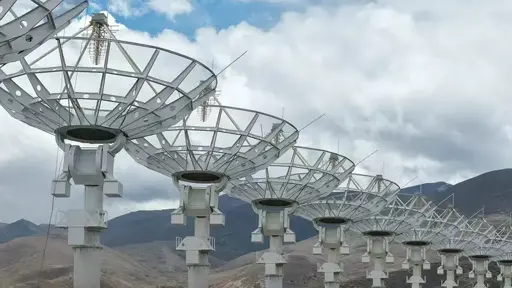
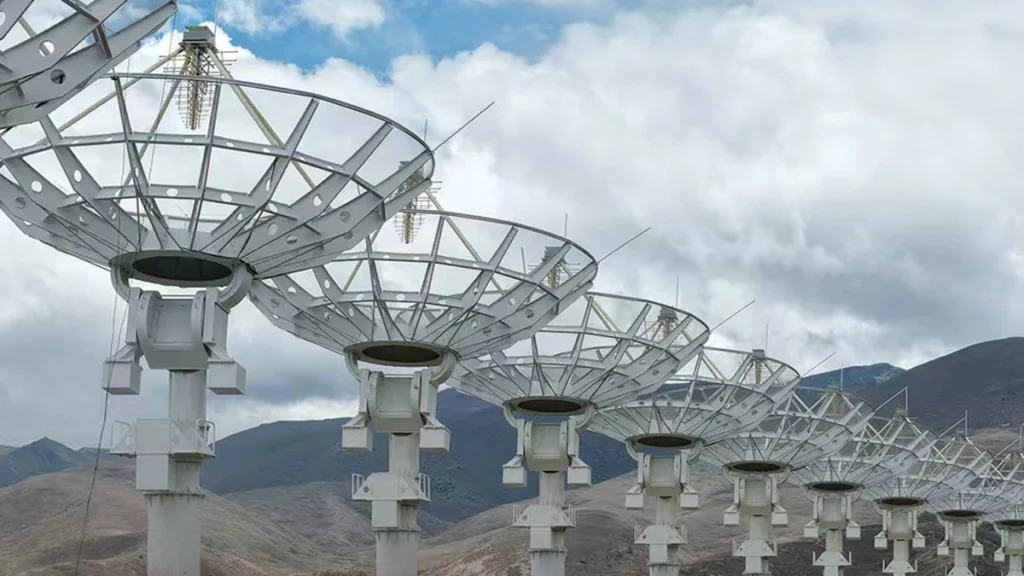
The International Meridian Circle Program seeks to advance worldwide space-weather monitoring capabilities.
On Thursday, Chinese scientist Zhang Qinghe stood before an international audience, presenting a plan to connect observation facilities, data and researchers around the world for space weather studies.
RELATED:
NASA Sets Roman Space Telescope Launch for No Earlier Than Aug. 30
Zhang was speaking at a forum during the 36th General Assembly and Scientific Symposium of the International Union of Radio Science (URSI GASS 2026), held in Krakow from Aug. 15 to Aug. 22.
He introduced the International Meridian Circle Program (IMCP), a flagship initiative spearheaded by the Chinese scientific community to advance worldwide space-weather monitoring capabilities.
At the 2014 URSI General Assembly in Beijing, he was among the recipients of the union’s Young Scientist Award. Now, 12 years later, he returned to the same international scientific community in a different role — representing a major science program proposed by Chinese scientists and inviting researchers worldwide to help build it.
As Zhang finished his presentation, Jonah Colman, scientist from the U.S. Air Force Research Laboratory, raised his hand. What interested Colman was also central to making such international cooperation work: how observation data from different parts of the world can be shared and used together. For Zhang, the scientific reason for building such a network is straightforward.
The China-initiated International Meridian Circle Program (IMCP), a major global science initiative, was formally launched with the signing of new cooperation agreements between China and five prominent international institutions on Thursday, aiming to enhance global capabilities… pic.twitter.com/zC6TZomjDi
— China Science (@ChinaScience) June 13, 2025
“The Earth keeps rotating. When one part of the world can no longer make certain observations, another can take over. Only through this kind of relay can we better serve space weather,” he said.
The program plans to incorporate existing facilities where observation capabilities are already strong, while adding new ground-based instruments in less-covered regions, including parts of Africa and South America. Zhang said China can provide equipment and technical support, while local partners provide sites, personnel and operational support. The resulting data will be shared.
“Data sharing is the link,” he said, explaining that data are at the core of scientific research and can help bring researchers from different countries together. The cooperation will go further.
The program also plans to provide funding for international teams to conduct research and attract scientists from around the world for full- or part-time research and exchanges. “Scientists have a shared language and a shared understanding of the physical world,” Colman said. “I’m excited to see where it goes,” Colman said.
According to Zhang, more than 50 institutions from about 20 countries have signed memorandums of understanding or letters of support for the program.
The next IMCP workshop is expected to be held in Beijing in March 2027. Colman, who has not yet participated in the project, said he is considering going. By then, Zhang will once again be welcoming international colleagues through a scientific community he first entered as a young researcher.
teleSUR/ JF
Source: Xinhua
From teleSUR English via This RSS Feed.
China claims other people are interested in a thing no one has heard about until now.
