

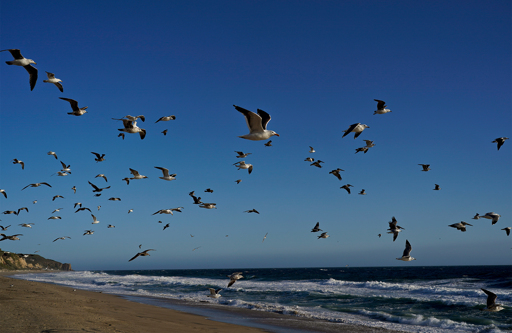
Arctic terns make the longest migration of any creature on Earth, with some Sterna paradisaea clocking more than 80,000 kilometers (49,709 miles) a year, flying from the Southern Ocean to their breeding grounds in the Arctic — and back. For a tiny bird, weighing less than an iPhone, it’s an astounding feat. South polar skuas (Stercorarius maccormicki) trace a similar figure eight around the Atlantic Ocean as they move between breeding colonies on Antarctic islands and the Arctic. In the Southern Ocean, grey-headed albatross (Thalassarche chrysostoma) breed on South Georgia Island. During the rest of the year, they fly a circle around Antarctica, covering roughly 22,000 km (13,670 mi) in as little as 46 days. The journeys of these and other migratory pelagic seabirds are almost beyond comprehension, and largely unseen. But with advances in tracking, researchers have realized seabirds fly broadly predictable paths over the open ocean. Last year, researchers used tracking data to identify six marine flyways that cross the Atlantic, Pacific, Indian and Southern oceans and touch the waters of 56 countries. A team of nearly a hundred were involved, led by researchers from the nonprofit BirdLife International, and their findings were published in the journal Global Ecology and Biogeography. Seabirds are the most at-risk birds, with more than 30% globally threatened. For migrants, life on the wing is especially perilous. They face myriad threats across multiple jurisdictions in national waters and on the high seas, at their breeding colonies, at stopovers during migration and on the open…This article was originally published on Mongabay
From Conservation news via This RSS Feed.