


By Elizabeth Cullen, Lex Innocentium 21st Century, World BEYOND War, August 21, 2026
***“…the world’s most important work, the work of peace”.
—***President J.F. Kennedy Dáil Eireann 1963
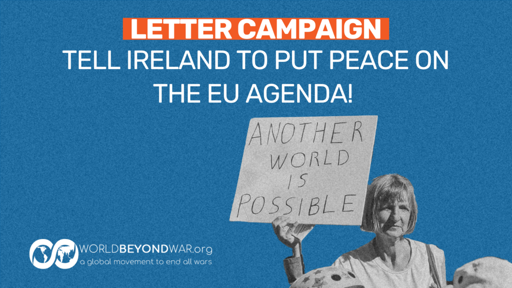
In November 2025, the government asked the Irish people to propose themes for their upcoming Presidency of the European Union[1]. Lex Innocentium 21st Century put forward the theme of peace, and proposed the establishment of a Peace Institute in Ireland. The Minister for Foreign Affairs and Trade, Helen McEntee, however stated that “Supporting Ukraine will be a central priority during Ireland’s EU Presidency later this year”[2]. Why can the achievement of peace in our troubled world not be the ‘central priority’ of Ireland’s presidency?
If we were to adhere to our constitutional obligation to commit to “the pacific settlement of international disputes by international arbitration or judicial determination”, we would be clearly pursuing the path of peace. We would also be working with the United Nations (UN), with its remit for world peace. Unfortunately, the government is doing the exact opposite. Removing the necessity for a UN mandate for the overseas deployment of Irish troops will do two things; it will tend to undermine the status and authority of the UN in Ireland and abroad (whose Charter Ireland is legally bound to uphold), and significantly, it will also enable Irish troops to operate under the aegis of the EU.
The Triple Lock was introduced following the rejection of the first Nice Treaty in 2001. Its purpose was to persuade people who had been concerned about the impact of the Nice Treaty on our neutrality to change their minds and to vote to accept the treaty. That Government commitment to neutrality and the Triple Lock was embodied in what the Bertie Ahern Government of that time called the “National Declaration by Ireland”. That National Declaration by Ireland was in turn responded to formally by the other EU States in what was called the “Seville Declaration” of the other EU States 2002 and both Declarations were formally registered at the UN along with the Nice Treaty when that was ratified. The National Declaration of Ireland gave a special legal basis and authority to the Triple Lock[3]. Of note, the Irish State has never issued a comparable National Declaration on any other issue.
In 2008, the Lisbon Treaty brought Irish foreign and security policy, among other areas, into the remit of the EU, and this was a matter of grave concern to many Irish people who had serious reservations about the increasing militarization of the EU, and who again voted not to accept the treaty.[1] To renege on this promise is the most anti-democratic action any Irish government has ever taken.
The electorate in both referendums had every right to be concerned as Ireland’s military involvement in EU matters has been steadily increasing. Ireland joined PESCO (Permanent Structured Cooperation) in December 2017 (after only a two-hour debate in the Dáil). The legally binding commitments made under PESCO included a commitment to have our military technical standards interoperable with those of NATO, a commitment to regularly increase our defence spending, and a commitment to make the European defence industry more competitive. In 2021, our peacekeepers were withdrawn from the Golan Heights, where they had been on a UN peace keeping mission for a decade to ensure that our Irish Defence forces would be able to fulfil their commitment to EU Battlegroups[4] [5]. Irish soldiers are now giving weapons training to Ukrainian soldiers [6]. The number of military flights over Ireland has also been underreported[7]. And of course, over the past 25 years, approximately three million US soldiers have passed through Shannon Airport in support of US wars[8]. More recently weapons have been illegally transported over Ireland to Israel[9].
The EU and NATO are tightly connected and, currently, NATO and the EU are cooperating on more than seventy measures[10]. As Ursula von der Leyen said at a joint EU/NATO press conference, “We are one Union, one Alliance, united in purpose” [11]
The arms industry is playing a large role in this militarization; in 2015, the European Commission created the oddly named “High-level Group of Personalities” on defence research, over half of whose members represented the military industry. As could be expected, the conclusion of this group’s deliberations was “reinforcing Europe’s overall military position”, and two years later, the EU approved, for the first time, the funding of military research and the development of new arms and technologies[12]. This trend continued, and two years later again, the European military industry received further support with the establishment of the Directorate-General for Defence Industry and Space[13]. A lot has happened since 2002, when the Berlin Plus Agreement formalized relations between the EU and NATO [14], and in 2026, an Irishman, General Seán Clancy, Chair of the European Union Military Committee stated that ”NATO remains the bedrock of European defence”[15].
Militarization comes at an enormous cost; research and development spending in defence in the EU has almost doubled over the past 5 years, growing from 9 billion euros in 2020 to 17 billion in 2025[16]. The EU and member countries have given 82.9 billion dollars to Ukraine since 2022 [17]. In the words of EU foreign policy chief Josep Borell “Another taboo has fallen …the taboo that the EU was not providing arms in a war, yes we are doing it” [18]. The current plan under “Rearm Europe” is to spend an unbelievable 800 billion euros on arms[19].
This is not what the Irish people voted for. Two referendums, and opinion poll after opinion poll (most recently February 2026), have clearly shown the wish of the Irish people to be neutral in conflict and to act as peacemakers.
It is disturbing therefore, to see that there have been few, if any, moves in the EU to seek a peaceful settlement to any of the current conflicts. Two agencies highlight this. The European Peace Facility (EPF), established in 2021, is badly misnamed; it is actually a 12 billion euro fund and is “primarily a financing tool for security and defence assistance rather than a diplomatic peace-mediation instrument.….”[20]. Financing the militarization of Europe cannot be the function of a peace facility. It has already promised 5 billion euros to Ukraine for “lethal and non-lethal military equipment and military training”[21]. There is no requirement for independent evaluation of the European Peace Facility or even for the facility to produce a report. There is no national or EU parliamentary oversight and it has been described as an “unsecured gun”[22]. Its budgetary arrangement ensures that it can circumvent an obligation not to fund warfare.
A further EU agency, the European Defence Agency (EDA ), was established three years later, in 2004 . Its aims include “acting as a military interface to EU policies” , “development of military cooperation” and of course “strengthening the European defence industry”[23]. A recent review of the work of the EDA revealed serious concerns, including being strongly influenced by the arms industry, lack of transparency in the review process, and an excessive reliance on self-assessment by applicants to the EDA [24]. Where is the EU agency for mediation and conflict resolution?
Minister Helen McEntee’s desire for military support for Ukraine is not in the interest of world peace”[25]. In his auspicious visit to Ireland in 1963, President J. F. Kennedy urged reform of the United Nations. He said that the UN must be fairly financed and its peace-keeping machinery strengthened; he foresaw a world where justice reigned. His call echoes to us through the intervening years and resounds in the wishes of the majority of Irish people for Ireland to be a peace maker. Our government must heed the will of the Irish people, work to strengthen the UN and to resist Ireland’s participation in the increasing militarization of the EU. The Irish government must keep its solemn promise to the Irish people, and heed their wish for Ireland to be a peacemaker, over and above any perceived commitment to the EU.
Our peaceful future needs our government to listen to the people and to keep the Triple Lock
Lex Innocentium 21 st Century is an Irish peace movement with our roots in ancient Irish Law (Lex Innocentium/Cáin Adomnáin, 697 AD). Lex Innocentium 21 st Century is a civil-society law that declares war to be a Crime against Humanity, a Crime against the Earth and a Crime against the Future. We invite people from all over the world to sign our soft-power, bottom-up, civil-society law on our website.
Web: https://lexinnocentium21.ie/
Email: contact@lexinnocentium21.ie or lexinnocentium21@gmail.com
Instagram: Lex Innocentium 21c
Facebook: Lex Innocentium, 21 st Century
YouTube: https://youtube.com/@lexinnocentium
[1] The existence of the Triple Lock was referred to by the statutory Referendum Commission (which sent documents about the treaties to all households before the vote) on the second Nice and Lisbon Treaty referendums. These solemn commitments given in two referendums to persuade people to change their votes and permit those treaties to be ratified, have given the Triple Lock a quasi-constitutional character which it would be unconstitutional – not to mind being a profound political betrayal by the politicians concerned – to try to remove by Oireachtas legislation at this stage. The Government’s attempt to abolish the Triple Lock before the end of the year is doubtless meant to give assurances to the EU about the matter before Ireland assumes the EU presidency on 1 July.
[1] The Development of the Priorities and Policy Programme for Ireland’s Presidency of the Council of the European Union 2026
[2] Minister McEntee expresses Ireland’s solidarity with Ukraine in Kyiv
[3] This information on the Nice and Lisbon referendums and the Triple Lock is from Anthony Coughlan on file and www.nationalplatform.org
[4] Last Irish troops to return home from decade-long mission in Golan Heights – Limerick Live
[5] https://www.thejournal.ie/last-irish-troops-syria-un-peacekeeping-to-return-home-6345441-Apr2024/
[6] https://militarnyi.com/en/news/ireland-joins-ukrainian-soldiers-training-program/
[7] Irish Times “248 US Military flights over Ireland went reported” April 20 2026
[8] https://www.shannonwatch.org/Military
[9] https://www.ontheditch.com/us-funded-munitions-on-israeli-national-airline/
[10] EU-NATO: 10th progress report reaffirms commitment to advancing cooperation amid instability and security challenges – Consilium
[11] https://ec.europa.eu/commission/presscorner/detail/en/statement/_22/_1332
[12] http://consilium,europa.eu/en/policies/defence-numbers/
[13] https://enaat.org/wp-content/uploads/2024/12/PeaceDisarmamentInEurope/_ENG.pdf
[14] under the radar
[15] “General Clancy’s NATO stance” The Phoenix March 13 2026
[16] https://www.euronews.com/next/2025/11/19/europes-rd-defence-spending-surges-amid-ukraine-war-which-eu-country-splurges-the-most
[17] https://www.eeas.europa.eu/delegations/united-states-america/eu-assistance-ukraine-us-dollars/_en?s=253
[18] Eu military missions report-web (3).pdf
[20] Letter from MEP on file
[21] Ukraine Assistance Fund: Council allocates €5 billion under the European Peace Facility to support Ukraine militarily – Consilium
[22] https://www.investigate-europe.eu/en/posts/european-peace-facility-controversy.0
[23] https://www.military.ie/en/public-information/defence-research-technology-and-innovation-rti-unit/european-funding/
[24] https://enaat.org/wp-content/uploads/2025/02/250224/_PR-EN/_CentreDelas-ENAATreport/_EDFreview.pdf
[25] Minister McEntee Attends Meeting of EU Defence Ministers Feb 2026
The post How Should Ireland Use Its Presidency of the European Union? We’re Glad You Asked. appeared first on World BEYOND War.
From World BEYOND War via This RSS Feed.