

MANILA — Will nuclear energy production help in energy security?
For region-based environmental organization Pangasinan People’s Strike for the Environment (PPSE), it will not.
Last July 27, in his fifth state of the nation address, Ferdinand Marcos Jr pushed for nuclear energy production “to reinforce the country’s energy security and to reduce rising cost of energy.”
“For our environmental defenders in Pangasinan, this is a fake and destructive energy project because its purpose is not to provide an electricity supply to the households and communities in our province,” PPSE stressed in a statement.
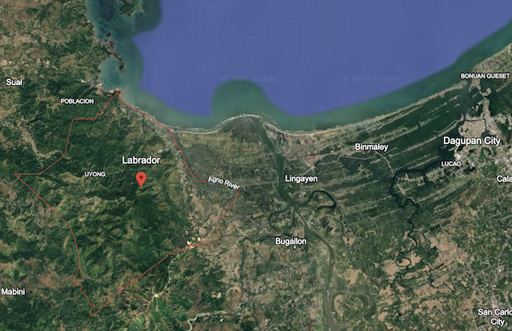
Proposed by Pangasinan 2nd District Representative Mark Cojuangco, the planned P225 billion ($3.88 billion) Labrador Nuclear Power Plant is an initial 1,000-megawatt facility to be built on a 120-hectare site.
While Cojuangco claimed that nuclear development could make Labrador the richest municipality in Pangasinan, PPSE stressed that these promises are detached from ground reality as communities are already hit hard by rising fuel prices, declining fish stocks, and high power bills—proving that mega-power projects is not a grounded solution.
“Development is not measured by how many buildings you can erect, but by whether the people have food to eat,” said Pax Guinto (real name withheld for security reasons) of PPSE.
The PPSE member noted that nuclear waste buried underground threatens severe soil degradation and will put communities at risk.

PPSE and other green groups in a March 21 forum against the Labrador Nuclear Power Plant (Source PPSE)
Nuclear energy for whom?
Pangasinan, long known as a coastal stronghold in Northern Luzon, derives its very name and identity from the sea. From the sprawling salt beds along its coasts to the world-renowned bangus (milkfish), the province’s rich marine ecosystems serve as a vital lifeline for millions.
In an interview with Bulatlat, Guinto of PPSE shared the importance of the “Atin ang Lingayen Gulf” (Lingayen Gulf is ours) campaign, which includes their strong opposition to the planned Labrador Nuclear Plant in Pangasinan.
According to Guinto, over 550,000 fisherfolk and more than a million residents depend directly and indirectly on the municipalities within Lingayen Gulf like Anda, Bolinao, Alaminos, Labrador, Lingayen, Binmaley, and Dagupan, for their survival. This includes small-scale fishers who find themselves increasingly squeezed out by skyrocketing fuel prices, ecological degradation, and repressive policies.
“We are launching the campaign, firstly to fight for the ocean, which is the source of livelihood of locals, and the ecological integrity of the sea.”
Lingayen Gulf is considered an Environmentally Critical Area under proclamation no. 156, meaning that the Gulf and its surrounding coastal zones are recognized as ecologically sensitive areas subject to strict environmental regulations.
Under the campaign, PPSE firmly opposes the proposed Labrador Nuclear Power Plant and planned Waste-to-Energy (WTE) incineration projects, while advocating for the livelihood of fisherfolk communities and protection of the environment. The group also demands an immediate halt to offshore black sand and magnetite mining operations such as those linked to Iron Ore Gold Vanadium Resources Inc. covering over 9,000 hectares across 26 coastal barangays in the municipal waters.
In a press release, PPSE also expounded the geopolitical reality behind the push for the power plant despite Pangasinan being a highly susceptible location. “The presence of a nuclear power plant transforms Pangasinan into a highly strategic vulnerability. In the context of modern military strategy, critical energy infrastructure serves a direct geopolitical purpose.”
The green group linked it to Pax Silica, stressing that as the U.S. seeks to secure absolute control over critical earth minerals for foreign profit, the proposed Labrador Nuclear Power Plant (LNPP) functions as a strategic asset to secure and power these foreign-dominated industrial supply chains.
The group further emphasized that the projects under the U.S.–Philippines 123 Agreement Framework and Nuclear Energy Road Map won’t truly benefit communities and are destructive to the environment.
The government’s Nuclear Energy Roadmap sets the national target of integrating nuclear power into the country’s energy grid by 2032. It is based on the U.S.–Philippines 123 Agreement, which provides the legal framework for foreign corporations to sell nuclear hardware, technical expertise, and Small Modular Reactors (SMRs) into the Philippines. Candidate sites under the roadmap include the proposed Labrador Nuclear Power Plant in Pangasinan.
A vow to push back
Beyond highlighting the severe environmental and social tolls of the proposed Labrador Nuclear Power Plant, PPSE emphasized that energy initiatives tied to foreign interests will never genuinely benefit the people.
“As long as it remains in the hands of local and foreign corporations, electricity prices will not decrease. Profit will continue to be prioritized over the welfare of the people, thereby monetizing these projects while also generating kickbacks and corruption,” the group said.
With the ongoing push for the nuclear plant and other energy projects in Lingayen Gulf, Guinto called on the public to stand up for the environment. Despite the escalating threats and harassment faced by environmental defenders in the region, Guinto vowed that PPSE and civil society will continue to push back and sustain environmental campaigns.
“The PPSE and the people will never back down; therefore, as champions of the people’s right to a safe and clean environment, the pro-environment movement will continue to grow and flourish for the genuine freedom and democracy of the people,” Guinto said. (AMU, RVO)
The post Pangasinan green group opposes Marcos Jr.’s pro-nuclear stance appeared first on Bulatlat.
From Bulatlat via This RSS Feed.