

MANILA – After four months, the National Fact-Finding and Solidarity Mission (NFFSM) released the findings of its investigation on the killing of 19 people in Toboso, Negros Occidental last April 19 which revealed serious violations of international humanitarian law.
“It was clear: the path of retreating civilians and revolutionaries is a dead end,” said Matty Miguel, convenor of Defend Negros, in a press conference on Wednesday, August 19. “The military can distinguish who among the individuals are combatants, civilians, and those incapacitated, but they killed them all.”
At least nine of the 19 people killed were civilians, including minors. Ten, on the other hand, are revolutionaries.
The report of the fact-finding team was based on the interviews of the residents of sitio Sinugmawan and sitio Plaringding and series of visits to the communities in Toboso and actual observations of the members of the fact-finding mission. The groups involved in the fact-finding also participated in the public inquiry organized by the Commission on Human Rights, which concluded on August 12.
Cristina Palabay, secretary general of human rights group Karapatan, said, “Negros 19 is the biggest single mass casualty involving international humanitarian law violations that we have documented and looked into in the recent years. This merits not only continuing attention but also continuing push for justice.”
The fact-finding report concluded that the Philippine Army violated Articles 48 and 57 of the Protocol I to the Geneva Conventions, which refer to the principle of distinction and proportionality. The Philippines ratified the Geneva Conventions, which refers to the set of international treaties that establish the rules of war through IHL.
Article 48 reads, “The Parties to the conflict shall at all times distinguish between the civilian population and combatants and between civilian objects and military objectives and accordingly shall direct their operations only against military objectives.”
Meanwhile, Article 57 of the Conventions, states that those who plan or decide upon an attack shall do everything feasible to ensure that the objectives to be attacked are neither civilians nor civilian objects are not subject to special protection. The only valid attack is targeted at military objectives – capacitated revolutionaries. The minor casualties in Toboso 19 massacre are considered specially protected persons of the rules of war.
Another violation is the targeting of armed combatants who were no longer in a position to fight back or hors de combat, the fact-finding report noted. The safeguards of hors de combat are outlined in the Article 41 of Additional Protocol I (1977) to the 1949 Geneva Conventions.
“A person who is recognized or who, in the circumstances, should be recognized to be ‘hors de combat’ shall not be made the object of attack,” the provision reads.
The report highlighted that the government soldiers were strategically positioned uphill in such a way that they had an unobstructed view of the fleeing individuals. The NPA revolutionaries could be identified within the range of soldiers’ high velocity firearms.
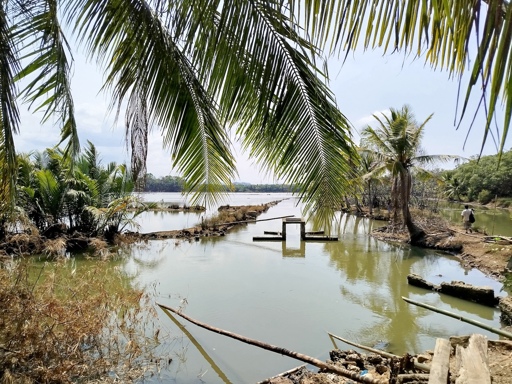
The mission report added that the site where civilians and revolutionaries were shot is a fishpond, with waist-deep muddy waters. It stated: “They were not in a position to inflict any harm on the soldiers, who were well protected by their strategic positions.By reason of their condition, the armed NPA members had transitioned into hors de combat and could have been easily captured. But the intention was obvious.”

Overlooking fishpond area where the 19 people were killed on April 19 in sitio Plaringding, barangay Salamanca, Toboso, Negros Occidental. (Photo by Anne Marxze D. Umil/Bulatlat)
Palabay said that this practice of “no quarters given” is prohibited not only under the Geneva Conventions, but also with the domestic IHL policy of the Philippines. It is considered a war crime under Section 4 of Republic Act 9851.
“Those incapacitated, both hors de combat and civilians, should be given temporary aid instead of being strafed with bullets,” Palabay added. “This is proof of the take no prisoners policy of this administration.”
A drone footage also captured Roger Fabiliar, one of the NPA revolutionary casualties, was submerged in a fishpond, unarmed, and as the report noted “clearly posing no imminent threat.”
A woman’s body had four gunshot wounds, including a gunshot wound to the leg that caused fatal bleeding, based on the autopsy of forensic pathologist Raquel Fortun in May.
Fortun noted that if the victim was still alive and incapacitated when the injury was inflicted, the failure to provide medical treatment could constitute a potential war crime since the injured person should have been afforded medical care.
Read: Forensic expert raises questions on Toboso killings
Fortun conducted an autopsy on five victims namely Alyssa Alano, Maureen Santuyo, Lyle Prijoles, Kai Sorem, and a male body that had been mistakenly identified as Errol. She said that the bodies bore multiple gunshot wounds from behind, raising questions about the military’s claim that the deaths resulted from an hours-long armed encounter.
Read: Humanizing the victims: Toboso massacre not a win for the Philippine military
Read: Negros massacre warrants probe on int’l humanitarian law violations
Extensive human rights violations
The right to life is applicable even in situations of armed conflict, according to Article 6 of the International Covenant on Civil and Political Rights (ICCPR), which the Philippines ratified again. This right protects every person from the arbitrary deprivation of life.
“In the context of the Negros 19 massacre, there are clear indications that the killing of the victims was arbitrary and unjustifiable, considering the attendant facts and circumstances,” the report stated, adding that there was also no justification for the use of lethal force.
The fact-finding team also identified that the bodies recovered from the funeral home showed severe burns, bloating, and decomposition due to neglect and prolonged exposure. “This reflects a failure in the care and lawful handling of human remains, revealing unprofessional management by the military and police forces,” the report added.
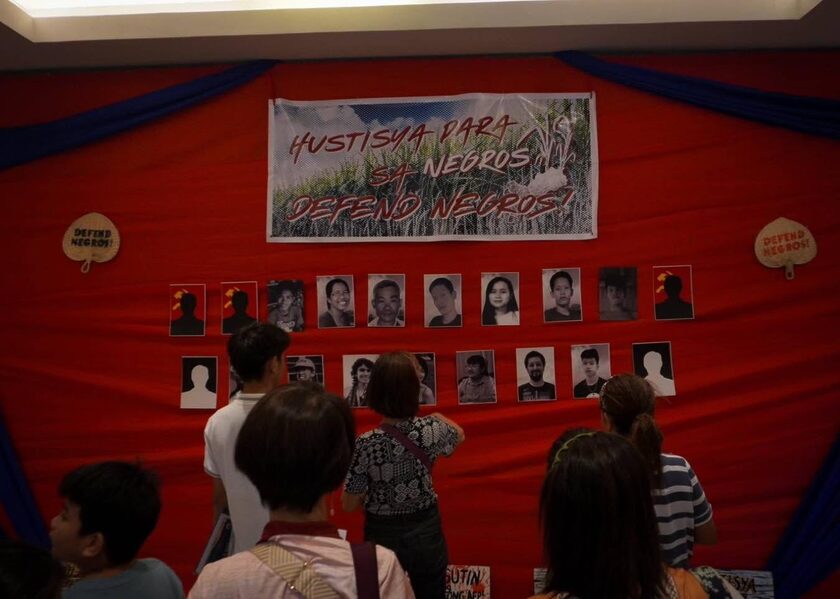
Portraits of the Toboso 19 casualties. Photo by Viggo Sarmago/Bulatlat.
Lisa, mother of Errol, said that for four months, their family could not grieve properly since they still do not have access to the body of Errol. “What they did to my son was brutal. And it was even more brutal that we could not have his body. I could not sleep well,” she said.
On May 11, another search team was dispatched to assist Errol’s family in locating and identifying his remains. They sought the assistance from the CHR – Negros Island Regional Office, which assigned two investigators to join the search.
The search started with the funeral homes. Personnel from the Niniel Funeral Homes stated that the bodies arrived naked, with their clothes and personal effects wet, foul-smelling, and wrapped in plastic, with no identification tags. However, Shekainah Funeral Home’s owner stated that all 19 bodies arrived at the funeral home, and maintained that the personnel from Philippine National Police – Scene of the Crime Operative (PNP-SOCO) followed procedures and properly tagged the bodies, which are in contradiction to initial accounts of another funeral home.
The search went on to the PNP-SOCO to request copies of the post-mortem examination records and other documents that could assist the team in identifying the remains. However, the personnel declined to answer and referred them to the Toboso Municipal Police Station.
There is no significant development in claiming the remains of Errol as of this writing. Lisa called on the local government unit to assist them in tracing their son’s remains. In a previous Bulatlat report, the family and the fact-finding team also urged the National Bureau of Investigation (NBI) to take action.
Read: Months after massacre, victim’s remains not yet given to family
Moreover, they gathered statements of the residents, showing signs of children’s trauma. Mothers recounted that their young children refused to be separated from them, even when using the bathroom.
“Daily routines were also severely disrupted, with residents returning home much earlier than usual out of fear of military operations in the community,” the report noted.
Due to this, the Children’s Rehabilitation Center (CRC) recommends an in-depth processing of the thoughts and experiences of the children and their parents in a safe space.
Call for justice
In a press conference on Wednesday, August 19, some family members expressed their anguish and called for justice.
“I still could not accept that they killed my daughter, Alyssa,” said Shiela Alano in a Filipino letter read at the press conference. “We are still looking for ways to get justice but those who killed them continue to hold arms, unaccounted for their crimes.”
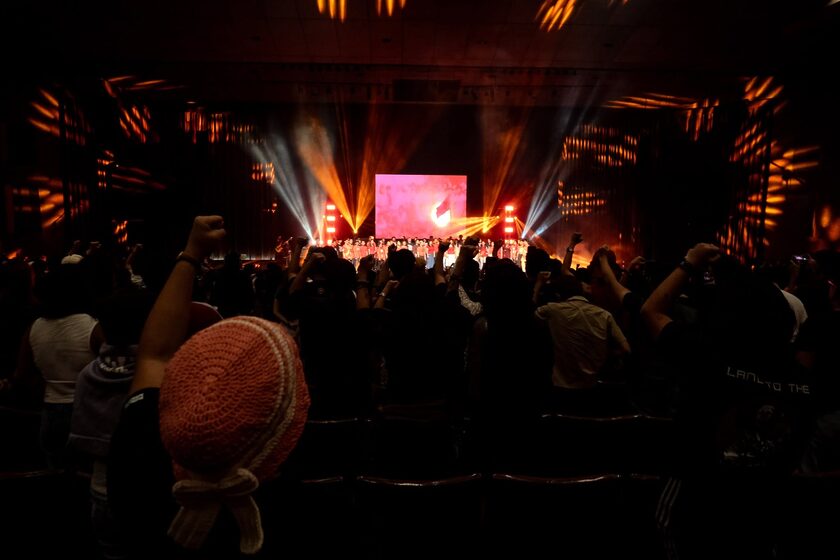
A tribute program at the University of the Philippines Diliman to amplify calls for justice for the Toboso 19 killings. Photo by Viggo Sarmago/Bulatlat.
Shiela said that her daughter’s decision to immerse with the landless farmers and farm workers of Negros was not a crime. “We raised Alyssa in a home filled with love, one that never condoned or perpetuated violence. Not once did I hurt her or ever lay a hand on her.”
Sol Santuyo, mother of Maureen Santuyo, also reiterated that helping the marginalized sectors was not a crime but an act of compassion. “They were helping people, but why were they killed? We need answers for the lives of our children. It has been four months but all we heard was red-tagging. Is that enough reason for them to kill them?” she asked.
Meanwhile, Karapatan Secretary General Cristina Palabay said that for a truly independent investigation to prosper, it must start with the pull-out of the 79th Infantry Battalion and other military units from Toboso.
The fact-finding team also recommended that the entry of individuals and organizations affiliated with AFP and the NTF-ELCAC into affected communities should be disallowed while investigations are ongoing.
“As long as they remain there, it will be hard to execute statements and judicial affidavits that the investigative bodies can submit to the court,” said Palabay. “There is no freedom to speak if the perpetrators are looming in the communities. There is a fear of reprisal and retaliation.”
Another recommendation is for the victims’ families and their legal representatives to be allowed full access to all documentation in possession of the 79th Infantry Battalion and the AFP, including the mission order, drone footage, after-operation reports, and other relevant records.
“If they are all for independent investigation because they are confident that what happened in Toboso is a legitimate military operation, then show the records,” Palabay added. “If you cannot provide it to the CHR and the family, then you are hiding something.”
Moreover, they called on the AFP, NTF-ELCAC, and individuals acting on their behalf to immediately cease approaching, intimidating, or harassing the families, relatives, and friends of the deceased. Most especially, the red-tagging and political vilification they had been releasing online.
The fact-finding team reiterated in their recommended the abolition of the NTF-ELCAC by repealing the Executive Order No. 70 and for the Philippine government to adhere to its obligations under the Geneva Conventions, the Republic Act 9851, and the Comprehensive Agreement on Respect for Human Rights and International Humanitarian Law (CARHIHL).
“We will not stop until we find justice,” said Shiela. “I will be brave like you (Alyssa),” Shiela said. (AMU, RVO)
The post International humanitarian law violated in Toboso massacre, fact-finding concludes appeared first on Bulatlat.
From Bulatlat via This RSS Feed.