

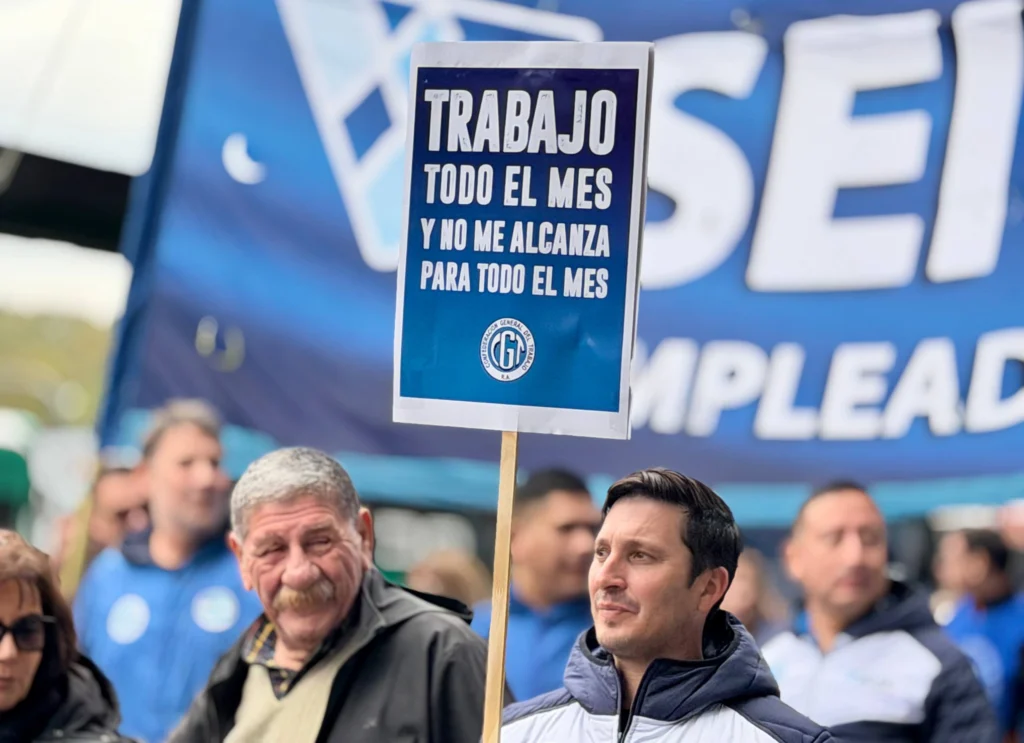
Thousands of protesters marched to Argentina’s Ministry of Economy on Thursday, demanding the right-wing government of President Javier Milei address a family debt crisis that, according to Central Bank data, has left roughly 5.8 million people with unpaid loans or severe arrears.
The demonstration was convened by the General Confederation of Labor (CGT), the two CTA factions (Workers and Autonomous), the Union of Workers and Workers of the Popular Economy (UTEP), and various self-organized debtor groups. Organizers estimate that some 20 million Argentinians carry some form of debt with financial institutions, with 6 million of those considered to be in a critical situation.
RELATED: Argentina Job Market Under Strain as Long-Term Unemployment Persist
In a statement, the CGT explained the underlying dynamic, noting that families resort to borrowing to cover rent, food, electricity, gas, and other basic household expenses.
A notable feature of this mobilization was the participation of a newly emerged social actor: individuals who organized under the banner “Organized Debtors” after realizing their personal financial distress was a shared experience. Marching alongside the union column under the slogan “It is not individual, it is collective,” this self-convened group explicitly called for limits on interest rates.
Cristian Jerónimo, co-secretary general of the CGT, placed direct blame on the national leadership, singling out both the President and the Economy Minister for carrying out what he described as a regressive adjustment policy that depresses wages, undermines consumption, and disrupts the entire productive system.
On the other hand, Hugo Godoy, secretary general of the Autonomous CTA, linked the indebtedness crisis to the deterioration of the formal labor market, stating that 340,000 formal jobs have already been destroyed and nearly 30,000 businesses continue to shut down.
Julia Moragues, a member of the Association of Personnel of Social Security Agencies (APOPS), attributed the surge in debt to the absence of wage negotiations. She noted that after 32 months without collective bargaining updates, salaries have remained well below inflation. That shift, she emphasized, has fundamentally altered why families borrow: they now go into debt to buy food, rather than for appliances or travel as was previously common.
| Endeudarse para comer: la dramática realidad financiera en Argentina. Más de 5,8 millones de personas se encuentran imposibilitadas de afrontar sus deudas bancarias y digitales donde la morosidad alcanzó un máximo histórico del 12,8 %, impulsada por costos financieros… pic.twitter.com/rPlVypt03h
— teleSUR TV (@teleSURtv) August 21, 2026

Among the most affected groups are retirees, many of whom supplement their minimum pension with informal work such as driving for ride-hailing apps or performing odd jobs. As of August 2026, that minimum pension totals 489,775.92 pesos (approximately 327 dollars) when including an extraordinary bonus that has been frozen at 70,000 pesos (about 46 dollars) for several months.
From teleSUR English via This RSS Feed.