

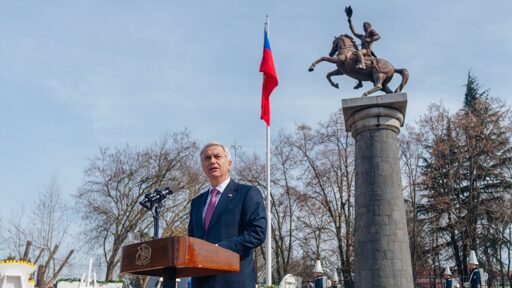

Just as he promised during his election campaign, right-wing President José Antonio Kast has launched a series of reforms to radicalize the neoliberal agenda in Chile and intensify anti-immigration policies.
However, one of Kast’s most important promises (which was a central pillar of his election campaign) was an ambitious legal reform to overhaul the law against organized crime.
On August 17, Kast finally submitted his proposal to the Senate. Following the same model as other neoliberal Latin American governments that have reformed the law in recent years, Kast proposes that the “state of emergency” become a sort of political norm that can be used on a regular basis.
During the 20th century, the Nazi philosopher Carl Schmitt had already stated that the sovereign is the one who can declare a state of emergency. For his part, the Italian philosopher Giorgio Agamben emphasized this idea but added that new governments were turning the state of emergency not into something exceptional, but into a routine tool of government used to control citizens and weaken democracies – a tool for which any justification, such as a “social threat,” is employed.
Chile is all too familiar with how the power of force can destroy democratic processes (as demonstrated by the US-backed dictator Augusto Pinochet). Kast is attempting to formally align itself with this historical trend.
To this end, in an apparent contradiction, he proposes reducing the state’s power to regulate the economy, while (according to the proposed law) strengthening its capabilities to prevent and prosecute crimes and “safeguard public order.”
Chile’s former president, the center-left Gabriel Boric, said of Kast’s proposal: “It seeks to establish a state of siege for 240 days, with exclusive authority vested in the president of the Republic and an unprecedented restriction on freedoms never before seen in Chilean democracy.”
He added: “Those of us in politics must be willing to collaborate with whoever is in government on matters of national policy, which does not mean compromising on our clear convictions.”
What would change in Chile?
Kast proposes eight specific constitutional amendments, along with 30 bills that, according to the government, are part of the Agenda Against Organized Crime and Terrorism (ACOT).
The reform proposes that the president be able to declare a new type of state of emergency, which would be imposed by presidential decree in the event of a “serious and imminent threat to public safety or whenever public safety has been seriously compromised.” This state of emergency may be extended for 120 days by presidential decree, although further extensions would require the approval of the National Congress.
In this regard, the president may “suspend or restrict personal liberty and freedom of movement, as well as the right to assembly; [and] restrict the exercise of the right to association; intercept, open, or search documents and all types of communications; and order the seizure of property.” According to Security Minister Martín Arrau, the introduction of a new type of state of emergency is justified to intervene in areas “where terrorist groups or organized crime operate and which are difficult to penetrate,” as reported by El País.
Read more: Anti-government protests in Chile face heavy repression
In areas declared to be in a state of emergency, the package of reforms and laws proposes that a general officer, appointed by the head of state, take command, although it is unclear whether this officer will be a civilian or a military or police officer.
In addition, the package of laws proposes, as is the case in other countries, the creation of a registry of organized crime and terrorist organizations, against which the state must take action. Under the proposal, the president would have the authority to designate a particular organization as terrorist following a report from the Public Prosecutor’s Office or the National Security Council.
It is important to note that the Executive Branch proposes withdrawing social benefits (such as health care) from those convicted of organized crime and terrorism, meaning these prisoners could be left without medical care. “When taxpayers fund benefits for people who have caused so much harm to society, there is a sense of injustice. That is what we want to correct,” said Arrau.
Along these same lines, the reforms propose that a person convicted of these crimes be permanently barred from holding public office and be ineligible for alternative sentencing measures for 15 years.
The Senate has 15 days to debate the proposal and render its verdict. This package of legislative reforms and far-reaching constitutional changes would set Chile on the path toward a security policy aligned with the model that Washington has been proposing for the past few years. Indeed, most governments aligned with the United States (in the coalition known as the Shield of the Americas) have replicated this model almost exactly.
From BT News via This RSS Feed.