


Kevin Abourezk
ICT
Alaska’s primary election on Tuesday yielded interesting results for Native candidates beyond Mary Peltola’s first-place finish in the U.S. Senate race.
Two Native candidates for Congress were among the top four candidates in their races as of Thursday, and at least one of those will move onto the general election in November having earned a strong second-place finish.
Alaska’s ranked choice voting system requires all candidates for a given race to appear on the primary ballot, regardless of party affiliation. Voters are allowed to vote for candidates outside their own party affiliation in primaries, with the top four vote-getting candidates for every race moving onto the general election in November.
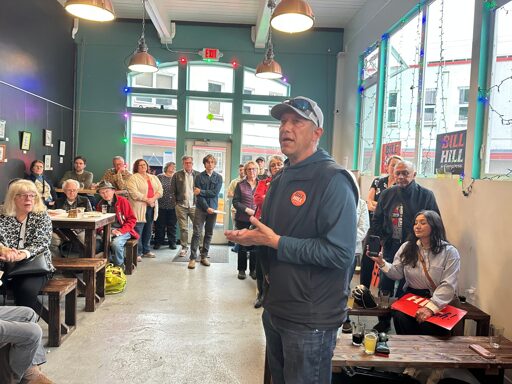
With 98 percent of precincts reporting as of Thursday, Aug. 20, in the race for Alaska’s lone U.S. House of Representatives seat, Independent Bill Hill, Dena’ina Athabascan, was in second place with 31 percent of the vote – 15 percentage points behind GOP U.S. Rep. Nick Begich.
The third highest vote-getting candidate in the race had earned just 8 percent of the vote by Thursday.
In the Alaska Senate race, with 98 percent of precincts reporting Thursday, Democrat David Leslie, Iñupiat, was running in fourth place with 1.13 percent of the vote, though the fifth-highest vote-getting candidate only trailed him by 0.02 percentage points.
Peltola was the top primary vote getter followed by the state’s junior U.S. senator, Republican Dan Sullivan. Another candidate named Sullivan, Dan J. Sullivan, came in a distant third.
Hill grew up in a small village in Bristol Bay, Alaska, learning to fish and hunt for subsistence. He spent 25 years as a teacher, principal and superintendent before becoming a commercial fisherman. He and his wife started Bristol Bay Brailer, a textile manufacturing business that supplies custom-made brailers for the commercial fishing fleet. A brailer is a large mesh bag used to hold and lift fish from a boat.
Leslie was born in Louisiana and raised in Fairbanks. He studied film and broadcast journalism at the University of Alaska Fairbanks and currently works as a contractor for environmental causes affecting Alaska and the Arctic, according to his campaign website.
As an activist, he has organized protests, rallies and fundraisers for a wide variety of causes.
Leslie told ICT recently that he decided to run for Senate because he didn’t see other candidates talking about important issues like the “genocide in Gaza,” federal immigration enforcement efforts and what he called President Donald Trump’s abuses of power.
“We need someone with a clear voice willing to protect and defend not just Alaskan Native people but all Americans,” he said.
In his interview with ICT, Leslie said he was concerned about the amount of super PAC money being invested into his campaign and the political ads that money has funded to support his campaign – all without his approval. In the two weeks leading up to the Alaska primary, a super PAC known as the American Democracy Project spent $300,000 to support Leslie.
According to Alaska Public Media, super PACs have spent more than $2 million attempting to elevate relatively unknown political candidates in the Alaska Senate race, including Leslie. Alaska Public Media reported that it contacted a major funder for the American Democracy Project, a wealthy Texan named Rishi Bhutada, who said other funders were using the super PAC to fund one of Peltola’s opponents – an aim that he said he didn’t share.
“Some different groups have been spending hundreds of thousands of dollars on ads in support of me and my campaign, and so I’ve been getting a lot of people reaching out to me thinking that these are my mailers or my video ads when they were not made by my campaign,” Leslie told ICT.
Additionally, Leslie said money shouldn’t get to carry so much influence in elections and criticized the millions of dollars spent by both Peltola’s and Sullivan’s campaigns.
“Too many people think money is the main indicator of whether or not someone will get elected, or even if we should listen to them in debates in other places,” he said. “Our elections should be about our values and our commitment to the community, not about who got the most rich people to donate to them.”
If she wins in November, Peltola, Yup’ik, will get a shot to become the first Native woman U.S. senator in America after advancing past the primary election in a race that could determine the balance of power in the U.S. Senate.
“We really need a champion for us in Washington, D.C., who gets us and will work hard for us,” Peltola told supporters Tuesday.
Besides Peltola, Leslie and Hill, 15 other Native candidates were seeking office in Alaska on Tuesday. They include:
- With just two candidates for the District 40 Alaska House of Representatives seat, Saima Chase, Iñupiat and a Democrat, and Robyn Frier, an Iñupiat and a Democrat, will move onto the general election
- With just three candidates for the District 31 Alaska House of Representatives seat, Maxine Dibert, Koyukon Athabascan and a Democrat, will move onto the general election
- With just three candidates for the District 39 Alaska House of Representatives seat, candidates Neal Foster, Iñupiat and a Democrat, Tyler Ivanoff, Iñupiat, Yup’ik and nonpartisan, and Reynold Okitkun, Village of Kotlik and a Democrat, will move onto the general election
- With just four candidates for the District 38 Alaska House of Representatives seat, Nellie “Unangiq” Jimmie, Yup’ik and a Democrat, will move onto the general election
- With 94 percent of precincts as of Thursday morning reporting and solidly in third place in the District 37 Alaska House of Representatives race, Dennis Robinson, Qawalangin Tribe of Unalaska and a Democrat, will likely move onto the general election, while Cade Woods, Curyung Tribal Council and an Independent, was running neck to neck against Kimberly Johnson, both having so far earned 10.17 percent of the vote for the fourth-place candidate position
- With 92 percent of precincts reporting in the race for the District S Alaska State Senate seat, candidates Darren Deacon, Native Village of Kalskag and a Republican, and Bryce Edgmon, Yup’ik and an Independent, appear to be headed to the general election, while candidate Wayne Morgan, Aniak Traditional Council and an Independent, appears likely to have lost the race for the fourth-place finish
- With 98 percent of precincts reporting as of Thursday morning, Meda DeWitt, Tlingit and an Independent, lost her bid for Alaska’s governor earning just 2.5 percent of the vote
- With 98 percent of precincts reporting as of Thursday morning, Greta Schuerch, Iñupiaq, a Republican seeking to become Alaska’s lieutenant governor, has lost her bid for the seat
- With 98 percent of precincts reporting as of Thursday morning, Christopher Steere, Iñupiaq, a nonpartisan candidate, has lost his bid to become Alaska’s lieutenant governor
ICT will work to provide updates on the results.
The post Besides Mary Peltola, two other Native congressional candidates could appear on Alaska ballots in November appeared first on ICT.
From ICT via This RSS Feed.