

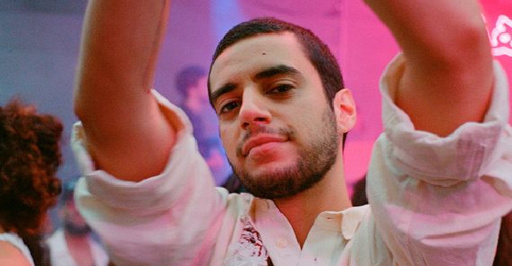
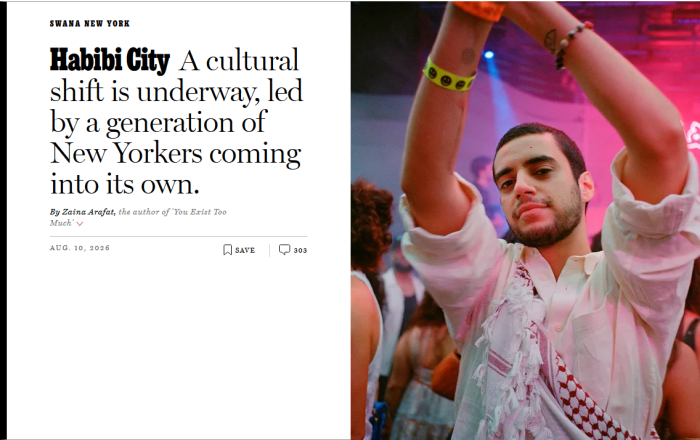
New York (8/10/26) on the “SWANA-ssance”: “Like that of other New York ethnic groups who had cultivated a sense of cool in response to oppression …the cultural energy was audacious, subversive and increasingly covetable by others.”
New York magazine’s feature story, “Habibi City” (8/10/26), shouldn’t be a controversial piece of reporting. This is no offense to the writer, Zaina Arafat, who fused her personal experience with shoe-leather journalism.
In essence, the piece is about the growing cultural influence of Arabs and Persians in New York City, corresponding with the rise of the city’s first Muslim mayor—and the growing political backlash to anyone, regardless of identity, who criticizes the Israeli government. An article exploring the city’s Tibetan communities or Ukrainian cultural institutions wouldn’t be seen as crossing some political boundary.
And yet, writing about dinner parties, get-togethers and lived experiences in the most diverse city on the planet is a problem for the right—if it’s about Arabs or Persians.
A ‘callous comparison’ of Zionism to hatred
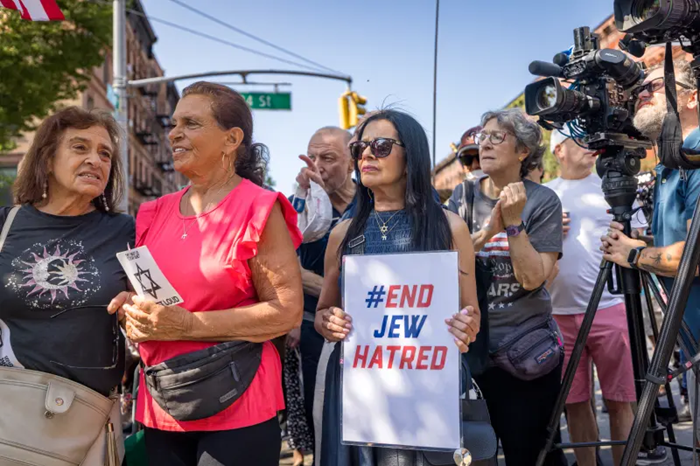
The New York Post (8/12/26) accompanied its article on New York‘s “Habibi City” piece with a photo of an “End Jew Hatred” rally.
The New York Post (8/12/26), citing “critics,” accused the piece of “repeatedly noting Israel’s response to October 7 while ignoring the actual terror massacre of that day.” It complained that New York said that Arabs and Persians “face xenophobia, Islamophobia and Zionism—along with the repercussions of speaking out against them,” calling this “a callous comparison of Zionism to menacing forms of hatred.”
Of course, we can’t see the Post doing the opposite: Had a piece appeared in New York covering Upper East Side Jews talking about the terror of anti-Zionism, we’d hardly hear criticism from the tabloid complaining that the magazine had silenced Palestinian voices, had not told the story from the perspective of the people the story was not about. That’s what’s called a double standard.
At Bari Weiss’ Free Press (8/11/26), right-wing pundit Liel Leibovitz (who is also the son of Israel’s most notorious bank robber—Haaretz, 2/27/13) blasted the New York article, taking particular issue with the term “SWANA,” meaning Southwest Asian and North African. He said it “represents anyone who is vaguely Middle Eastern and dislikes capitalism, America and the Jews,” while gleefully making the racist joke that this acronym previously stood for “Solid Waste Association of North America.”
This is actually tame stuff from Leibovitz, who once supported Poland’s limiting of Holocaust property claims (Tablet, 8/17/21): “There’s a name for people who imagine that the right to reclaim your great-grandmother’s house should extend forever: Palestinians.”
‘Not theirs to erase’
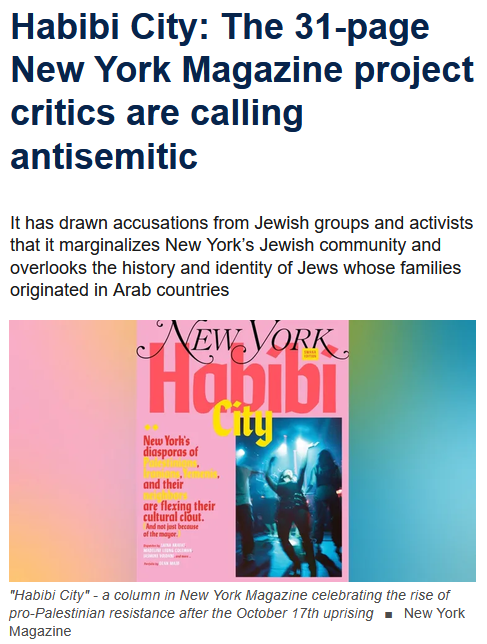
The Israeli news outlet i24 (8/13/26) described the New York piece as “celebrating the rise of pro-Palestinian resistance after the October 17th [sic] uprising.”
But Leibovitz is not alone in denouncing the New York magazine piece. From i24 (8/13/26), an Israeli outlet:
The pro-Israel organization AIPAC said the magazine’s framing “erases what [Zionism] actually represents for millions of Jews: the belief that Jews, like other peoples, have the right to national self-determination and security.”
Jewish civil rights organization End Jew Hatred also condemned the feature, saying: “Jewish identity is not theirs to erase, and Jewish history will not be rewritten to fit a political narrative.”
Jonathan Greenblatt, chief of the Anti-Defamation League, said on X (8/10/26):
Calling for other peoples’ self-determination while labeling the Jewish people’s request for the same treatment as hate is not factual—[it’s] a blatant, disgusting double standard.
As FAIR (12/15/23) has written, driving people of a different ethnicity off of their land so that your people can have an ethnic majority is not called “self-determination,” but “ethnic cleansing”—and occupying people’s land while denying them the right to vote is not self-determination but apartheid.
‘Dialogue should never become taboo’
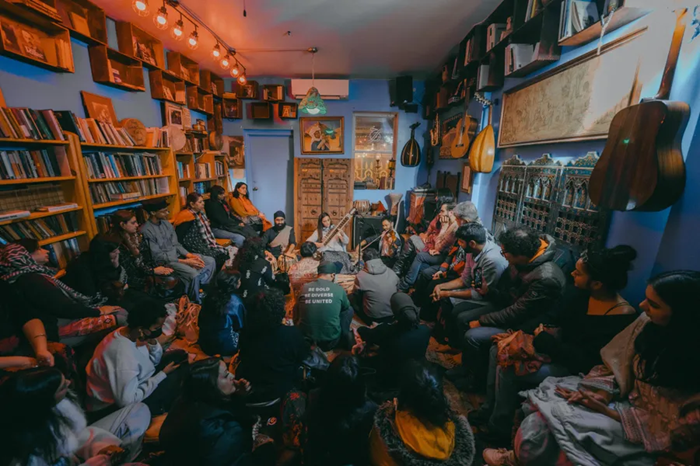
New York‘s photograph (8/10/26) of the Barzakh cafe, whose mission includes “bring[ing] together people who might otherwise never meet,” including “Palestinians from Gaza and Jews.”
Despite all the caterwauling about writing Jewish people out of history, the article does talk about Jews and Israel. There’s a passage about El Atigh Abba, owner of the Brooklyn cafe Barzakh:
At the same time, Abba makes a point of emphasizing the specific culture of each community that passes through. Laura Elkeslassy, an Arab Jewish singer, has led a yearly Mimouna at Barzakh—a dinner that marks the return to eating leavened bread after Passover. On Easter weekend, the café held an Armenian and Ethiopian Christian dinner. So much of Barzakh’s mission is to bring together people who might otherwise never meet and who, in other contexts, might be enemies: Palestinians from Gaza and Jews, including anti-Zionist Israelis.
In fact, Abba’s story is quite nuanced:
At Barzakh, one of the first sources of tension was over whether to allow a group of Palestinians from the pre-1948 borders to perform with Israeli peers. “Of course, they’re not Zionists, but these were tensions we had to reckon with,” Abba recalls. Last year, Barzakh hosted a Hebrew-Arabic language exchange. After the event was posted on Instagram, a heated debate unfolded in the comments section. “Consider how many Arabic speakers are forced to learn Hebrew as a means of survival,” one user noted. “This is hope,” said another. Some called on Abba to cancel, but he didn’t budge. “There is within the Arab young generation, the kids who were born here in [the] US, an idea that you cannot sit with an Israeli in the same room,” he told the Forward [5/30/25] at the time.
The piece went on:
Most recently, in July, Barzakh hosted a performance by the Palestinian singer Nour Darwish and the Israeli musician Noam Helfer. They were part of Feel Beit, an anti-Zionist, pro-dialogue artistic partnership. Reactions were mixed. One of the local DJs took issue with the use of the word dialogue. “I stood by it,” Abba tells me. “Words like dialogue and conversation should never become taboo. I also felt it was important to say that an Arab born in New Jersey doesn’t get to tell a Palestinian in Nazareth who they can share a stage with or how they should conduct their own struggle for liberation.”
This certainly doesn’t read like erasure. It sounds like some critics just didn’t read the article.
Murdoch heir ’tilts toward Hamas’?
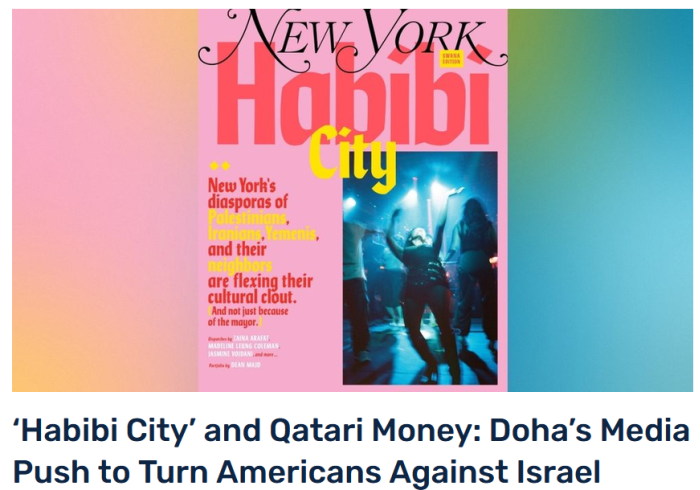
The Combat Antisemitism Movement (8/14/26) acknowledges that James Murdoch’s business deal with Qatar probably had nothing to do with New York‘s “Habibi City” story—but it still somehow demonstrates “that Qatar is making a concerted effort to shape America’s public space against Jews and Israel.”
The group Combat Antisemitism Movement (CAM) started its attack on the article (8/14/26) by noting that Commentary editor John Podhoretz (New York Post, 8/12/26) believed the article sent a message: “Jews aren’t welcome in Mamdani’s NYC.”
It is truly nonsensical to say any presence of one group of people in the city means another is excluded. A review of Greek life in Astoria wouldn’t be read as anti-Turkish. Does the popularity of the Irish pub scene in Woodside, where bars are often festooned with pro-unity posterage, mean the English aren’t welcome in the city? Are the city’s various Chinatowns an F-you to the Japanese?
But it gets weirder. New York was acquired by Murdoch scion James Murdoch just months ago (AP, 5/20/26). CAM referenced a piece in a right-wing DC-based website:
“Under James Murdoch,” according to the Washington Free Beacon [8/10/26], referring to the youngest son of media mogul Rupert Murdoch and the magazine’s new owner, “New York Magazine Tilts Toward Hamas.”
And indeed, there’s evidence to suggest the left-wing son of the English-speaking world’s most famous publishing magnate has been influenced by Hamas’s sponsor, the emirate of Qatar—which is also in business with Murdoch.
It is true that “James Murdoch challenged his father regarding Israeli dispossession of Palestinians from their homes” (Al Jazeera, 8/9/11), reportedly during a meeting at 10 Downing Street in 2002 (CAIR, 7/25/07). But James Murdoch also “pledged to donate $1 million to the Anti-Defamation League” in 2017 (New York Times, 8/17/17). It’s hard to imagine that the younger Murdoch, not exactly a man in the shadows, is now the secret link between Palestine’s Hamas and the Zionist ADL.
It’s also rich to think any link to Qatar means influence by Hamas. The biggest US military base in the Middle East is outside Doha (Reuters, 1/14/26), and last year the White House (5/14/25) boasted “an agreement with Qatar to generate an economic exchange worth at least $1.2 trillion.” We can only look at the CAM and the Free Beacon while channeling Sigmund Freud: Is Hamas in the room with us right now?
And the National Review (8/17/26), in its attack on New York’s cultural reporting, noted that CAM “says it’s likely that editor-in-chief David Haskell commissioned the piece ‘well before’ Murdoch’s purchase of the magazine was complete,” and that the group admitted, “That doesn’t necessarily mean Qatar is dictating New York magazine*’*s editorial decisions.”
All of these nonsensical responses to a straightforward piece of cultural reporting are a testament to what Arabs, Persians and other groups are up against in the press. Merely telling their stories and sharing their narratives will be met with cries of antisemitism and hysterionic conspiracy theories about Qatari propaganda.
What we need, then, is more articles like “Habibi City.”
From FAIR via This RSS Feed.