


Note: This story is based on the latest available information as of 9 a.m. PT Aug. 20. Please refer to your local government, fire agency websites and social media for the most timely information regarding fire activity.
Nika Bartoo-Smith
Underscore Native News + ICT
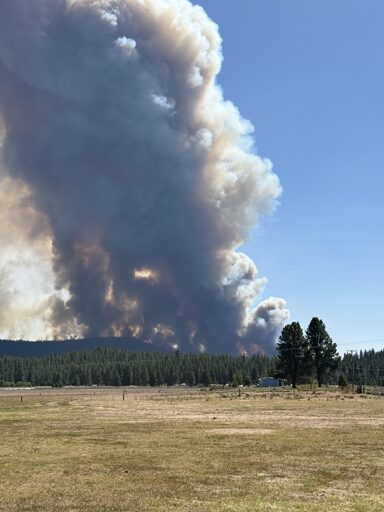
Klamath County, Oregon — As crews work to contain the Wrights Spring Fire in southern Oregon, the Klamath Tribes Wildland Fire Program has been on the ground since Day One.
The Wrights Spring Fire, first reported on Aug. 5, has grown to over 54,000 acres since first reported. As of 9 a.m. Pacific Time on Aug. 20, the fire was 55 percent contained, according to Watch Duty.
“It burned very quickly and escaped all the initial attack efforts,” said Tim Sexton, Klamath Tribes Wildland Fire Program manager.
The cause of the fire is still unknown. It encompasses a region southeast of Chiloquin and northeast of Klamath Falls within the Fremont-Winema National Forest.
One person, Jason Ensign from Klamath Falls, died on Aug. 7 while operating a bulldozer, working to contain the spread of the fire.
973 personnel have worked to contain the fire, according to Inciweb, including the 14 fire-qualified personnel of the Klamath Tribes Wildland Fire Program.
“When we initially got out there, it was extreme fire behavior, rapid rates of spread, long-range spotting, and pretty inaccessible,” said David Lilly, citizen of the Klamath Tribes and the Klamath Tribes Deputy Wildland Fire Program Manager.
“I’m really proud of our fire program and our firefighters. They went out initially around the same time that I responded to the fire and worked through that first shift into the next day and so they were facing those really tough conditions,” he continued.
The Wrights Spring Fire
Responding to the fire right away, the Klamath Tribes Wildland Fire Program crew spent a full 27 hours working to contain the fire that first day, according to Lorentino Weiser, a squad leader on the team.
Since then, the crews have continued to work tirelessly to both attempt to contain the fire and do prevention work in other areas near to the fire.

Left to right: Victor Parazoo, Gus Miller, Trevor Red Fox, Naydra Hicks, David Lilly, Trevin Lilly, Petey Henthorne (kneeling), Zach Osborn, Shasta Haynes, Chad Rich (back), Mario Sainez (front), Lorentino Weiser (back), Tim Sexton (front), and Kenai Kauffman. (Photo courtesy of the Klamath Tribes)
“I’m glad we’re here working (the Wrights Spring Fire), but it was pretty devastating to see because it’s a lot of the area I grew up hunting,” said Weiser, Modoc and Paiute.
The fire is currently burning through areas that are both culturally and historically significant to the Klamath Tribes, including former reservation lands, and sites such as Saddle Mountain.
Last week, crews from the Klamath Tribes Wildland Fire Program spent a few days doing fire mitigation and prevention work on a cemetery where many ancestors of citizens of the Klamath Tribes are laid to rest. Though not currently impacted by the fire, the cemetery is near the perimeter, according to Lilly.
“Our cemeteries are really important to our people, like a lot of cultural sites, and so that was a big part, to be able to go try to prevent the fire from getting there,” Weiser said.
Klamath Tribes Wildland Fire Program
In 2023, the Klamath Tribes first launched the Wildland Fire Program, a significant milestone for the tribe.
“Today the fire organization is managed by the Klamath Tribes, not the (Bureau of Indian Affairs), and it’s the first time that the Klamath Tribes has had a fire program that is entirely developed and managed by the Klamath Tribes,” Sexton said.
Sexton was hired in March 2023 to manage the program. He came on with decades of experience in fire management, including working for the U.S. Forest Service and serving as the district fire management officer for the Chiloquin Ranger District of the Winema National Forest.
The program consists of a three-person fire engine crew, a 10-person wildland fire module and a fuels person along with Sexton, Wildland Fire Program manager, and Lilly, deputy Wildland Fire Program manager.
Sexton is one of only two in the program who are not Klamath tribal members.
“(We are) creating opportunities for tribal members locally to be able to be hired by the tribe and get trained and work on fire assignments locally, regionally and nationally, and gain that experience,” Lilly said.

Kyle Gomez USFS and Lead READ on the fire with Chairman William E. Ray Jr. (Photo courtesy of the Klamath Tribes)
The team is busy year round. Beyond actively responding to wildfires, the program focuses most of its efforts on ecosystem restoration of trust lands and former reservation lands that are currently managed by the Fremont-Winema National Forest and the U.S. Fish and Wildlife Service, according to Sexton. That work involves stream restoration and prescribed burns.
The program itself is something that many tribal members have wanted to see happen for a long time.
Weiser, who has been on the crew since the program began in 2023, remembers his late grandfather who worked for the tribe talking about the need for a fire program.
“It’s really good to be able to work on our homelands. And it’s really impactful to me because it’s something my grandpa really wanted for years and years since I was a kid,” Weiser said. “It’s something I can look back on and be like ‘we finally got this going.’”
This story is co-published by Underscore Native News and ICT, a news partnership that covers Indigenous communities in the Pacific Northwest.
The post Klamath Tribes respond to Oregon fire appeared first on ICT.
From ICT via This RSS Feed.