

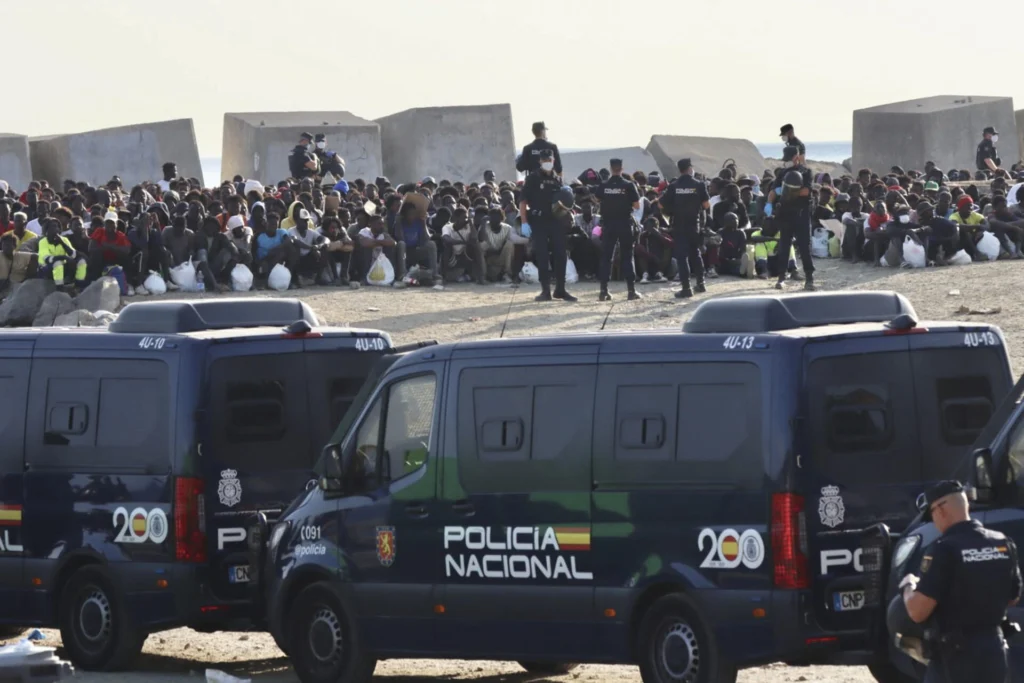
The Spain’s government transferred this Tuesday approximately 1,700 migrants from informal beach settlements in Ceuta to temporary reception camps to alleviate an unprecedented humanitarian and sanitary crisis in the North African enclave.
The coordinated operation, led by the National Police, began early in the morning at the informal settlements on El Trampolín beach. Officials reported that the relocation of the 1,700 migrants was voluntary and proceeded without major security incidents.
To prevent potential altercations, authorities divided the population according to geographic origin.
RELATED: UNICEF Calls for Urgent Identification of Unaccompanied Children in Ceuta
Migrants of Sub-Saharan origin were escorted to Margarita Hill, located less than one kilometer away, where they underwent identification and placement in newly established cabins. Simultaneously, individuals from Maghreb countries were directed on foot to the Colmenar Hill distribution area, located near the Tarajal border crossing. This separation strategy aims to manage the diverse groups safely during the transition.
The Ministry of Inclusion, Social Security & Migrations conditioned these two temporary spaces to house a combined 1,800 people. However, the global plan aims to expand capacity to over 5,000 places using other public facilities.
The Spanish Ministry denied rumors regarding the structural collapse of tents due to bad weather in Colmenar Hill. Authorities clarified that some structures were dismantled preventively while they remained unoccupied to avoid any unnecessary damage.
The Spanish government on Thursday announced plans to establish temporary shelters for around 1,800 migrants in Ceuta, in an effort to avert a humanitarian crisis following last month’s influx from Morocco. An estimated 72,000 migrants entered the Spanish enclave, although… pic.twitter.com/ADkNDzdj6d
— CGTN Africa (@cgtnafrica) August 20, 2026
Severe Health Collapse
The emergency relocation responds to the critical accumulation of over 3,500 people living on the beach. This high concentration followed the massive irregular arrival of 80,000 people from Morocco on July 30 and 31.
Although the vast majority returned shortly after crossing, several thousand undocumented immigrants remain in the Spanish enclave. They continue to face extremely precarious conditions, living in makeshift camps or wandering through urban and mountain areas.
Following the evacuation of the beach, the local municipality launched a sanitation campaign to restore environmental conditions. However, local authorities temporarily suspended operations when dozens of relocated individuals returned to search for personal belongings.
The local Department of the Environment warned that cleanup efforts will not resume until security is guaranteed. Currently, there is no permanent police presence on the beach to protect municipal workers from potential confrontations.
Ceuta clears migrant beach camps as hundreds moved into emergency shelters
Spain has opened new accommodation for up to 1,800 migrants.
The move follows July’s mass influx from Morocco. pic.twitter.com/bm5Ug4puzD
— Viory Video (@vioryvideo) August 20, 2026
This humanitarian situation has triggered urgent sanitary warnings across the autonomous territory. The General Nursing Council denounced an unprecedented health collapse caused by extreme overcrowding and the complete lack of adequate sanitation infrastructure.
To address the basic needs of the population, the Red Cross distributes 4,000 daily meals with the support of local NGOs. Meanwhile, the Spanish government continues to face intense political pressure to resolve this ongoing border crisis.
From teleSUR English via This RSS Feed.