

US workers with employer-sponsored health insurance are expected to spend an average of $5,297 on healthcare this year, including premiums deducted from their paychecks, deductibles, and copayments, according to a new estimate from benefits consulting giant Aon reported Thursday by The Wall Street Journal.
That’s $388 more than last year, and the pain is expected to intensify in 2027. According to a survey conducted by WTW, another consultant, US employers anticipate their healthcare costs will soar 11.1% next year. That could be the steepest increase in more than two decades, and would mark the fifth consecutive year of rising employer healthcare costs.
As the Journal noted, expensive cancer treatments and widespread adoption of weight loss drugs are among the factors driving up spending—and costs. For workers, that means larger deductions from their paychecks, higher out-of-pocket costs, and, for some, abandoning insurance altogether.
“Employers are telling us that this is utterly unsustainable,” WTW population health leader Jeff Levin-Scherz told the Journal.
Jason Wilburn, co-owner of Paul Wissmach Glass Co. in Paden City, West Virginia—which employs 35 people—said that the company has endured double-digit premium increases every year since 2021, with healthcare costs now accounting for 5% of revenue. That’s a higher percentage than the company’s margin of profit.
To cope, Wissmach Glass Co. increased its biweekly payroll deduction from $40 to $50 per worker, even though the company is still paying about 90% of the total premium. The increase has resulted in some employees deciding to drop their coverage.
“It’s frustrating and sad,” Wilburn told the Journal. “Something’s got to change.”
Democrats cited the report in a statement Thursday, noting that President Donald Trump and Republicans “have spiked healthcare costs for millions of Americans.”
“First, they cut Medicaid by nearly $1 TRILLION—the largest cut to healthcare in history—to pay for tax cuts for the ultrarich,” the party said, referring to the so-called One Big Beautiful Bill Act signed by Trump last year. “Then, they refused to extend the enhanced Affordable Care Act premium tax credits, hiking premiums by an average of 58%.”
“Trump and Republicans’ cuts have already forced 3 million people to drop their coverage, with more expected to drop coverage in the coming months as premiums are expected to see another double-digit increase next year,” the Democrats’ statement continued. “More than half of Americans already could not reliably afford healthcare in 2025—a five-year low—and nearly 1 in 4 American workers report staying in unwanted jobs just to maintain consistent health insurance.”
“Donald Trump and Republicans’ endless cuts to healthcare have jacked up costs for millions of Americans," Democratic National Committee spokesperson Jaelin O’Halloran said. “Everyday Americans are dipping even further into their savings and taking on record amounts of debt to afford a trip to the doctor’s office or lifesaving medicine—and Trump doesn’t care.”
“While Trump prioritizes his White House vanity projects and tax cuts for the rich, working families are pinching pennies to pay their medical bills or forgoing healthcare coverage because they can’t afford it—and they will hold Trump and Republicans accountable in November,” O’Halloran added, referring to the upcoming midterm elections.
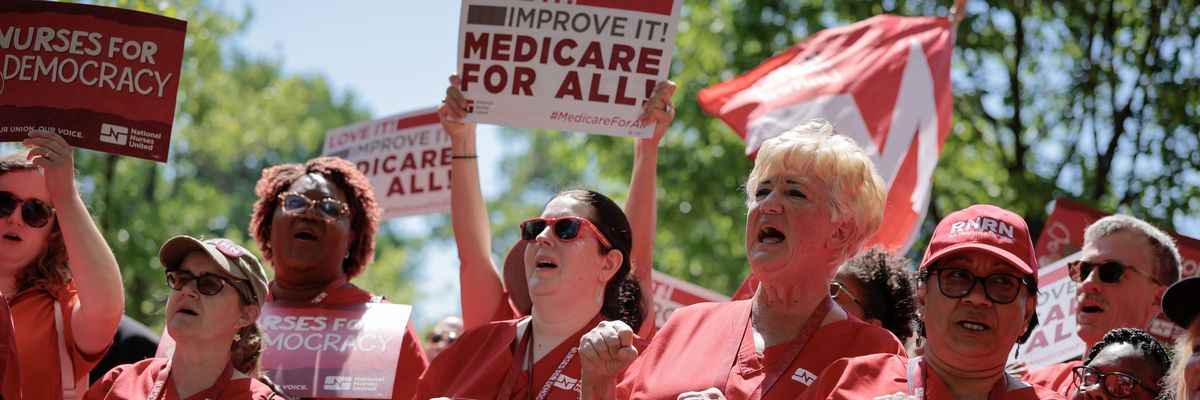
While progressives have long argued that the solution lies in decoupling health insurance from employment, Democratic leaders remain loath to advocate Medicare for All or other universal healthcare options. Just this week, House Minority Leader Hakeem Jeffries (D-NY) reaffirmed his opposition to Medicare for All, a position at odds with 90% of Democratic voters surveyed in a new CBS/YouGov poll.
As Common Dreams recently reported, a recent Yale University study found that Medicare for All—as proposed in legislation introduced by Sen. Bernie Sanders (I-Vt.) and Reps. Pramila Jayapal (D-Wash.) and Debbie Dingell (D-Mich.)—would save over 114,000 lives annually and $1 trillion per year in US healthcare spending.
Rep. Ro Khanna (D-Calif.) cited that study in an interview on Sunday in which he refuted Jeffries’ stance.
“Medicare for All is arguably the most important priority,” Khanna said, calling for a vote on Sanders’ bill. “It would save money, and it would save lives.”
From Common Dreams via This RSS Feed.