

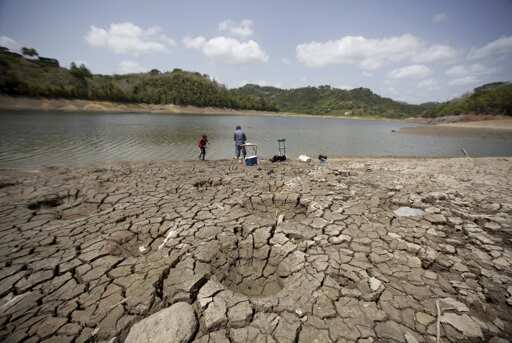
The government of Puerto Rico is rationing water in San Juan and other major cities as a severe drought continues to worsen, with no immediate relief expected. Since August 7, more than 180,000 customers are facing 48-hour water interruptions under a rotating schedule, as the Aqueduct and Sewer Authority (AAA) and the island’s government work to address the escalating crisis.
July was the driest month ever recorded in San Juan in more than 120 years, and the capital’s fourth-hottest July. According to the U.S. Drought Monitor, nearly a quarter of Puerto Rico is currently facing severe drought, while an additional 36 percent is experiencing moderate drought.
The drought is intensifying, but thousands of Puerto Ricans had already been dealing with water shortages, with some communities going without reliable water for up to a year. Many residents have been denouncing that the infrastructure that supplies water and is under AAA surveillance has not received adequate maintenance for decades, causing 60 percent of the water to be lost.
But Puerto Rico’s water crises cannot be separated from its colonial status, the authority the United States has over the island, and complicit political parties.
The Water Crisis Is Political
Puerto Rico’s two dominant political parties, the New Progressive Party (PNP) and the Popular Democratic Party (PPD), have alternated power for decades, and both bear political responsibility for stagnant wages and the deterioration of AAA operations. Both parties have historically influenced the agency’s management and Governing Board appointments, with leadership positions sometimes used to reward political allies.
Changes in administration often bring shifts in management strategies and priorities, which disrupts long-term infrastructure planning. When the PPD is in opposition, it frequently points to water service failures to criticize the sitting PNP administration. Mayors from both parties, meanwhile, often attribute problems to AAA’s central management while distancing themselves from decisions made by previous administrations led by their own political party.
PNP and PPD administrations have also promoted outsourcing, arguing that private contractors can respond more quickly to emergencies. However, the UIA (Unión Independiente Auténtica, or Authentic Independent Union represents approximately 2,800 workers at the Puerto Rico Aqueduct and Sewer Authority) maintains that permanent employees have been denied meaningful wage increases because of alleged budget constraints, while the government continues to spend millions of dollars on private crews to perform leak repairs and other work that could be handled by AAA’s own workforce. Unionized AAA employees have gone over a decade without substantial pay raises, with some workers earning only around $10.50 an hour despite nearly two decades of service.
Successive administrations have also allowed AAA to accumulate billions of dollars in debt to address recurring financial problems, rather than investing in water system maintenance. Years of fiscal mismanagement under both parties contributed to the federal intervention of the Financial Oversight and Management Board (FOMB), which froze collective bargaining agreements and implemented restrictive classification and compensation plans for the agency’s employees. These measures have increased the demands placed on workers, without providing sufficient salary increases.
Importantly, neither PNP nor PPD provide a solution for the water crisis, as both accept the island’s colonial status and U.S. authority over the island. The FOMB exercises sweeping control over Puerto Rico’s finances and government operations, including budgets, contracts, and executive orders. It also has the authority to challenge Puerto Rican laws in court and seek to have them overturned. Its policies have contributed to the privatization of the island’s power grid and the implementation of extensive austerity measures, which have weakened the government’s ability to invest in and maintain essential infrastructure.
The Fight for Puerto Rico’s Natural Resources
The current water crisis is part of a broader struggle to protect Puerto Rico’s natural resources. For months, people on the island have been denouncing Proyecto Esencia, a proposed luxury tourism and residential complex in Cabo Rojo, Puerto Rico. Spanning approximately 2,000 acres and three miles of beachfront, it includes hotels, exclusive residences, golf courses, and a private airfield, and is backed by foreign investors like billionaire businessmen David and Simon Reuben.
Although the AAA has already established that it does not have the capacity to supply water to the project, some politicians are attempting to allow for these kinds of commercial development. The Speaker of the House of Representatives, Carlos “Johnny” Méndez (PNP), introduced House Bill 1079 to loosen the restrictions established under Law 292-1999, which protects and conserves the island’s karst landscape — a natural filtration system that supplies fresh water to 500,000 Puerto Ricans — potentially allowing construction in areas currently protected under the law.
Senate Bill 1183 and Senate Bill 1173, proposed by Thomas Rivera Schatz, the president of the Senate for the PNP, could seriously harm water quality in Puerto Rico by eliminating and weakening the prior environmental controls required for construction. All of these measures help enable projects like Esencia, which could destroy significant areas of wetlands and dry forest.
Puerto Ricans Are Fighting Back
Residents of San Juan and other affected municipalities, grouped under the “We Demand Water” Coalition, as well as other leftist and feminist groups, are demanding real solutions to the water crisis.
Puerto Rico’s AAA workers staged a 24-hour strike on August 11. Dozens of people held a protest on Saturday, August 15 outside the entrance of the Fairmont Hotel in San Juan, where Governor Jenniffer González-Colón hosted the first of two events to celebrate her 50th birthday and raise campaign funds. Protesters chanted and held signs to express their opposition to several pressing issues on the island, including the water rationing, the recurring power outages, and the Esencia development.
Essential services are a basic right. Both the local government and U.S. colonial policies are to blame for Puerto Ricans experiencing crisis after crisis.
For an AAA run by workers and the communities it serves! Down with the Fiscal Control Board and the colonial rule of the U.S. over the island!
Esencia no va! Agua para el pueblo, no para los ricos!
The post Puerto Ricans Fight Back Against Water Rationing and Privatization amid Severe Drought appeared first on Left Voice.
From Left Voice via This RSS Feed.