

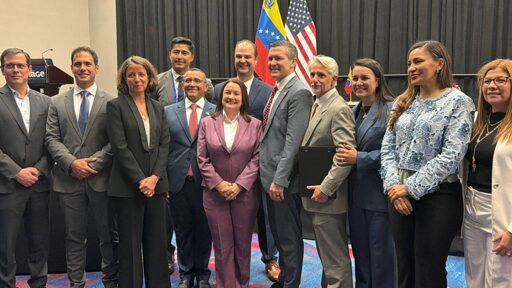
Caracas, August 20, 2026 (venezuelanalysis.com) – The Venezuelan government has signed agreements with Texas-based Hunt Oil and SLB amid ongoing efforts to court foreign oil firms.
Venezuelan Oil Minister Paula Henao finalized the deals on Tuesday on behalf of Acting President Delcy Rodríguez.
Hunt Oil, originally founded by far-right tycoon H.L. Hunt in the 1930s, signed “Productive Participation Contracts,” which are concession-type deals, to operate the mature Caro and Carisito oilfields in eastern Venezuela. The two projects, belonging to the Oriente branch of state oil company PDVSA, produce light crude and natural gas.
CEO Hunter L. Hunt said in a statement that his firm “wants to play a constructive role in revitalizing and growing Venezuela’s oil and gas production.” Hunt Oil previously leveraged its close ties to the George W. Bush administration to secure energy contracts in Iraqi Kurdistan following the 2003 US invasion.
For its part, SLB, formerly Schlumberger, inked deals focused on reservoir studies and provision of services. SLB is the world’s largest oilfield services provider. According to Reuters, the multinational will work to reactivate 15 oil rigs in the Caribbean nation, with only two onshore rigs presently active.
Crossover Energy, a company created in 2022 with no prior energy track record, is also reportedly close to finalizing agreements to run Venezuelan oilfields, having acquired an operating firm in eastern Venezuela. Crossover Energy had signed a memorandum of understanding with the acting Rodríguez administration in May.
The Colorado-based firm showed no verifiable commercial registration, public website, or operating history before its agreement with the Venezuelan government. Crossover CEO Eric McCrady previously ran Sundance Energy Inc., which filed for bankruptcy in 2021 with over $250 million in debt, before being sold and liquidated in 2022.
Henao traveled to Houston alongside PDVSA executives to participate in an event titled “Empowering Venezuela: Energy, Investment & Opportunity” on Tuesday as part of the August 17-20 International Meeting for Applied Geoscience and Energy (IMAGE). She was joined by US Energy Undersecretary Kyle Haustveit.
According to Venezuelan state broadcaster VTV, Henao presented “investment opportunities” while also detailing “the benefits of recent reforms and joint work with the US Department of Energy.” The Venezuelan minister went on to hold meetings with US officials to “consolidate the cooperation agenda.”
In parallel, ONGC Videsh Ltd (OVL), the overseas arm of India’s state-owned Oil and Natural Gas Corporation (ONGC), recently secured a US Treasury waiver to resume its activities in Venezuela.
“Now we have full freedom to work on the Venezuela project because earlier we were restricting our operations there because of the sanction-related risks,” ONGC executive Anupam Agarwal said in a press conference last week.
OVL owns 40 and 11 percent respective stakes in the San Cristóbal and Carabobo-1 extra-heavy crude ventures in the Orinoco Oil Belt. Agarwal stated that the company was in talks with Venezuelan authorities to renegotiate agreements and assume operational control of the projects.
Furthermore, ONGC is also looking to collect around US $500 million in overdue dividends that state oil company PDVSA was unable to pay due to US sanctions.
Hunt Oil, SLB, and OVL have followed energy majors such as Shell, Chevron, and Repsol in taking advantage of Venezuela’s pro-business overhaul of the energy sector. A reformed Hydrocarbon Law slashed royalties and taxes, turned over control of operations and sales to private corporations, and subjected disputes to international arbitration bodies.
In addition to securing a favorable environment for Western corporations, the Trump administration has also seized control of Venezuelan oil revenues, which are deposited in a US Treasury account before US officials decide when and how much should be returned to Caracas. The White House is also reportedly deducting the costs of its January 3 military operation against Venezuela from the export earnings.
According to Bloomberg, BP received a US Treasury license to join Vitol and Trafigura in lifting and re-selling Venezuelan crude. A BP tanker loaded fuel oil headed for Houston on Tuesday. The intermediary companies secure cargoes at below-market rates and deposit the proceeds into a designated US Treasury account before rerouting them to final customers for a profit.
The London-based multinational is likewise moving forward in multiple offshore natural gas projects in Venezuelan waters. BP, alongside Qatar’s UCC and the UAE’s XRG, is set to develop the second phase of the Loran Field. It will also explore the Cocuina-Manakin Field alongside Trinidad and Tobago’s NGC. The Venezuelan state holds no stake in either project, with the owed royalties and taxes also significantly reduced under the reformed legislation and likewise to be deposited in the US Treasury account.
Edited by Lucas Koerner in Philadelphia.
The post Venezuela: Hunt Oil, SLB Strike Deals as BP Joins US’ Handpicked Crude Resellers appeared first on Venezuelanalysis.
From Venezuelanalysis via This RSS Feed.