

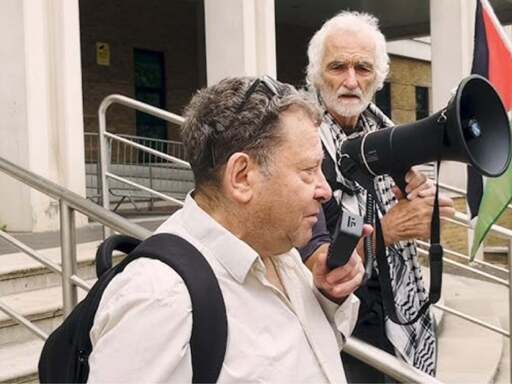

Day three of Tony Greenstein’s trial at Kingston Crown Court before Judge Sarah Plaschkes KC saw the defendant take the witness stand. There was significant tension over what evidence the jury was permitted to consider.
Judge orders jury to leave court repeatedly
Tony Greenstein, a 72-year-old Jewish anti-Zionist, Marxist, and atheist from Brighton, faces charges under Section 12(1) of the Terrorism Act 2000 of inviting support for a proscribed organisation, Hamas, following social media posts published on 7 October 2023.
The defence team openly referred to evidence that the Crown and the court had decided the jury should not be allowed to see. The defence cross-examined police on the gap between the size of the original interview transcript and the heavily redacted one shown to the jury. Consequently, the judge ordered the jury to leave the court on several occasions in an attempt to prevent the defence from referring to excluded evidence.
Greenstein stated in evidence that the prosecution had actively resisted admitting his past writings because his decades-long opposition to religious fundamentalism directly undermined the Crown’s allegations.
Tony Greenstein’s heritage
In the morning, under questioning from his defence barrister, Lawrence McNulty, Tony Greenstein laid out his identity and heritage in detail. He told the jury he was raised in an Orthodox Jewish household as the son of a travelling rabbi who stood on the frontline at the 1936 Battle of Cable Street, helping erect barricades in east London to stop Oswald Mosley’s British Union of Fascists from marching.
He testified that his father hated the Conservative Party due to widespread antisemitism in 1930s Britain.
Greenstein explained he went from a childhood within a Zionist family to abandoning Zionism at age 14 or 15, subsequently dedicating decades to socialist, anti-racist, and pro-Palestinian campaigning.
He told the court that Christians can also be Zionists and defined antisemitism by its original nineteenth-century meaning as the hatred of Jews. When asked about his view on religion from the stand, he quoted Marx, describing it as the “opium of the masses”.
There were frequent, sharp interruptions from the bench. When Greenstein described Gaza as a “human prison” and a “cage” where Palestinians were held under siege for 57 years, surviving on polluted water and strictly rationed electricity, Judge Plaschkes halted proceedings.
When the defence touched on the history of Zionism, previous escalations in Gaza, and casualty figures, with Greenstein stating at least 100,000 had died, the judge intervened.
‘That’s the problem with the ruling class’
Warning that the court was not tasked with examining the broader history of the Middle East, the judge directed the defendant to stay focused on the specific indictment. Tony Greenstein retorted from the witness box that:
that’s the problem with the ruling class in this country, they turn a blind eye to genocide.
Judge Plaschkes repeatedly ordered the jury to withdraw to the jury room while parameters of questioning were argued between counsel and the bench, reminding Greenstein that the court was not a political forum.
When proceedings resumed before the jury, the defence examined Greenstein’s public writing record on his website, azvsas.blogspot.com, which spans over 3,500 published articles since 2008 covering Palestine, gay rights, disability, and progressive causes.
The defence presented blog titles and excerpts from historic pieces where Greenstein had explicitly condemned Hamas, including articles titled “The lousy hamas government” (citing The Angry Arab and Israeli newspaper Haaretz) and “Hamas does its best to make Palestinian lives a misery”.
He also referenced a post titled “I support the Palestinians not Israeli created Hamas”, where he argued that divide and rule is a colonial imperial playbook and that Israel funded and armed religious movements to prevent a two-state solution.
Alleged clear distinctions
Giving evidence, Tony Greenstein stated he has consistently argued in over 20 blogs that national liberation movements cannot succeed under religious fundamentalist leadership. He described Hamas as a conservative traditional sect, noting their stance on homosexuality is a social taboo, but not executable like in Saudi Arabia. He pointed out that historical Britain was homophobic and that his father, who lost most of his family in the Holocaust, noted the only good thing Hitler did was kill all the gays.
His commentary on 7 October related to a tactical breach of an impregnable military perimeter after a 17-year blockade, comparing the event to historic Caribbean slave revolts. He testified that he had limited information on the day, but knew there was a breakout and felt it was justified.
He drew a clear distinction between supporting an act of resistance against military occupation and endorsing the organisation carrying it out, comparing it to supporting the French Resistance during the Second World War without endorsing the communists.
Asked directly by McNulty if he did, has, or ever supported Hamas, Greenstein stated he answers no. He said he supports it as part of the resistance, but as an organisation he does not support it. When asked if he would invite anyone to support Hamas as an organisation, he replied: “No, obviously not. It would be absurd.”
Addressing his post stating that Hamas should be congratulated for the breach, Greenstein explained it was a rhetorical figure of speech, adding that if he was the recruitment sergeant they think he is, he would not have started with his criticisms.
When defence counsel asked whether his post was an instruction for ordinary members of the public to contact and congratulate Hamas, Greenstein replied: “No… presuming they have the number, which I don’t.”
Cross examining Tony Greenstein
During cross-examination, prosecutor Kate Temple-Mabe faced the complex task of prosecuting an anti-Zionist Marxist defendant for allegedly promoting an Islamist organisation whose politics he has long opposed.
The Crown stated that it did not allege Tony Greenstein held wholesale or long-term ideological support for Hamas, but argued instead that his words on 7 October constituted an invitation of support in that specific moment for a “Gaza ghetto uprising”.
The prosecution questioned his reach on X and whether he wanted people to share his posts. Greenstein stated he was simply sharing political opinions rather than proselytising, adding that his reach was minimal as he believed his account was shadow-banned among feeds dominated by “lots of Elon Musk-type people ranting about immigrants”.
The prosecution focused on granular linguistic analysis, questioning Greenstein on his specific use of the words “one” and “we” in the tweet stating “whatever ones criticisms of Hamas, we should congratulate them”. Greenstein rejected the assertion that he was inciting followers to endorse a banned organisation, accusing the prosecution of an obsession with Hamas and maintaining he was offering political analysis of an anti-colonial counter-offensive.
The trial continues
The prosecution also cross-examined Tony Greenstein on later commentary from early 2024 involving Peter Tatchell regarding LGBTQ+ rights under Hamas governance. Greenstein argued that criticisms of reactionary social policies should be made at a different time and not weaponised to justify genocide. Greenstein reiterated that his focus during ongoing military actions remained centred on solidarity with the Palestinian people to get food and aid in, and stopping the bombing.
Following the conclusion of cross-examination, the jury was dismissed ahead of tomorrow’s closing speeches.
Featured image via the Crispin Flintoff Show- screengrab
From Canary via This RSS Feed.