


Miles MorrisseauICT
The hundreds of skulls are hung with such precision and care that you are immediately taken in by the rugged beauty of the work and admiration for the skill and patience of the artist. But a closer inspection reveals the ugly truth. Each reindeer skull has a bullet hole.
This wasn’t the result of harvesting and hunting over the years. This was a mass execution.
Pile o’ Sápmi Supreme was created in 2017 by Máret Ánne Sara, a Sami artist from Norway who used the skulls of her brother’s reindeer herd which the government forced him to cull.
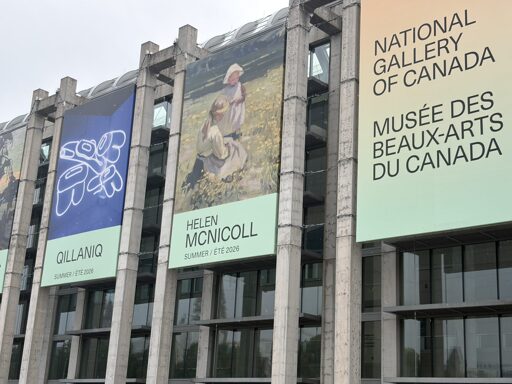
It is one of a numerous works in the exhibit Qillinaq at the National Art Gallery of Canada in Ottawa which is undergoing an artistic re-birth with an Indigenous eye.
While art galleries and other institutions south of the border are under threat for expressing ideas and work that celebrate non-European history, the gallery continues to expand the space for Indigenous artists in an ongoing process of decolonization that is reframing Canadian arts.
Reneltta Arluk, Senior Manager, Policy Protocols and Strategic at the National Art Gallery was born and raised in the Northwest Territories. She is Inuvuliaviut Gwichin and Denesuline and Cree from Treaty 8 territory, Wood Buffalo region.
In 2022 there was a big shift within the National Gallery to with the creation of policy and programming that centered Indigenous ways and decolonization. “To bring forward and create a sovereign sense of Indigenous ways and knowing in a major institution,” she tells ICT while sitting in the cathedral-like foyer of the gallery.
The program was founded by Steve Loft, Mohawk, who now serves as vice-president of the department and Michelle Lavallee, Ojibway from Chippewas of Nawash First Nation, who is now director of curatorial practices and Indigenous ways of decolonization.
The gallery had separated Indigenous and Canadian art whether it was historical or contemporary. The new vision of the gallery was to bring everything together.
“One of the big shifts was to change the Canadian galleries and make it indigenous and Canadian gallery so when you go through the gallery now you’re seeing how art is speaking to each other through this Canadian lens,” states the NAG website.
The transformed exhibit received praise in Canada’s national newspaper, The Globe and Mail, who raved, “What a revelation to see the Woodlands School, represented by Norval Morrisseau’s Artist and Shaman Between Two Worlds, hung alongside the work of London, Ont., artists Jack Chambers and Greg Curnoe, including Curnoe’s colourful View of Victoria Hospital, Second Series.”
In addition to changes to the internal structure of the institution, “We work in relation with every department,” Arnuk says. “We work with Indigenous lead practice that is now exploring through acquisitions and programming.”
Qillaniq is the latest exhibit that is taking a uniquely Indigenous perspective of contemporary art from Inuit and Indigenous artists from the circumpolar north.
“Qillaniq means shimmering water, the light that shimmers on water from sunset and sunrise,” she says. “It’s the largest circumpolar exhibition that has been done…it features over 70 contemporary living artists…there are over 100 works in total and having curators from each of the different circumpolar regions has really allowed the work to have a visceral northern feeling that really showcases northern Indigenous exquisiteness.”
The exhibit opens up a doorway to Indigenous expression from a northern perspective that is unparalleled. There are pieces like the reindeer skulls that can hit like a gut punch and there is a comfort of walking into a giant feast basket that can make you feel like an offering to the spirit world or be immersed in the smell of willow smoke under skies of linen; marking the journey of salmon in an elaborate expression data collection.
Qillaniq will be on display at the National Gallery until September 20, the Indigenous and Canadian Art exhibit is on permanent display.
The post National Gallery of Canada continues artistic decolonization appeared first on ICT.
From ICT via This RSS Feed.