

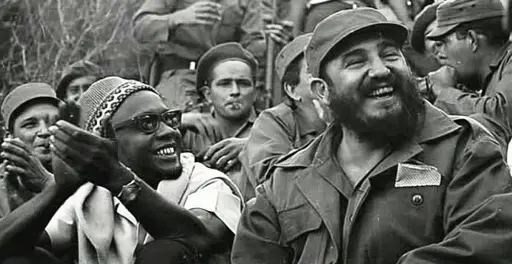

On August 13, 2026, the world marked one hundred years since the birth of Fidel Castro, the man who not only led the 1959 Cuban Revolution and the building of a socialist state, but also went on to become a key contributor in Africa’s twentieth-century liberation history. The centenary landed at a difficult moment for Cuba. An acute economic crisis, oil shortages, and a tightening US sanctions regime. But even under that weight, Cuba stands. And across Africa, Fidel is being remembered not as a distant Cold War figure but as a revolutionary internationalist whose name is stitched into the continent’s own liberation story.
This legacy is well-deserved. Castro’s revolution triumphed in 1959, just as Africa was entering its most decisive decade of decolonization. At that point, only Ghana and Guinea stood as independent sub-Saharan states. Within ten years, the political map of the continent would be transformed. Cuba, a small island ninety miles from the United States, chose to see its own struggle as bound up with that continental awakening.
Castro said as much in 1975, describing Cuba’s ancestry in Africa and the debt that history imposed; a promise, in his words.
“African blood flows freely through our veins. Many of our ancestors came as slaves from Africa to this land. As slaves they struggled quite a great deal. They fought as members of the liberating army of Cuba. We are brothers and sisters of the people of Africa and we are ready to fight on their behalf.”
What followed was six decades of doctors, teachers, soldiers, engineers, and political cadres sent to a continent thousands of kilometers from home.
In an interview with Ignacio Ramonet, Fidel Castro reflected on Cuba’s commitments to other oppressed nations, including the struggles for independence across Africa.
“Cuba’s heroic solidarity with our sisters’ nations in Africa has been well enough recognized. That glorious page of our revolutionary history deserves to be known, even if only to encourage the hundreds of thousands of women and men who are internationalist combatants, it should be written, as an example for present and future generations, nor, in my opinion, are people sufficiently knowledgeable about the history of Europe’s imperialist and neocolonial looting and pillaging of Africa, with, of course the full support of the united states and NATO.”
Read more:Fidel Castro: a life of revolution
Solidarity with Africa’s struggle for liberation
Cuban doctors arrived in Algeria in 1963, an important detail that compliments the popular image of Cuban internationalism as primarily military-centered. From the beginning, Cuba’s engagement with Africa also involved medicine, education, and technical assistance. But the Congo crisis, and particularly the assassination of Patrice Lumumba, was a decisive moment in the development of Cuba’s revolutionary internationalism.
Speaking at the United Nations in September 1960, Fidel Castro condemned the continued influence of colonial interests in the Congo and explicitly defended Lumumba.
“The hand of the colonialist interest has been clear and visible in the Congo, and our opinion is consequently that colonialist interests have been favored and that every fact indicates that reason and the people of the Congo are on the side of the only leader who remained there to defend the interests of his country, and that leader is Lumumba.”
Castro extended this argument to Algeria, where the struggle against French colonialism was still underway. Declaring Cuba’s support for Algerian independence, he challenged the claim that Algeria was an extension of France and condemned the violence being inflicted on Algerian communities. He contrasted the international community’s willingness to intervene in the Congo with its reluctance to confront French colonialism in Algeria.
For Castro, however, the question of liberation extended beyond the formal end of colonial rule. He declared:
“We are, therefore, on the side of the Algerian people, as we are on the remaining colonial peoples in Africa, and on the side of those who are discriminated against in the Union of South Africa. Similarly, we are on the side of those peoples that wish to be free, not only politically, for it is very easy to acquire a flag, a coat of arms, an anthem, and a color on the map, but also economically free, for there is one truth which we should all recognize as being of primary importance, namely, that there can be no political independence unless there is economic independence, that political independence without economic independence is a lie; we therefore support the aspirations of all countries to be free politically and economically. Freedom does not consist in the possession of a flag, a coat of arms, and representation in the United Nations.”
The Congo and Algeria became the central proposition that would underpin Cuba’s later engagement with Africa. Five years later, in 1965, Che Guevara led a Cuban contingent into the Congo to support the revolutionary struggle directly. The mission did not achieve the victory Havana had hoped for, but its historical significance lay on the fact that Cuba had begun making a direct material commitment to the African struggles.
Internationalism at full scale
Nothing captures the scale of that commitment like Angola. When Portuguese colonial rule collapsed in 1974, Angola fractured into a three-way civil war, drawn deeper into crisis when South Africa’s apartheid government invaded Namibia to crush the Soviet and Cuban-backed MPLA before it could consolidate power.
Castro’s answer was Operation Carlota, named for an enslaved woman who led a Cuban uprising in 1843, a deliberate act of historical framing that tied the mission to Cuba’s own history of Black resistance. Cuban troops helped halt the South African advance on Luanda and secured the MPLA’s survival at independence. Over the sixteen years that followed, hundreds of thousands of Cuban personnel rotated through Angola, fighting, dying, and building an air and armored presence far beyond what a country of Cuba’s size should have been able to sustain against a superpower’s embargo.
The decisive moment came at Cuito Cuanavale in 1987–88. The battle broke the myth of apartheid South Africa’s military invincibility, shifted the regional balance of power, and helped force the negotiations that led to Namibian independence and South Africa’s withdrawal from Angola. It is difficult to overstate what that meant for the anti-apartheid movement, a small, blockaded Caribbean nation that had offered enormous solidarity and sacrifice.
African leaders praise Fidel
Fidel’s charisma, political conviction and commitment to revolutionary internationalism brought him into close contact with some of Africa’s leaders and revolutionaries, including Kwame Nkrumah, Julius Nyerere, Samora Machel, Agostinho Neto, Amílcar Cabral, Ahmed Sékou Touré, and Thomas Sankara. These relationships were based on a wider political convergence around anti-colonialism, national liberation, socialism, Pan-Africanism and resistance to imperialism.
While Western narratives have often presented a contested picture of Fidel Castro and his legacy, there is far less ambiguity in the memory of many African liberation movements and peoples about what Fidel and Cuba represented. For those who experienced colonialism, apartheid and foreign intervention, Cuba’s support was not an abstract Cold War alignment. It was material solidarity.
Perhaps with the passage of time, the historical record will allow an even fuller appreciation of what Fidel and the Cuban people did for Africa.
Read more:Cuban solidarity with Africa was ‘never rhetorical, it was practical’
When Nelson Mandela met Fidel after his release from prison, his admiration was unmistakable, and it was rooted in something more profound than gratitude for military assistance. Mandela repeatedly pointed to the breadth of Cuba’s contribution to African liberation, the soldiers who fought alongside African forces, but also the doctors, teachers, engineers, and technicians who worked across the continent. Cuban internationalism was never reducible to arms shipments. It was an offer of human capacity, knowledge, skills and institutions to societies attempting to overcome colonialism and transform themselves. And in many respects, this civilian commitment outlasted the military one. Cuban troops eventually withdrew from Angola, but medical and educational cooperation continued into the 1990s, even as Cuba itself entered the severe economic crisis of the Special Period following the collapse of the Soviet Union.
Cuba continued to send doctors and other professionals abroad at a time when its own people were facing severe shortages at home.
By 1998, addressing the South African Parliament, Fidel put a number to the military dimension of this commitment; 381,432 Cuban soldiers and officers had served alongside African forces in struggles for independence or against foreign aggression. It represents the scale of a small country’s material and human commitment, a continent that Cuba was never compelled to assist, but whose struggles Fidel and the Cuban Revolution regarded as inseparable from their own.
Castro’s African legacy was built on a simple, unfashionable conviction, that no nation is free in isolation, and that solidarity, to mean anything, has to cost something. A century after his birth and ten years after his death, that is still the reason his name is spoken with respect from the continent. If Africa remembers what Cuba did for its liberation struggles, then perhaps the time has also come for Africa to ask what it can do for Cuba.
Cuba is today facing an economic crisis and the continuing weight of the US blockade and sanctions. Yet the country that once sent soldiers, doctors, teachers and technicians to Africa when it had very little of its own still carries the consequences of that commitment. If internationalism means anything, then solidarity must also be reciprocal.
Africa’s remembrance of Fidel should therefore also be a call for concrete solidarity with the Cuban people today, for defending Cuba’s sovereignty, opposing the blockade and refusing to allow a country that contributed so much to African liberation to face its present difficulties in isolation.
Read more: Fidel Castro’s final reflections
From BT News via This RSS Feed.