


Bullets:
Tens of millions of tons of annual demand from mines and refineries can be displaced through metals recovery from urban waste.
But the industry overall features high operating costs, and low profits.
Most of the feedstock for urban mines are from junked cars and trucks, especially EV’s.
China began development of their urban mining industry over two decades ago, and today has 85% of the world’s recycling capacity.
Western firms are far behind, and are unlikely to catch up. China’s urban mining industries benefit from its dominance in EV and battery production, and in electronics.
Inside China / Business is a reader-supported publication. To receive new posts and support my work, consider becoming a free or paid subscriber.
Report:
Good morning.
China has deep structural advantages across most of the supply chains for the key minerals and metals, and is decades ahead of Western Europe and North America, who are trying to catch up.
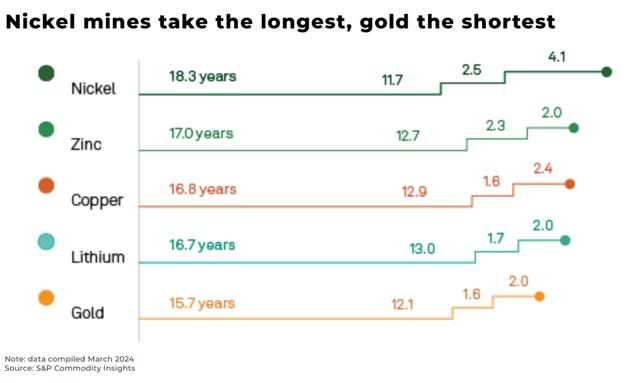
It takes a long time to get new mines up and running, and then years more to build out refineries. Efforts are underway to get those going, with mixed results so far.
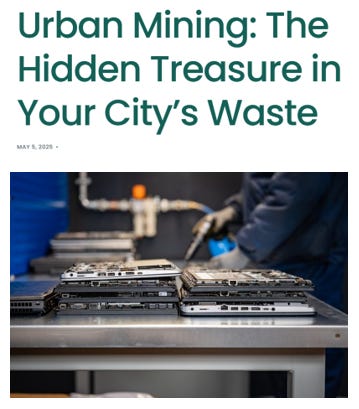
But there is another source of raw materials, and which are already refined. It’s in the mountains of waste dumps across the world. Urban mining is the recovery of those materials by going through those landfills, particularly from electronics and cars.
Annual demand for raw materials will grow by two thirds from today, to 167 billion tons in three decades. So we will need a lot more mines, and refineries. But the metals in electronic waste, for example, have already been mined and refined. This is an analysis of what comes back after recycling printed circuit boards. In a single metric ton of PCB’s, 40% of the waste is metallic. Copper can be up to 30%. Tin, nickel, silver, and gold are also recoverable.
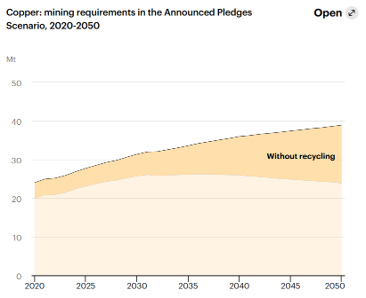
Urban mining can displace a lot of the demand on virgin mines, if the industry can develop fast enough. 40 million tons a year of copper will be needed in 2050. 15 million tons of that copper demand can theoretically come from urban landfills, and peak demand from copper mines might be in 2030 or so, IF urban mining can scale up:
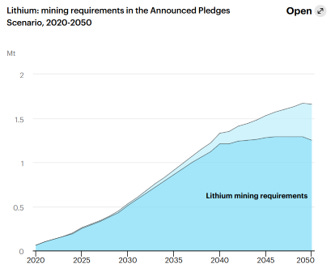
All the growth in demand for lithium from 2040 onward can come from urban mining of car batteries, mostly.
But already we see the China problem. Electric vehicle and storage batteries will be the source of over 90% of the feedstock for urban mines, and China also makes most of those. Chinese companies dominate production, and exports, of electric vehicles, and the batteries for them.
And China is also way ahead on the recycling of batteries. In 2023, global capacity for both pretreatment and metals recovery grew 50% year over year, and China was 80% of both of those. That’s to say that China’s urban mining industry is growing much faster than the rest of the world, and by 2030, Chinese companies are forecast to have 75% of global pretreatment and 70% of recovery capacity.
A lot of that is driven, again, by where the fleets of electric cars and trucks are, as well as electronics. The Chinese government itself is a major investor in the Urban Mining industry.
Western analysts are sounding the alarm, that Europe and the North America are already far behind. In the EU, over 10 million tons of electronic equipment gets thrown out every year.
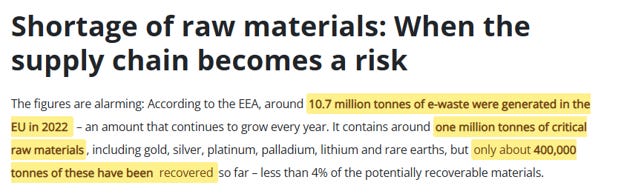
That includes one million tons of critical materials. But only 400,000 tons have been recovered, in total—that’s not an annual recovery number; it’s the sum of all years, and only 4% of what was potentially recoverable. And given that the European Union imports most of its electronics, and most of its critical materials, that creates a dependency problem, a part of which might go away if new investments in urban mining are made there.
China has been making those investments for two decades, and now enjoys strategic dominance in the technology and science of metals recovery. That makes them less dependent on new raw materials, and ensures continued control of the supply chains for batteries, chips, and rare-earth magnets:
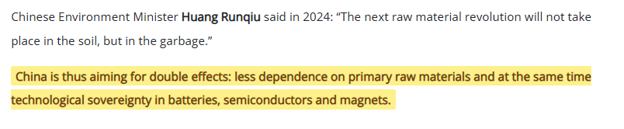
But the far bigger challenge in other markets is industry economics. The gross value of materials recovered from a single ton of circuit boards is over $10,000. That’s the revenue side. But the costs to gather and process a ton of electronic waste to pull out that value are high. Labor costs in Europe are at least five times higher. The industry requires heavy use of chemicals, and China has already built the supply chains and industry clusters to manage the entire process, end-to-end. And China built the infrastructure for this industry over many years, when the cost of land acquisition and labor were far lower than today.
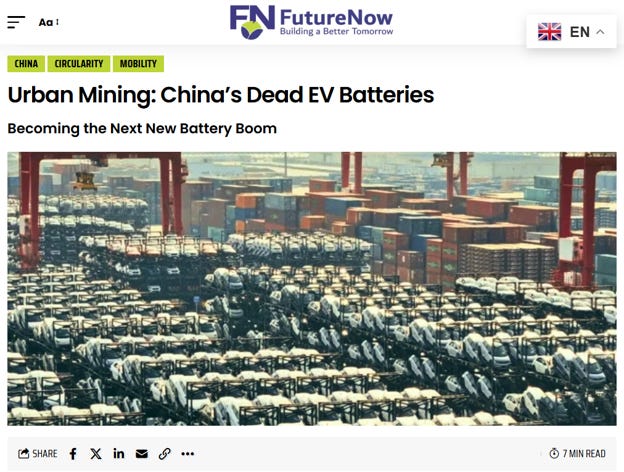
So Western countries face serious economic and environmental challenges, for the urban mining for electronics. And most of the feedstock volume for urban mines will come from automotive and heavy industrial sectors anyway, so we’re back to Electric Vehicles again. The cars and batteries are the feedstock for China’s urban mines. Old batteries are collected, taken apart, and shredded—that’s the “pretreatment”, then the materials recovered through chemical refining. 300,000 tons of EV batteries were recycled last year, at a market value of about $7 billion US, and that is forecast to double by 2030.
The recovery rates are very high. For nickel, cobalt, and manganese they get 99.6% back; in the case of lithium it’s over 96%. Most of those raw materials are sourced abroad, so China is essentially mining their old cars for materials to build new ones.
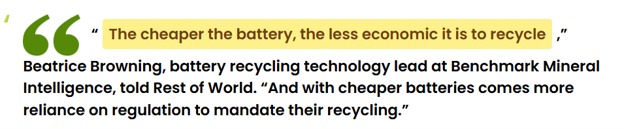
But here we run into the money problem: This is not a high-profit industry. So China’s push for urban mining is top-down, and policy-driven, because there simply is no private-sector urge to build it. Mandates for immediate recycling of EV batteries, and cradle-to-grave tracking of every battery sold here.
China electrified mass transportation a generation before Western countries; they’re about 10 years ahead on the feedstock for EV’s coming off the road, trading in for new. 820,000 tons of worn-out batteries hit Chinese urban mines last year, and China has 85% of the world’s capacity for recycling. That part, too, is over two decades in the making—national five-year plans since 2004 have carved out mandates for the circular economy, building out lots of excess capacity before those feedstocks ever appeared. Today there are 49 Urban Minerals bases in 27 provinces, with capacity of over 40 million tons a year.
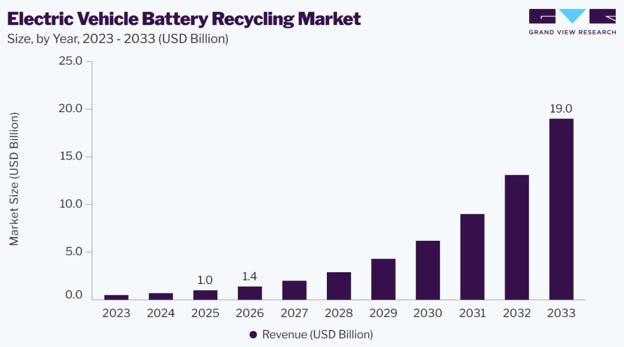
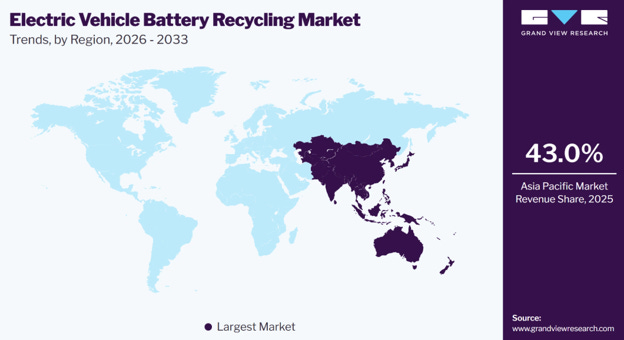
Now that capacity is filling up, because Asia is where most of the world’s EV’s are, so far. The urban mining industry is growing fast, at 45% per year, but APAC is 43% of the market today, because the EV and electronics industries are far larger and more mature, here, and China has already developed a national recycling industry.
With the development of urban mining, China’s economy becomes much more circular, with a lot more closed loops. China is 80% of global battery manufacturing, and that fact alone makes it unlikely that North America or Europe can ever match China in volume. China’s builds 60% of the batteries for EV’s, and have been selling millions of them every year, for many years. “The US and Europe can’t recycle batteries” that haven’t been sold yet. EV’s are most of the feedstock for urban mines, so the United States and the EU are 10 years behind.
The battery technologies are also changing to the benefit of Chinese industry. LFP batteries don’t have nickel or cobalt, and Western companies can’t make money recycling the lithium batteries. Many Western firms have capacity, but not enough feedstock to keep them going. So their solution is to adopt the same strategy in urban mining, as American carmakers and drone manufacturers in their industries: get the government to write checks and wall off the domestic markets, to protect them from China.
Be Good.
Resources and links:
Urban Mining: The Hidden Treasure in Your City’s Waste
https://www.elemental.biz/urban-mining-the-hidden-treasure-in-your-citys-waste/5670/
Recycling can bring multiple benefits in ensuring reliable and sustainable critical mineral supplies
https://www.iea.org/reports/recycling-of-critical-minerals/executive-summary
Printed circuit board recycling
https://scispace.com/pdf/printed-circuit-board-recycling-physicochemical-and-economic-4l9b0kpklg.pdf
China as a blueprint: From waste importer to recycling world champion
https://felss.com/en/blog/urban-mining-waste-is-the-new-ore/
Urban Mining: China’s Dead EV Batteries
https://futurenowgreennews.com/urban-mining-chinas-dead-ev-batteries/
L’engagement en faveur de l’économie circulaire et de l’exploitation minière urbaine favorise le recyclage du cuivre en Chine
https://internationalcopper.org/fr/resource/commitment-to-the-circular-economy-and-urban-mining-drives-copper-recycling-in-china/
China embraces new opportunities by tapping into ‘urban mines’
https://www.chinadaily.com.cn/a/202411/05/WS6729e437a310f1265a1cb975.html
Research on Urban Mining Development in chinafile:///C:/Users/dell/Downloads/Research%20on%20Urban%20Mining%20Development%20in%20China.pdf
Research on Urban Mining Development in China
https://www.engineering.org.cn/sscae/EN/10.15302/J-SSCAE-2017.04.015
Electric Vehicle Battery Recycling Market (2026 - 2033)
https://www.grandviewresearch.com/industry-analysis/ev-battery-recycling-market-report
Why is it so hard for the US to get urban mining right?
https://www.latitudemedia.com/news/why-is-it-so-hard-for-the-us-to-get-urban-mining-right/
CHART: China’s global electric car dominance
https://www.adamasintel.com/charts-china-global-electric-car-dominance/
China’s Monopoly on Critical Minerals
https://www.statista.com/chart/35398/china-dominant-share-in-global-mining-production-of-critical-minerals
Visualizing China’s Dominance in Clean Energy Metals
https://elements.visualcapitalist.com/visualizing-chinas-dominance-in-clean-energy-metals/
New mines take nearly 18 years to build in 2020-23
https://theoregongroup.com/investment-news/new-mines-take-nearly-18-years-to-build-in-2020-23/
Inside China / Business is a reader-supported publication. To receive new posts and support my work, consider becoming a free or paid subscriber.
From Inside China / Business via This RSS Feed.
Very propaganda
