

Kansas Department of Revenue
Erin In The Morning is a reader-supported publication. To receive new posts and support my work, consider becoming a subscriber.
A Douglas County judge declared the state’s invalidation of a transgender woman’s Kansas driver’s license was likely an unlawful violation of her right to Due Process—paving the way, potentially, for other Kansans to contest anti-trans ID laws on the same grounds. The full memorandum from the judge is at the bottom of this piece.
Many trans Kansans across the state lost their driver’s licenses and IDs earlier this year. They were forced to seek out new ones with an incorrect gender marker by SB 244. The bill, passed in February, has become one of the most restrictive anti-trans laws in the country. It invalidated state IDs that don’t match one’s sex assigned at birth and instituted a bathroom ban on state-owned or -operated facilities, such as many parks, libraries, airports, bus terminals, and courthouses.
It also greenlit a “bounty hunter” clause, which enabled private citizens to sue anyone they suspect of being transgender in a bathroom that doesn’t align with their sex assigned at birth. If the claim is substantiated by the courts, a person could collect monetary damages—a cash reward for enduring the injustice of sharing a bathroom with a trans person. (There have been no reported incidents of someone successfully making this claim, however.)
But the rollout, like that of many anti-trans policies, was haphazard, messy, and disorienting, robbing Jamie Miller of Lawrence the opportunity to meaningfully contest the invalidation of her state ID. This caused irreparable harm, the judge found.
“Due Process is nothing more (and nothing less) than the right to meaningful notice of what action the Government intends to take/has taken with respect to some personal interest and a meaningful opportunity to be heard,” District Court Judge James McCabria wrote. “When the government fails to make sufficiently clear what action is going to occur, when it will occur and what steps one must take to be heard on that action, Due Process has not been afforded.”
McCabria granted Miller a temporary injunction, as first reported by the Lawrence Journal-World. This means she will be able to retain a “female” gender marker as the case continues to play out in the courts. “No other remedy will suffice,” McCabria wrote.
Since the bill went into effect, Miller has had to spend money on alternate modes of transportation, resort to getting around by e-bike, and navigate describing her intimate medical history any time she needs to produce an ID for verification purposes.
It was a drastic and sudden shift for the nearly 60-year-old Kansan, who has been living openly as a woman for over a decade now.
The invalidation of Miller’s driver’s license “has caused her to isolate from public life, created roadblocks to obtaining necessary medical care, created issues for caring for her disabled adult daughter, limited social interactions and limited interactions with distant family members,” the initial April complaint reads. It also says the situation “leaves her without the form of identity verification required in daily life including but not limited to voting, getting prescription medications, air travel, banking, or requesting government documents” and that she “cannot sign or approve any document listing her sex or gender as ‘male’ without committing fraud.”
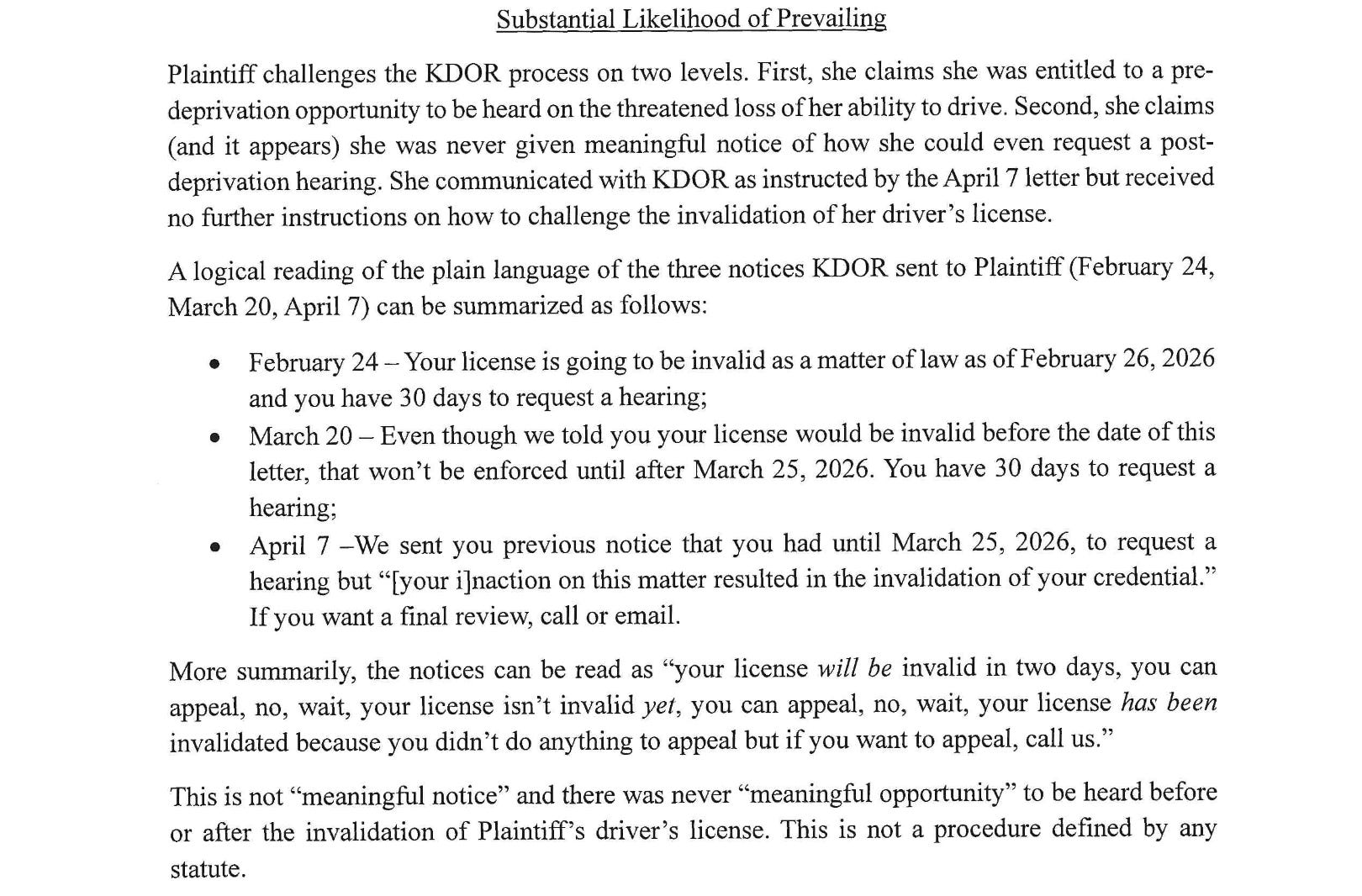
The court also found Miller has a “substantial likelihood of prevailing” in her legal claims against the state. The implementation of SB 244 was painted as inconsistent and opaque, as seen in a series of contradictory notices sent to Miller.
“Summarily, the notices can be read as ‘your license will be invalid in two days, you can appeal, no, wait, your license isn’t invalid yet, you can appeal, no, wait, your license has been invalidated because you didn’t do anything to appeal but if you want to appeal, call us,’” McCabria wrote. “This is not ‘meaningful notice’ and there was never ‘meaningful opportunity’ to be heard before or after the invalidation of Plaintiff’s driver’s license. This is not a procedure defined by any statute.”
CAPTION: A Douglas County judge issued a temporary injunction granting relief to Jamie Miller, a Kansas woman whose driver’s license was invalidated by the anti-trans law, SB 244.
Miller is a U.S. Army veteran who was honorably discharged in 1997. Currently, she is also the primary caretaker for her adult daughter, who is disabled—another facet of her life severely impacted by the sudden invalidation of her ID, the complaint says.
This is not the only challenge to the law. In the same filing, the court rejected a bid to consolidate Miller’s case with another similarly situated case.
Moreover, earlier this month, a group of transgender men known as the “Kansas Compliance Crew” went viral for challenging the law through malicious compliance—using the women’s restrooms that state law requires them to use. At one park where they demonstrated, the manager called the police. The KCC told Erin in the Morning neither the staff nor law enforcement had known about SB 244.
Kansas lawmaker Rep. Abi Boatman, a Democrat, told KCUR earlier this summer that SB 244’s ID provision, like its bathroom restriction, is causing more problems than the state seems to be willing to address. Boatman is transgender, too.
“There seems to be a disconnect between the law that was passed and the way it’s being enforced,” Boatman said. “I think part of it may be that it was just so quick and so ill-informed and unplanned that they have run into more difficulties than they expected, invalidating people’s licenses.”
Erin In The Morning is a reader-supported publication. To receive new posts and support my work, consider becoming a free or paid subscriber.
From Erin In The Morning via This RSS Feed.
You must log in or # to comment.