

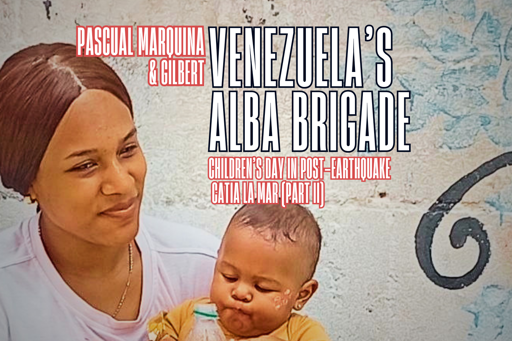
By Cira Pascual Marquina and Chris Gilbert – Aug 17, 2026
Following the recent earthquakes, ALBA Movimientos’ Venezuela chapter wanted to organize a response that would strengthen popular power at the local level. The brigade was to be unlike typical relief efforts, which are usually imposed on communities for better or worse, because it would work with the existing organizations in the communities, especially the communes.
Thus, the Alba Movimientos Brigade was formed with representatives from various grassroots movements and projects taking part in it, including the two of us. In the wake of the January 3rd attacks, the government started to pursue a very inclusive national unity, focusing more on “peace and tranquility” than on socialism. Yet all of us hoped that our brigade would not only build popular power but also serve as a springboard for recharging Venezuela’s socialist project.
In a preparatory discussion on a WhatsApp group, someone had posted a Chinese slogan related to the 1976 Tangshan earthquake: Deepen the criticism of Deng, carry out relief work, and demonstrate the superiority of the People’s Communes and the socialist system! Most of the chapter agreed that—apart from the Deng reference—this was a good expression of the brigade’s intentions.
The community chosen as the focus of our activities was the Romulo Gallegos Communal Circuit in Catia la Mar.[1] This communal circuit has high levels of internal organization and had been struck by a missile fragment during the January 3 attacks, generating anti-imperialist sentiment. The community is also largely Afro-Venezuelan, with a serious commitment to its traditions such as the June 24 feast of San Juan Bautista (the afternoon celebration of which had been interrupted by the earthquake).
Early on, the Brigade’s main contact in Catia la Mar, Raimelis Navarro, had told us that her community was “strong in the area of culture.” Consequently, she warned that a failure to celebrate Venezuela’s Children’s Day—which falls on July 20, several weeks after the quake—would be a serious blow to the community.
That meant that the Alba Movimientos Brigade, which had recently adopted the name “Venezuela por la vida,” was charged with supporting the Romula Gallegos Communal Circuit in celebrating Children’s Day.
To carry out the mission, the brigade’s minibus left Caracas for La Guaira that hot Sunday packed with toys, crayons, festively decorated cakes, and coloring books, accompanied by a clown and a musical group. After unloading the bus in the sweltering heat, we sought out what little shade there was.
One group set up in a cross street and began working with kids with the coloring books, while another headed up one of the hillsides toward the “Rincón del Músico,” [Musician’s Corner] to perform there. The cakes were put in a refrigerator, with a view to plating them up in the afternoon. Interestingly, we were not alone. A local foundation had set up a trampoline and inflatable castle nearby and was preparing to serve hot dogs later on.
People who think that it is absurd to include celebrating a festival like Children’s Day as part of earthquake relief would do well to consult the work of E.P. Thompson. The English Marxist showed that social classes are not automatic products of the mode of production; they are specific historical constructions. They are therefore culturally “thick,” sustained by shared memories, traditions, standards, and ritual observances. A really-existing working class depends not only on bread but also on dignity.
This means that a blow to Children’s Day for the working people of Catia la Mar, like a massive salary cut or mass firing, would not be merely a symbolic loss; it could be experienced as an assault on collective worth. Such assaults can become politically explosive, pushing historical processes toward either revolution or counterrevolution.
The ALBA brigade was working for the former, of course, and even attempting to convert the huge surge of solidarity produced in the wake of the earthquake into a positive force for sustaining the revolution.
Someone who understood this remit well was brigade member Amaranta Pérez, a seasoned musician who was performing in the Rincón del Músico, high up on the hillside. There, among members of the San Juan Bautista cofradía and children assembled to receive toys, Amaranta sang music from Venezuela’s revolutionary repertoire while also improvising songs related to what was happening in the surroundings. She was backed up by a percussionist and a cuatro player.
On a break from performing, Amaranta offered her reflections on the importance of song in this context: “People need music too. There is so much devastation, but we can also approach this situation through song, through art, and through sharing with children.”
As indicated, the Rincón del Músico is the terrain of the “cofradía” [brotherhood-sisterhood] that organizes the annual San Juan Bautista celebrations. Since Amaranta’s repertoire also includes Afro-Venezuelan musical forms, that provided a strong basis for connection and dialogue with some members of the cofradía.
This respectful interchange was much appreciated by members of the community, who have not always been treated in this way by outsiders. In fact, the Afro-Venezuelan traditions of the whole La Guaira coast have recently come under assault from evangelical fundamentalists who actually blame them for the earthquake, alleging that it was divine punishment for their Afro-syncretic beliefs and practices, particularly the use of drumming.
It is worth pointing out that this cultural battle is not merely a theological one, in which the evangelicals are promoting irrational superstition in the face of more grounded and autonomous traditional practices, but is also an assault on the community’s social fabric—its internal strength and socialist potential.
In this sense, it was interesting to talk with Giranana Díez, the leader of the San Juan cofradía in the zone. In her comments, she consistently pointed to the very practical and material benefits of the San Juan feast. For example, she told us how the celebrations of San Juan on the day of the earthquake had brought people out of their houses and into the streets, where they were safer.
The celebrations also meant that collective food was available immediately after the double quake occurred. That was because every year, the community prepares a sancocho, a large communal soup, to share with neighbors and visitors. “For many decades we’ve done this,” Giranana told us. “Normally, it’s ready long before the sun begins to set.” This year, the soup was only finished moments before the earth began to shake.
“That same sancocho,” she said, “helped us after the earthquake, after the fright. It calmed the nerves of those gathering and those who were seeking safety with their community.”
Communal Responses in the Aftermath of the Earthquake: Catia La Mar (Part I)
The evangelical Christians, who number about 30 percent of the country’s population, are not the only antagonistic force this community has faced in recent times. There has also been a wave of confusing NGO support, neither the character nor the durability of which is clear.
Raimelis, the community leader, is troubled by the NGO relief projects because they create temporary dependence on external actors while breaking the community’s relationship with the Venezuelan state.
“Now there are lots of NGOs offering help,” she said. “But afterwards we’ll be left on our own, relying on the support of the government, because they’re the ones who will still be here. That’s what we’re trying to help people understand: this isn’t the way forward, because you can’t live indefinitely on international emergency aid. Maybe it will last a month if you ration it. But then what?”
Then there are the outrageous contradictions, such as the US aid that is distributed by military personnel: “If the North Americans really want to help us,” Raimelis points out, “why don’t they lift the sanctions?”
Even so, the policy of this very well-organized community has generally been to accept aid from whoever wants to give it, provided the community’s internal organization can take charge of distribution. They learned this the hard way, when an NGO arrived with food and began chaotically distributing it on their own. The disastrous and humiliating result was that some families were left with nothing while many boxes went to whoever was standing closest to the distribution point.
In celebrating Children’s Day with this community, the Alba Movimientos Brigade was obviously working in a different and more humble register. We had shown the discipline of letting the community itself choose where support would be applied: even if that meant spending a day focused on filling in coloring books with the kids and plating up chocolate cake, which is what we found ourselves doing in the afternoon.
The day closed with an amazing demonstration of how surprising children can be. A nine-year-old boy seized a toy guitar, placed himself before Amaranta’s backup musicians, and led the whole group in the imperfect but very enthusiastic performance of a local song. The community itself was surprised by his initiative.
Watching him belt out strophe after strophe before an astonished and delighted audience, one wondered whether the earthquake and surge of solidarity in its wake had somehow led to this new expression of talent and initiative. In any case, it was a good figure for what we were hoping to achieve: a new communal impulse out of the ruins and a new force for the future.
Note[1] A communal circuit is a grouping of neighboring community councils (direct democracy spaces in the territory) that coordinate planning, decision-making, and collective projects, often as a step toward becoming a formally constituted commune.
(MRonline)
From Orinoco Tribune via This RSS Feed.