

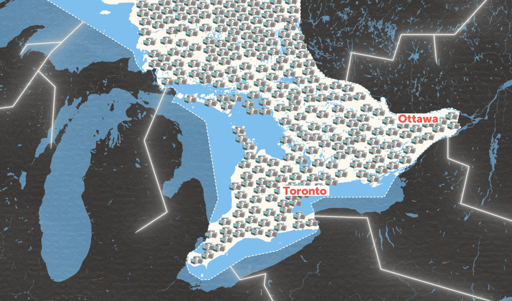
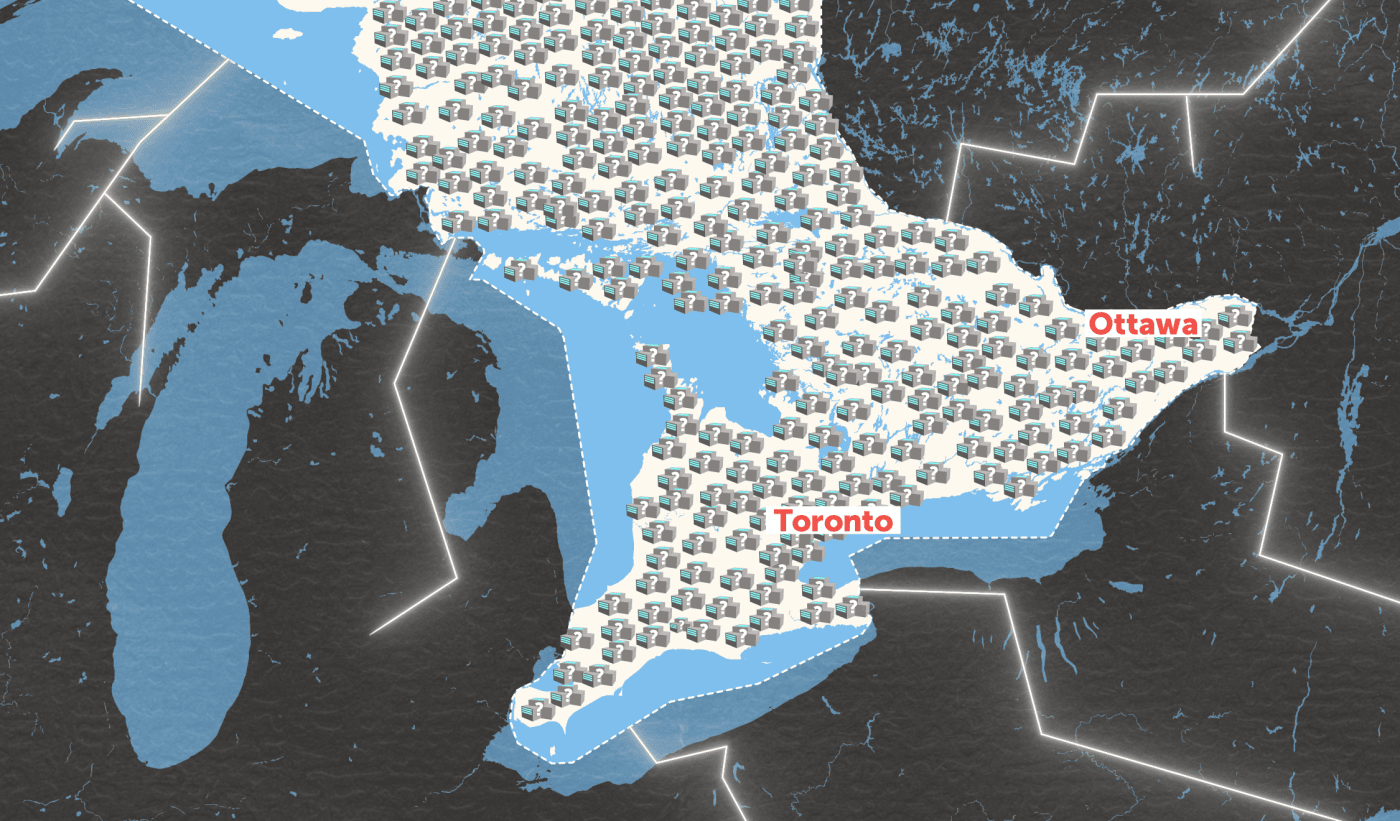
Video: L. Manuel Baechlin / The Narwhal
This story is part of a series called Shockwave: Rising energy demand and the future of the Great Lakes. The Great Lakes region is in the midst of a seismic energy shakeup, from skyrocketing data centre demand and a nuclear energy boom, to expanding renewables and electrification. In 2026, the Great Lakes News Collaborative will explore how shifting supply and demand affect the region and its waters.
It’s the summer of data centre controversies in Ontario.
In a season where city council chambers are usually quiet, residents of Hamilton, Oakville, Mississauga, Burlington and Toronto have shown up to public meetings in droves. Many are there to resist proposals for massive new data centres in their backyards, worried about noise, water use and energy bills.
By mid-August, Oakville and Mississauga moved to freeze new data centre construction for a year. Hamilton came within an inch of doing the same.
On Aug. 13, Ontario Premier Doug Ford weighed in.
Standing in front of a wall of servers at a government-owned data centre in Guelph, Ford unveiled the province’s new “data centre playbook” — and made clear he had little patience for local revolt against the boom he wants to usher in.
“This is the way of the future,” he said. “Either we do it or Donald Trump’s going to do it, and I’m not giving Donald Trump nothing, absolutely nothing.”
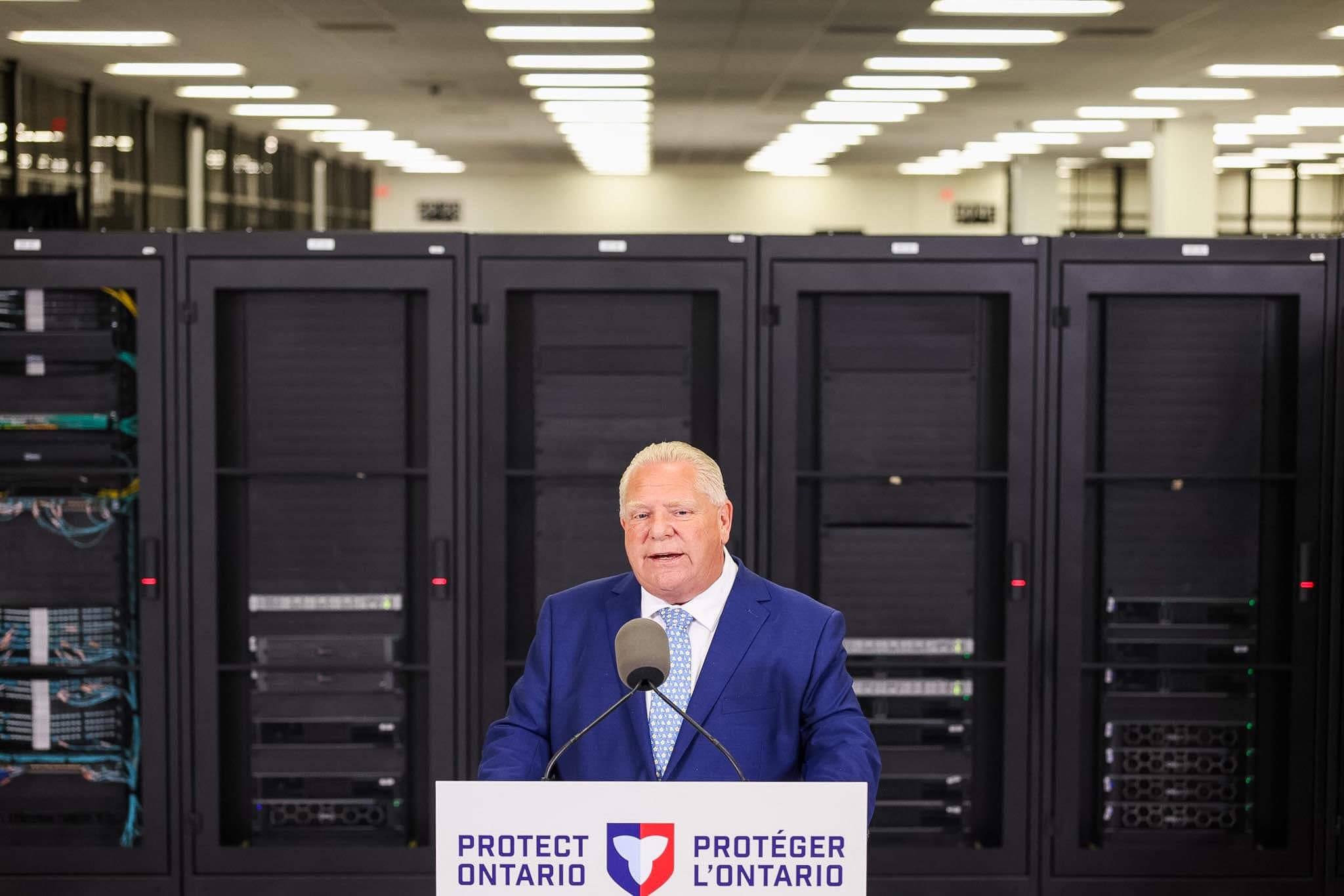
Premier Doug Ford unveiled his government’s strategy to manage data centre investment on Aug. 13, 2026. The $122-billion data centre industry has been eyeing Ontario because of its relatively clean electricity grid, cool weather and proximity to the Great Lakes. Photo: Doug Ford / X
Pushback is also happening in Fergus, Sault Ste. Marie and Armour Township, where a project was cancelled in June in the face of public opposition. Ford calls data centre skeptics “hypocritical,” suggesting residents fighting these projects were “misinformed.”“It just doesn’t add up,” he said, arguing that people can’t rely on artificial intelligence (AI) and cloud storage while also refusing the infrastructure that enables them.
It was a blunt, campaign-style pitch for a $122-billion industry that has been lobbying hard to take root in Ontario, attracted by its clean electricity grid, temperate weather and proximity to the Great Lakes (four of the five count shorelines in the province). But the data centre push has sparked real concerns about the very few rules governing these massive facilities, and the resources needed to run them.
It’s a story with chapters being written across Canada — including Alberta, where more than 40 are proposed, and New Brunswick, stirring worries about the impacts on old-growth forests and wetlands. Around the world, communities are making it clear they view the centres and the technologies they enable with increasing caution.
And now Ontario is making moves. The province’s playbook has been posted online for public consultation until Sept. 12. It’s currently just a draft, not yet in force — and the legislature won’t be back to debate it until Oct. 27, after an extended summer break.
Here’s everything you need to know.
What are data centres — and why do they matter so much right now?
Strip away the technical jargon and a data centre is just a warehouse full of computers — racks and racks of servers that store and crunch the data behind everything from your email to chatbots to this very story.
Whether you like them or not, data centres have become the backbone of the modern economy: cloud storage, artificial intelligence, banking systems, health care and government services all run on them.
They’re not new — Ontario already has dozens — but artificial intelligence has supercharged their scale and size. Today’s data centres are requesting hundreds of megawatts of power, dwarfing older facilities that ran on less power and used less water to cool their servers. While artificial intelligence has its own tension points (which we won’t get into here, but feel free to check out our AI policy), resource use is the root cause of local concerns around the physical space occupied by data centres.
How does a data centre get built in Ontario?
Energy Minister Stephen Lecce has said the province “welcome[s] data centre entrants” — but that welcome comes with strings attached and an approval process that can take up to three years, maybe more.
The groundwork for this process was laid out first in Bill 40, formally the Protect Ontario by Securing Affordable Energy for Generations Act — the first law governing data centres among provinces — and further in the new playbook.Between the two, it’s clear that data centres need to prove two things to be able to connect to Ontario’s grid.The first is to prove they will be able to cover the full cost of their own electricity connections and use — something other businesses aren’t required to do — so regular households aren’t stuck covering the cost. To enforce that, Ontario wants to create a new, higher electricity rate for any data centre over one megawatt. Quebec’s version of this rate kicks in at five megawatts, so Ontario’s lower bar would catch a lot more projects.
The second is to show the centre will be good for Ontario’s economy. The playbook lays out a three-part criteria to determine this: what jobs, investments and tax revenue it could bring to Ontario; whether it would keep local data in the province; and whether benefits to the host community outweigh the financial and environmental costs. If a data centre can’t satisfy these criteria, Bill 40 gives the energy minister the power to reject its grid connection request.
“The bottom line is, if a data centre wants to come to Ontario, it is not your right,” Lecce said in a July press conference as the criteria were unveiled. “We now have the right to say no.”
Data centres also have to get approval from municipalities, which determine zoning and building permits. However, most Ontario municipalities don’t yet have zoning rules that specifically address data centres. This means projects can often move ahead on land already zoned for general industrial use, leaving councils with limited power to say no.
Notably, data centres in Ontario do not have to go through a full environmental assessment, according to analysis from law firm McCarthy Tétrault. It’s also unclear if the province will enforce the constitutional duty to consult Indigenous communities on proposed data centre projects.
But the province is ensuring other things. The playbook says the government will favour centres that use quieter equipment. It’s also encouraging companies to build their own power supply instead of relying entirely on the public grid, since that can get them running faster than waiting in line for a grid connection. Doing so would exempt a data centre from the process outlined in the playbook. It may also see data centre projects proposed with on-site natural gas plants, as we’re seeing in Alberta.
One thing neither the playbook nor Bill 40 makes clear is what size of data centre the new process applies to.
How will data centres impact Ontario’s electricity demand?
Significantly — and the numbers keep increasing with every new forecast.
In 2024, the system operator forecast Ontario’s overall electricity demand will grow 75 per cent by 2050 — a sharper jump than previously projected, driven largely by factories and data centres. The centres are expected to account for about 13 per cent of that new demand by 2035.
A more recent forecast suggested data centres could eventually make up close to nine per cent of all electricity used in Ontario by 2050.
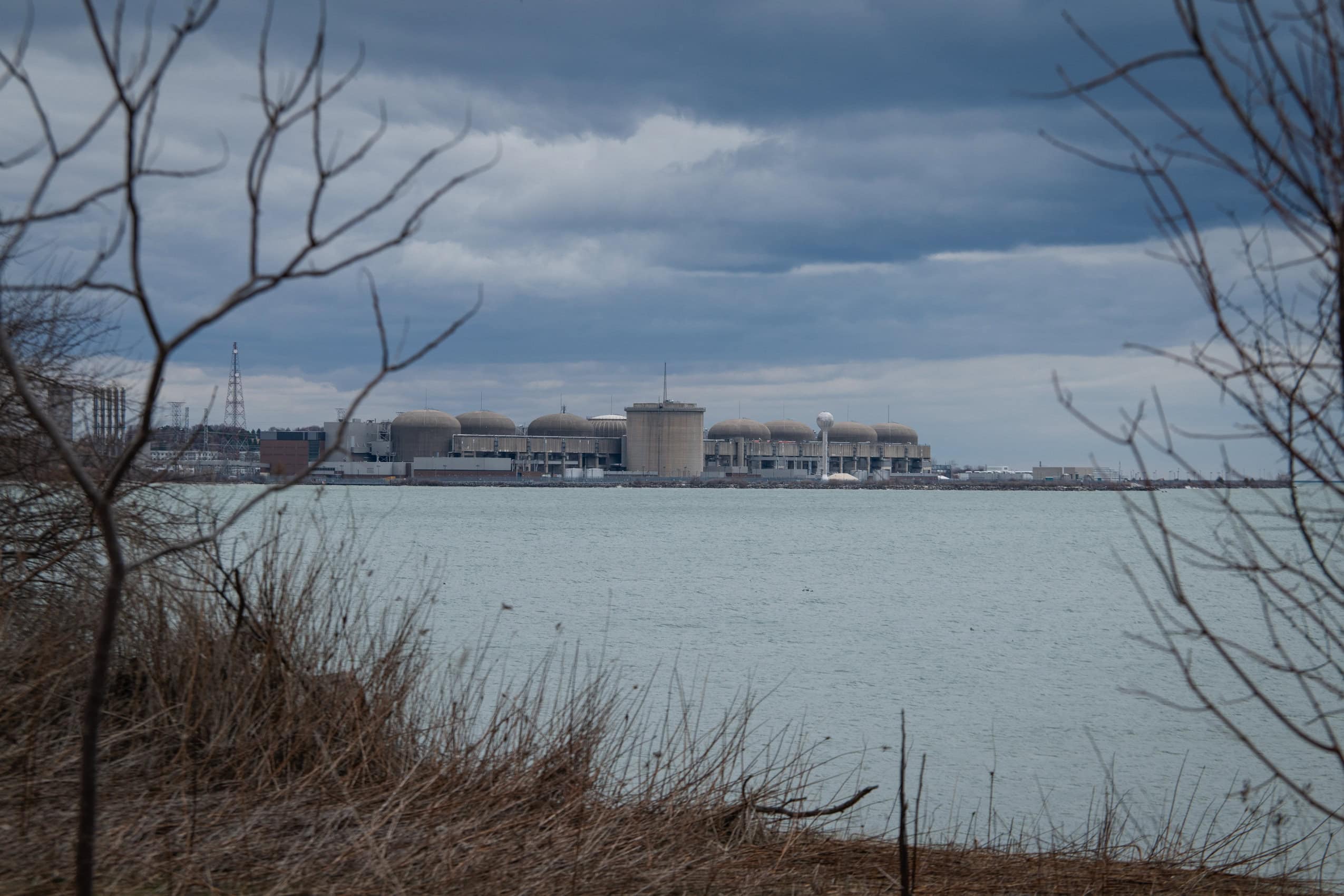
Ontario currently generates most of its electricity from low-emission sources, including nuclear power from the Pickering generating station, seen here in April 2026. But during times of peak energy usage, the province leans on natural gas — a fossil fuel — to meet demand. Photo: Laura Proctor / The Narwhal
What are data centres using all that electricity for? To stay running all the time; servers never sleep, constantly processing web traffic and requests.
The province says it’s already fielding interest in data centre builds that would add up to roughly 30 per cent of Ontario’s current peak electricity demand.
That’s a lot of energy demand — and brings us to the supply challenge ahead.
Will this increase in data centre energy demand result in Ontario using more natural gas?
Possibly, at least in the short-term future.Most of Ontario’s electricity comes from low-emissions sources like nuclear and hydro power. But when demand spikes, like during a heat wave when those who have air conditioners turn them on, natural gas plants are usually what fills the gap, since they can be switched on and off quickly.
That matters for data centres, which run around the clock. If a facility is drawing heavily during one of those peak moments, it could be leaning on gas power to do it. And that fossil fuel is primarily made up of methane, a potent greenhouse gas driving climate change and the worsened wildfire seasons, floods and other severe weather we’ve experienced as a result.
How will data centres impact Ontario’s water usage?
We don’t know yet.
Existing large data centres use water-based cooling systems to keep servers from overheating. That means that all the water pulled into a centre absorbs the heat from the servers and evaporates into the air. Any water that doesn’t evaporate is reused and then sent to a local plant as wastewater. In closed-loop systems, water just circulates in pipes that cool the servers, so there is little lost to the air.
According to one estimate, a single one-megawatt data centre can use up to 25.5 million litres of water a year just for cooling — about what all of the homes in the city of Mississauga use in a day. Many of the data centres being proposed in Ontario are larger than that, which means, depending on their cooling system, they could also be using a lot more water.
Microsoft is building three data centres in Ontario, which share an estimated total demand of approximately 200 megawatts. One planned in Toronto’s Etobicoke area was approved to use up to about 40 litres of water every second for cooling — that’s about five bathtubs full every five seconds, and 1.2 billion litres a year. A separate Microsoft complex in Vaughan is expected to use about 730 million litres of municipal water a year.
The province’s playbook says Ontario will favour data centres that use water-free or closed-loop cooling and reuse waste heat — for instance, to help warm nearby buildings.
What are Ontario municipalities doing about data centres?
On Aug. 11, Oakville became the first Ontario municipality to pass a one-year pause on building new data centres. Mississauga is set to follow suit. Both were facing major AI data centre proposals, or at least land acquisitions that suggested them.
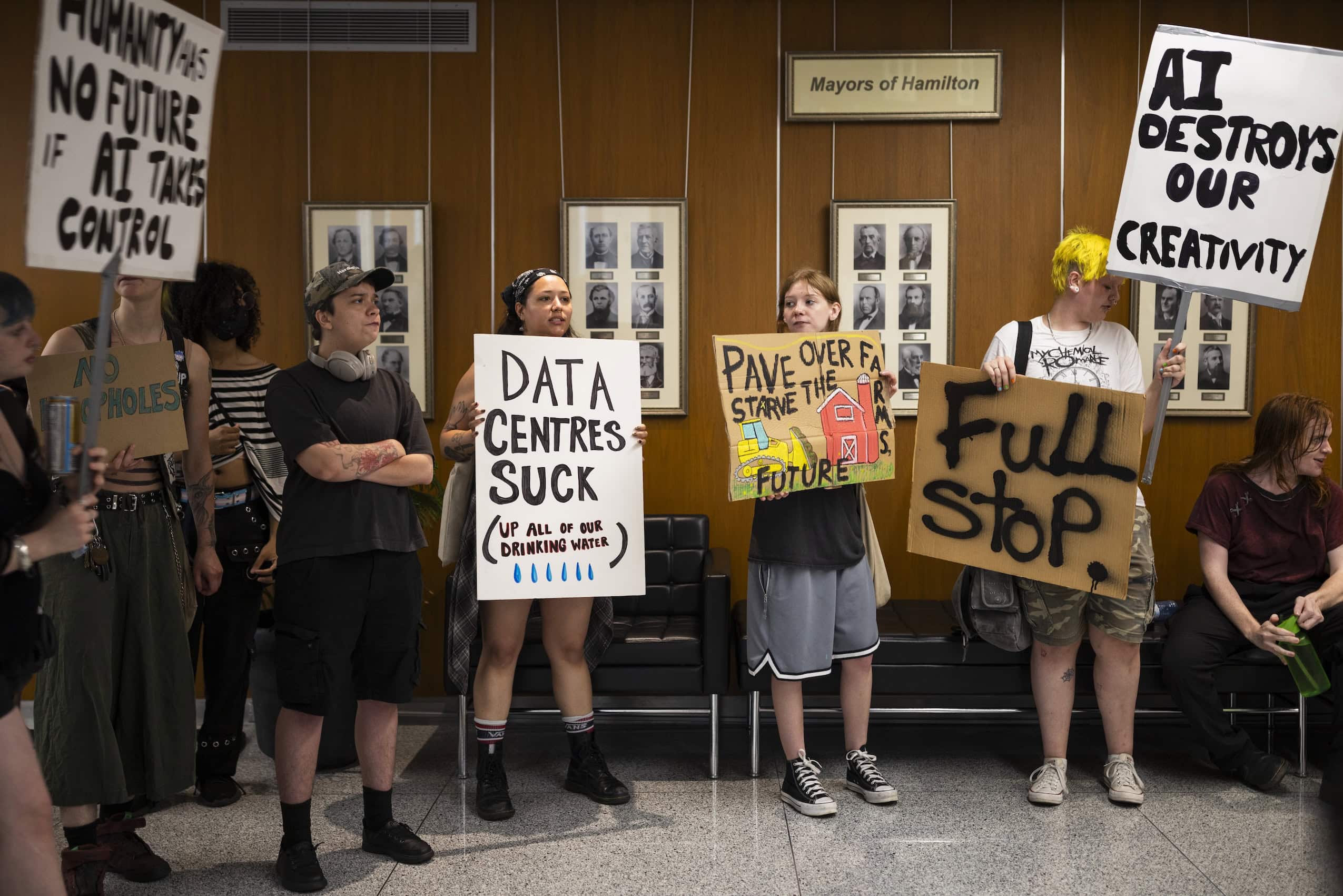
In Hamilton, demonstrators attended a July 2026 city council meeting where a proposal to temporarily ban data centre development was narrowly voted down. Other Ontario municipal councils have gone the other route and approved temporary pauses on data centres. Photo: Nick Iwanyshyn / The Canadian Press
Other municipalities are taking different approaches. Hamilton voted down a proposed pause. Burlington and Waterloo Region have asked staff to review existing rules and impacts. Both, along with Toronto, have asked the province for clearer regulations. Centre Wellington and Sault Ste. Marie are sussing whether they can pass temporary bans.
Ford has resisted calls for a province-wide ban, saying local councils will still have a say and that he’d “rather go to a willing host.” While Ontario law requires municipalities to indicate their support before a wind or solar farm can be developed (usually through a council motion or resolution), no such formal rule was proposed in the data centre playbook.
What does Doug Ford mean when he says Ontario needs data centres to address ‘data sovereignty’?
Both Ford and various companies aspiring to build data centres in Ontario have framed this push as a matter of national security: keep the servers here or risk losing control of Canadians’ data to countries like the United States.
But it’s harder said than done. Yes, building data centres would mean Ontarians’ data is kept in Ontario physically. But what actually determines control over data isn’t the building’s location — it’s who owns the company running it, and which country’s courts and laws they’re accountable to.
The Narwhal’s reporters are telling environment stories you won’t read about anywhere else. Stay in the loop by signing up for our free weekly dose of independent journalism.
From The Narwhal | News on Climate Change, Environmental Issues in Canada via This RSS Feed.