

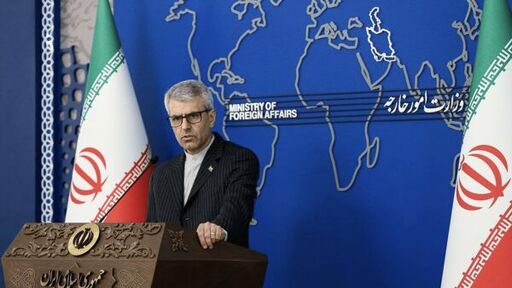
A day after the United Arab Emirates (UAE) accused it of launching two ballistic missiles towards its territory, Iran “categorically dismissed” the accusations, calling them “baseless” on Wednesday, August 19.
The UAE has since announced the suspension of all trade, commercial exchanges, and financial transactions with Iran as well.
Esmail Baghaei, official spokesperson of Iran’s foreign ministry, claimed the UAE’s accusations “run counter to the principle of good-neighborliness and undermine ongoing efforts to strengthen trust among regional countries,” IRNA reported.
On Tuesday, the UAE Defense Ministry claimed that its armed forces had detected two ballistic missiles fired from Iran towards its territory.
Though it later added that the missiles fell into the sea and probably targeted maritime shipping lanes, not its territory, the country’s Foreign Ministry nevertheless announced the suspension of all its trade and financial transactions with Iran.
The UAE is a major source of trade for Iran. Their economic relations have continued despite earlier Iranian missile attacks toward US military bases in the country as well as some civilian targets, in what Iran claims is retaliation to the US using its bases to launch attacks against Iran during the war.
Though the UAE claimed that it is still open for dialogue to find a diplomatic solution to the dispute, the timing of its move has led to speculations that it is acting under US pressure.
The US has imposed several unilateral economic sanctions against Iran. Last week, Treasury Secretary Scott Bessent declared Iran would be subjected to further and unprecedented economic warfare in the coming days if it fails to open the Strait of Hormuz.
Read more: Strait of Hormuz will remain shut, says Iran, as US threatens intensified economic warfare
“The fake news about two missiles was initially strange. Then it became clear that the UAE is carrying out Scott Bessent’s orders for economic warfare,” Seyyed Mohammad Marandi, professor who had earlier been part of Iran’s negotiating team in Geneva claimed in a post on X on Wednesday.
Meanwhile, Baghaei urged other nations in the region to refrain from such allegations and stop providing aid to “the mischievous” actions of US and Israel as such acts would harm “regional peace and security.”
UAE is key US ally in the region
Immediately after the UAE accused Iran of firing missiles toward its territory, US Secretary of State Marco Rubio called its national security advisor Sheikh Tahnoon bin Zayed Al Nahyan and talked about coordination between the two countries “to hold Iran accountable for its ongoing attacks” in the region, a statement issued by the state department on Tuesday said.
The US has military bases in the UAE which have been targeted by Iran in retaliation to US-Israeli attacks.
Iran’s blockade of the Strait of Hormuz and its attacks on ships trying to cross it have invited strong reactions from the UAE in the past as well.
However, the last acknowledged Iranian attack against UAE territory was in early May, when its missiles landed at its Fujairah Port, which is one of its largest oil export hubs. Iran has also denied targeting UAE-owned ships in the strait.
Possible false-flag attacks
Iranian media has claimed the attacks on the UAE on Tuesday were most likely false-flag attacks. They claim Iran has never launched an attack before issuing a prior warning.
Abbas Araghchi, foreign minister of Iran, described a similar attack on the office of Prime Minister of the Kurdistan region in Iraq Masrour Barzani, in a post on X on Monday, as a “false-flag” attack and denied Iranian involvement in it.
“Nothing justifies the reckless attack on PM Barzani’s office. Kurdish friends should be vigilant against false-flag ploys to sow discord between neighbors,” Araghchi said, citing the long security cooperation between the Kurds and the Iranian state.
Though Araghchi did not name any particular country, reports in Iranian media speculated possible Israeli involvement.
On Wednesday, Baghaei also hinted at the history of “false-flag” operations in the region and advised the countries to be cautious about such acts, particularly at a time when complexities have been created due to the US-Israeli war on Iran.
Recently, Iraq has uncovered secret Israeli bases in the country, built without the knowledge of the government. These bases were used to launch attacks across the border during the initial months of war against Iran.
From BT News via This RSS Feed.