

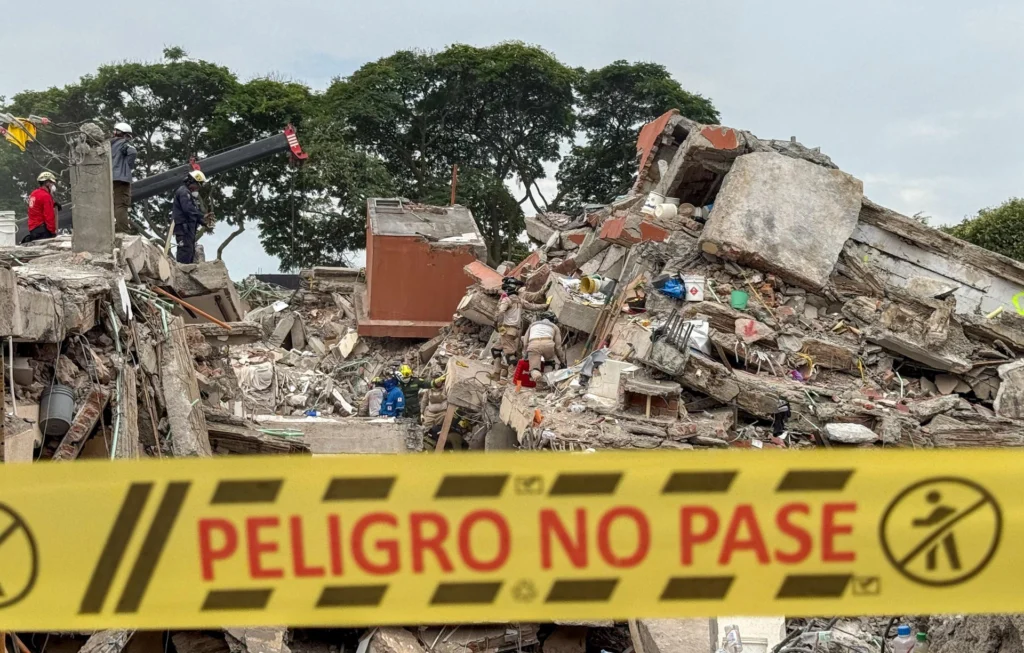
Mayor Alejandro Eder announced that the reconstruction of Cali, following last week’s devastating 7.4 magnitude earthquake in Colombia, will require at least three years as recovery operations begin.
The Cali’s local administration has officially transitioned from the initial emergency phase of active search and rescue to a long-term plan focused on assisting earthquake victims and clearing debris.
Mayor Alejandro Eder explained that while the primary mission during the first week was saving lives, teams in the hardest-hit zones have now transitioned to retrieving deceased victims from the collapsed structures. To coordinate this massive undertaking, the municipal government has activated more than 30 administrative dependencies.
RELATED: Colombia Earthquake: De La Espriella Reduces Death Toll Confirmed By Medical Examiner’s Office
“We are experiencing (…) an emergency that will last about three years. We are in the phase of caring for victims, but then we have to rebuild Cali: a resilient Cali, an inclusive Cali, a Cali with a future, a Cali for young people. Cali will come out stronger, we’ll get ahead,” said Eder.
The Infrastructure Secretariat has already removed 25,032 tons of debris from the streets, while engineering teams conduct structural assessments across the urban area to guarantee public safety.
The 7.4 magnitude earthquake caused severe damage to critical infrastructure, leaving 350,000 residents without electrical power, which represented over 50% of the city’s total energy demand and disabled 44 electrical circuits.
According to Roger Mina, manager of the Municipal Enterprises of Cali (Emcali), specialized technical teams restored power to 99% of affected users within 48 hours. Additionally, Emcali deployed 12 mobile satellite internet connection points in key strategic sectors to facilitate communication for emergency responders and displaced families.
Desde el Puesto de Mando Unificado, entregamos el reporte actualizado de la situación en Cali.
Nuestros equipos permanecen desplegados, atendiendo las emergencias y adelantando labores de búsqueda y rescate.#CaliSomosTodos pic.twitter.com/2UCnhbUNvU
— Alcaldía de Cali (@AlcaldiaDeCali) August 19, 2026
Text reads: “From the Unified Command Post, we delivered the updated report of the situation in Cali. Our teams remain deployed, responding to emergencies and advancing search and rescue efforts.”
Regional Solidarity Actions
In the political and social sphere, the disaster has mobilized regional solidarity. Mayor Eder acknowledged receiving humanitarian assistance from El Salvador, Peru, Mexico and the United States, as well as from Bogotá and local solidarity initiatives organized by the residents of Cali themselves. The municipal office has established strategic coordination points to receive food donations and direct humanitarian supplies to the affected neighborhoods.
However, the scale of the destruction has highlighted structural vulnerabilities within the urban infrastructure, triggering protests from local victims who demand immediate housing solutions and denounce historical state neglect in the poorest neighborhoods. The local government intends to utilize the reconstruction process to build a more resilient and inclusive city, prioritizing social projects and job creation for the local youth.
En Cali tenemos aproximadamente 12 albergues: 2 oficiales y 10 autogestionados. Los hemos acompañado desde el primer momento y ahora fortalecemos este trabajo con la @Cruzrojavalle, la @DefensaCivilCo y los organismos de control.
Estamos verificando que las familias alojadas… pic.twitter.com/oa88L0jK9i
— Alejandro Eder (@alejoeder) August 19, 2026
Text reads: “In Cali we have approximately 12 hostels: 2 official and 10 self-managed. We have accompanied them from the very beginning and now we are strengthening this work with the @Cruzrojavalle, @DefensaCivilCo and the control bodies. We are verifying that the housed families are properly registered as injured and working to ensure decent conditions while moving towards a housing solution. Emergency resources from the Cali budget are also being managed to start prioritizing rent subsidies. No injured family will be alone in this recovery process.”
Disasters of this magnitude in Latin America often expose deep socioeconomic inequalities. While middle-class neighborhoods quickly recover public services, marginalized sectors frequently face prolonged displacement and slow institutional responses.
Social movements in Cali are currently urging the government to ensure that emergency funds are distributed equitably, avoiding bureaucratic delays and guaranteeing that international aid reaches the most vulnerable families first.
From teleSUR English via This RSS Feed.