

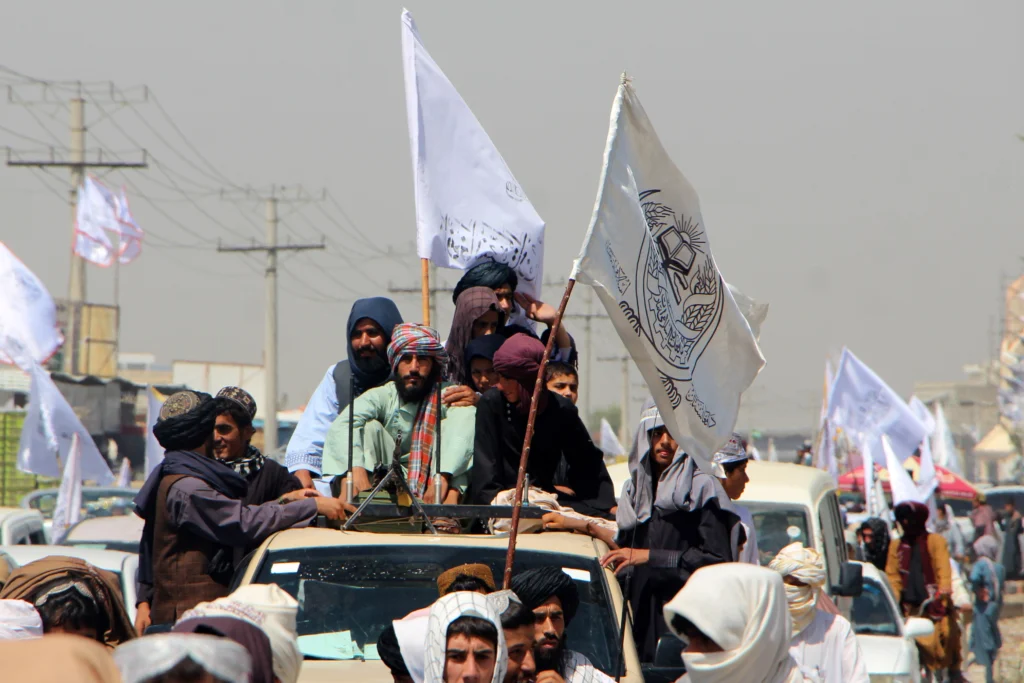
The Taliban leadership tightens its political grip across all thirty-four provinces.
August 2026 marks five years since the collapse of the Ashraf Ghani administration in Kabul, Afghanistan. The withdrawal of foreign military forces on August 15, 2021, ended a twenty-year armed occupation led by the United States.
RELATED:
Afghanistan: Taliban Celebrate 5th Anniversary of Return to Power Amid Humanitarian Crisis
Half a decade later, Afghanistan operates under the central authority of the Taliban movement, which reconstituted the Islamic Emirate of Afghanistan.
Following the transition of power, foreign development aid, which funded over 75 percent of the former government’s public expenditure, was halted. The United States and European institutions froze approximately 9 billion dollars in Afghan central bank assets held overseas.
World Bank economic monitoring indicates that real gross domestic product growth remains subdued at roughly 4.8 percent, heavily affected by domestic revenue constraints, sanctions, banking restrictions, and the forced return of over 3.7 million Afghan refugees from neighboring Pakistan and Iran.
From Anti-Soviet Mujahideen to Ideological Militancy
The political and ideological origins of the Taliban trace back to the geopolitical conflicts of the Cold War during the late twentieth century. Following the 1979 military intervention by the Soviet Union in support of the Democratic Republic of Afghanistan, the United States launched Operation Cyclone.
Managed by the Central Intelligence Agency alongside Pakistani intelligence agencies and foreign financial backers, this program channeled billions of dollars in weapons, logistics, and funding to various anti-Soviet insurgent factions known as the Mujahideen.
After the Soviet withdrawal in 1989 and the subsequent fall of the central government in 1992, the Mujahideen factions failed to establish a unified administration. The resulting civil war severely damaged major cities, disrupted trade routes, and created widespread lawlessness across rural regions.
In 1994, Mullah Mohammad Omar organized a distinct movement in Kandahar Province. Composed primarily of Islamic clerical students (talib) and former anti-Soviet fighters, the group pledged to restore security, eradicate administrative corruption, and enforce strict religious law.
By September 1996, the Taliban captured Kabul and declared the establishment of the first Islamic Emirate of Afghanistan. Their initial period of rule, which lasted until the U.S.-led invasion in late 2001, was characterized by centralized authority, strict social regulations, and total prohibition of secular political institutions.
New Wave of Global Protests Against the Afghan Taliban Regime’s Dark Rule: Rallies and Demonstrations Held in 24 Cities
On the completion of five years since the Afghan Taliban returned to power, protests and rallies were held in 24 cities across various countries, including… pic.twitter.com/41HTnLW0sr
— Khorasan Ghag (@Khorasanghag_) August 18, 2026
The Architecture of Capitulation: U.S. Involvement and the Doha Accords
The return of the Taliban to power in 2021 was accelerated by the structural breakdown of the foreign-backed government in Kabul and direct diplomatic arrangements between the United States and Taliban leadership.
Over twenty years of military occupation, the U.S. government spent approximately two trillion dollars on combat operations, infrastructure, and training for the Afghan National Defense and Security Forces (ANDSF).
Despite these expenditures, the administrative structure in Kabul suffered from pervasive corruption, political fragmentation, and limited operational reach beyond major urban centers.
Military operations by NATO forces, including persistent airstrikes, night raids, and high civilian casualty rates in rural provinces, alienated rural communities and reinforced local support for the insurgency.
By 2018, acknowledging the strategic stalemate, the U.S. government initiated direct bilateral negotiations with Taliban representatives in Doha, Qatar, completely excluding the officially recognized government led by President Ashraf Ghani.
These negotiations concluded on February 29, 2020, with the signing of the Agreement for Bringing Peace to Afghanistan, commonly known as the Doha Agreement. Signed by U.S. Special Representative Zalmay Khalilzad and Taliban political chief Mullah Abdul Ghani Baradar, the accord committed the United States and its allies to a complete withdrawal of all military forces within fourteen months.
In exchange, the Taliban pledged to prevent transnational militant groups, specifically Al-Qaeda, from using Afghan territory to threaten the security of the United States and its allies.
Crucially, the agreement stipulated the release of up to 5,000 Taliban prisoners held by the Afghan government as a confidence-building measure, in exchange for 1,000 government captives. The systematic release of these experienced fighters strengthened Taliban combat ranks.
As U.S. and NATO military forces executed their final withdrawal in mid-2021 under President Joe Biden, Taliban forces rapidly captured provincial capitals, culminating in the entry into Kabul on August 15, 2021, without significant armed resistance from state security forces.
Immediate Decrees, Structural Restructuring, and Gender Exclusion
Upon securing the capital, the Taliban moved swiftly to dismantle the legal and political architecture of the former republic. On August 19, 2021, the leadership formally declared the restoration of the Islamic Emirate of Afghanistan.
The 2004 Constitution was suspended, the National Assembly was dissolved, and civil ministries were reorganized under supreme religious authority centered in Kandahar under Supreme Leader Hibatullah Akhundzada.
In September 2021, the Taliban administration abolished the Ministry of Women’s Affairs and replaced it with the Ministry for the Promotion of Virtue and Prevention of Vice.
Specialized courts, human rights commissions, and legal prosecution units previously established to handle cases under the 2009 Law on the Elimination of Violence Against Women were completely disbanded.
Between August 2021 and August 2026, the de facto Taliban authority issued more than one hundred executive decrees and directives specifically regulating the lives of women and girls.
The Taliban created restrictive laws against women primarily to enforce their strict, ultra-conservative interpretation of Deobandi Islam mixed with traditional Afghan tribal customs. Taliban view the absolute separation of genders and the removal of women from the public eye as central to building what they consider a “pure” Islamic state.
In September 2021, female students were barred from secondary education above the sixth grade. This Taliban prohibition was expanded in December 2022 to exclude women from attending public and private universities entirely.
Subsequent Taliban regime decrees prohibited women from working in non-governmental organizations and United Nations agencies, restricted female employment in government offices, banned women from visiting public parks, gyms, and public baths, and mandated the presence of a male guardian (mahram) for long-distance travel.
According to data compiled by UN Women in August 2026, these policy measures have produced severe economic and structural impacts. Approximately 78 percent of young Afghan women are currently not engaged in education, employment, or formal training.
Recent Taliban legal decrees issued in 2026 further curtailed women’s standing before civil courts by placing legal authority primarily with male family heads and restricting pathways to judicial recourse.
Concurrent decrees banning women from medical and technical higher education programs have reduced the future pipeline of female healthcare professionals, increasing structural strain on a public healthcare system already facing elevated maternal and infant mortality rates.
Afghan women are being forced into begging under the Taliban, while being denied the right to work and study. Don’t blindly defend this criminal regime just because it speaks in the name of Islam. Hypocrisy has always been abundant. pic.twitter.com/nT0iHtvP1f
— شیرین
(@Shirin12219) August 18, 2026
Five Years in Power: Governance, Economic Crises, and Monopoly on Violence
Five years into its administration, the Islamic Emirate of Afghanistan operates under a centralized governance structure that has stabilized domestic revenue collection while struggling against severe macroeconomic contraction.
Following the foreign military withdrawal, the national budget contracted sharply from approximately six billion dollars in 2021 to roughly 2.44 billion dollars.
To offset the loss of foreign financial assistance, the taliban regime Ministry of Finance instituted reformed customs collection mechanisms, standardized border tariffs, and expanded domestic taxation on agricultural and commercial sectors.
Despite these fiscal measures, the broader Afghan economy remains under structural strain. The freezing of nine billion dollars in foreign liquid reserves, combined with international banking restrictions and sanctions, has created persistent liquidity shortages and restricted foreign direct investment.
Economic growth has been further pressured by the forced return of over 3.7 million Afghan refugees from Pakistan and Iran, alongside severe regional droughts that have damaged agricultural productivity.
In terms of domestic security, the taliban administration maintains a effective monopoly on violence across most provinces. The organized armed resistance factions that emerged in 2021 have largely been suppressed or driven into exile.
The primary internal military challenge facing the government is the Islamic State Khorasan Province (ISIS-K), an armed rival faction responsible for targeted bombings against religious minorities, government officials, and foreign diplomatic missions.
The Taliban General Directorate of Intelligence and specialized security forces have conducted sustained counter-insurgency operations against ISIS-K cells, reducing the frequency of large-scale urban attacks within major Afghan cities, though regional security monitoring continues to identify the group as an active security concern.
Geopolitical Integration: Pragmatism in a Multipolar World
Lacking formal diplomatic recognition from Western governments, the taliban administration in Kabul has cultivated operational relationships with neighboring regional powers, including China, Russia, Iran, and the Central Asian republics.
These regional actors have adopted a pragmatic diplomatic approach centered on border security, counter-terrorism cooperation, trade, and regional transit infrastructure.
In 2024, the People’s Republic of China became the first country to officially accept the credentials of an ambassador appointed by the Islamic Emirate.
In July 2025, the Russian Federation formally recognized the Taliban government, citing the need for practical regional engagement on counter-terrorism and economic stability.
Furthermore, in May 2026, Moscow signed a bilateral military-technical cooperation agreement with Kabul focused on technical defense assistance and regional security oversight.
Five years after the departure of foreign troops, Afghanistan occupies a distinct position in Central and South Asian geopolitics. While Western nations continue to condition official diplomatic normalization and sanction relief on political inclusion and human rights reforms, neighboring regional powers continue to expand practical trade and security arrangements.
Sources: teleSUR – Al Jazeera – Al Mayadeen – Press Tv – IRNA – Hispan Tv – DW – CNN – BBC – VIDC – The Guardian – Swiss Info
From teleSUR English via This RSS Feed.