

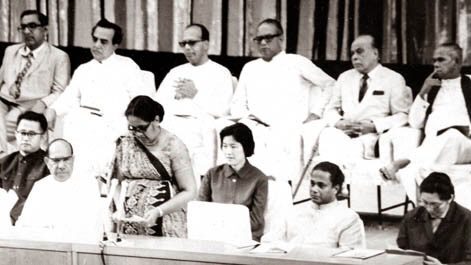

On August 16, 1976, representatives from 86 countries met in Colombo, Sri Lanka, for the Fifth Conference of Heads of State or Government of the Non-Aligned Movement. This was the first summit of the Non-Aligned Movement (NAM) held in Asia and, perhaps, the largest international conference ever held in Sri Lanka.
In her inaugural address to the summit, Sri Lanka’s Prime Minister Sirimavo Bandaranaike – the first woman to hold the position of prime minister in the world – raised the issue of economic sovereignty: “If we truly want to disarm imperialism and colonialism, we must certainly forge counter-weapons in the international monetary and financial spheres.”
The 1976 Non-Aligned Movement summit marked a decisive turning point for the Third World movement, shifting from the noble ideals of anti-colonialism and national sovereignty to the far more arduous process of building institutions for economic transformation. Two years earlier, in 1974, Third World countries had successfully lobbied the United Nations General Assembly to adopt the Declaration on the Establishment of a New International Economic Order – a set of proposals to reform the world economy and redress centuries of colonial exploitation. The meeting in Colombo aimed to build the institutions for this new order: the Third World’s “counterweights.”
Two weeks after the Colombo conference, Sri Lanka’s Permanent Representative in New York, Hamilton Shirley Amerasinghe, transmitted the results to the UN Secretary-General for distribution to the General Assembly. That 154-page document is perhaps the most comprehensive articulation the Non-Aligned Movement (NAM) ever produced of what a different world economy would look like. Half a century later, it reads less as a historical curiosity than as a to-do list.
The forging of counterweight weapons
The Economic Declaration adopted in Colombo insisted that “only a complete restructuring of existing international economic relations” would resolve the crisis of the developing world. From Sri Lanka to Ghana, political independence often did not translate into true economic sovereignty, as the existing structure of production, trade, and finance was monopolized by a few corporations based in the United States, Europe, and Japan. The declaration highlighted several essential elements of reform that remain remarkable for their accuracy and enduring relevance.
In terms of production, the declaration advocated a new international division of labor, with the relocation of industry from the North to the South and the transfer of technology under favorable conditions. Regarding trade, the declaration defended linking commodity prices to the cost of imported manufactured goods; this aimed to counteract the deterioration of the terms of trade, ensuring that a given volume of tea or cocoa would not allow for the purchase of a decreasing amount of machinery each year.
In the area of finance, the declaration demanded a radical reform of the international monetary system to “eliminate the dominant role of international currencies in international reserves” and “prevent the dominance of a single country over decision-making.” Regarding debt, the declaration called for the conversion of loans into grants, moratoria, restructurings, and the complete cancellation of debt for the least developed countries, particularly those that had “suffered foreign occupation and aggression.”
Perhaps the most significant aspect was the attempt to impose stricter regulations on transnational corporations, whose power had surpassed that of many nation-states. The declaration asserted the right of states to “supervise, authorize, regulate, and nationalize transnational corporations,” and denounced those companies that “deplete resources, distort economies, and infringe upon the sovereignty of developing countries” and “frequently resort to bribery, corruption, and other undesirable practices.”
Among the institutions proposed for South-South collective self-sufficiency were: a Council of Commodity Producers’ Associations, a Special Fund to finance commodity stabilization reserves, a Bank for Developing Countries, a Developing Countries Payments Union proposed by Egypt, and studies aimed at “a compensatory currency backed by the economic potential of non-aligned and other developing countries.”
The debt crisis and the long decline
By the late 1970s, the landscape began to shift rapidly in favor of Northern capital. The 1979 Volcker Crisis sent interest rates soaring in the United States, increasing borrowing costs for the Global South. Mexico’s default in 1982 marked the beginning of the Third World debt crisis and a lost decade for many newly independent states in Africa and Latin America. The reform demands of the Non-Aligned Movement (NAM) were replaced by the IMF’s demands for structural adjustment: the terms of the debate had changed.
Negotiations to establish a UN code of conduct for transnational corporations failed spectacularly in the early 1990s. This failure contributed to a long period in which the role of transnational corporations in geopolitics was completely erased. Issues related to good governance, corruption, and human rights were increasingly weaponized against newly independent states in the Global South, conveniently ignoring the destructive role of transnational corporations that controlled production and the arteries of trade and finance.
Sri Lanka’s own trajectory condensed all that radical change into eighteen months. Less than a year after the fifth summit of the Non-Aligned Movement, in July 1977, Sri Lanka elected a right-wing government that made it the first South Asian economy to liberalize its economy. In a sense, the host country had abandoned the agenda at the national level even before the ink was dry. The subsequent political trajectory reinforced many of the same economic dynamics that the 1976 conference had sought to reverse.
An unfinished project
In 2022, Sri Lanka became the first Asian country to default on its external debt in the 21st century. Under its 17th program with the IMF, the country underwent a debt restructuring process largely favorable to creditors – including an externally imposed domestic debt restructuring that targeted workers’ pension funds and novel macroeconomic indicator-linked bonds, which tie debt payments to GDP growth. The Sri Lankan government currently allocates more than 40% of its budget to debt service.
When Sri Lanka defaulted, there was no common framework for debt restructuring among middle-income countries. Nor was there significant South-South coordination amid what was essentially a wave of debt crises in the Global South. Sri Lanka’s own situation in 2026 confirms the need to create the counterbalancing mechanisms proposed in 1976.
The demands of 1976 echo many of the major political debates taking place in the Global South today. The weaponization of access to the US dollar, US-controlled payment systems, and the US market has once again highlighted the danger of single-country domination. Current demands for national ownership and domestic processing of natural resources (from Indonesia to Zimbabwe) echo the 1976 critique of the international division of labor. The 1976 insistence on concessional technology transfer foreshadows current debates on climate justice and green industrial policy.
What has changed is the material basis. In 1976, the Global South’s influence was rhetorical and demographic; South-South trade was scarce, and the institutions proposed in Colombo never materialized. Today, the center of gravity of the world economy has shifted to Asia, trade among developing countries exceeds their trade with the Global North, and Global South-led development finance and local currency settlement projects have expanded.
Although the objective conditions for forging these counterweights may have improved, the subjective conditions remain challenging in some parts of the Global South. State formation in much of the South has entrenched elites whose fortunes are tied to the agendas of transnational corporations and foreign creditors. These elites readily succumb to tariffs, credit ratings, and bombings. Therefore, forging these counterweights requires changing the social base of leadership within the Global South itself. Only then can these counterweights be transformed from an idea into a material force.
Shiran Illanperuma is a Sri Lankan journalist and political economist. He is a research fellow at
Tricontinental: Institute for Social Research and co-editor of Wenhua Zongheng: A Journal of Contemporary Chinese Thought. He is a visiting professor at the Bandaranaike Centre for International Studies.
This article was written by Globetrotter.
From BT News via This RSS Feed.